
Al-Fatiha is the surah every Muslim in India knows by heart, usually from the age of four or five. That is exactly the problem. Most of us learned it by ear, long before anyone mentioned Tajweed, and the small slips we picked up then have been repeated in every rak’ah since.
This guide goes through Surah Al-Fatiha one ayah at a time and points out what to listen for: the letters people commonly mix up, where to stretch and where not to, and which sounds are heavy. Read it with a mushaf open, say each line aloud, and if you can, record yourself. Ayah numbers follow the Hafs count used in Indian mushafs, where the Bismillah is ayah 1.
Ayah 1: بِسْمِ اللّٰهِ الرَّحْمٰنِ الرَّحِيمِ
- Bismillaah: the hamza of the name of Allah is not sounded because you are joining, and the lam of Allah is light here, because the letter before it has a kasra. Heavy “Allah” after a kasra is a common slip. The full rule is in heavy and light letters.
- Ar-rahmaan: the lam of “al” is silent (ر is a sun letter), so you say “ar-“, not “al-“. The ر has a fatha, so it is read heavy. The ح is the throat letter, not a soft ه: “rah-maan” from the middle of the throat.
- Ar-raheem: same sun-letter start, same heavy ر. If you stop at the end, the long ee before the final meem can be held for 2, 4 or 6 counts. Pick one length and keep it the same at every stop in your recitation.
Ayah 2: الْحَمْدُ لِلّٰهِ رَبِّ الْعَالَمِينَ
- Al-hamdu: ح is a moon letter, so the lam is read clearly: “al-hamdu”. The ح must not turn into ه (“al-hamdu” with a breathy h is a different letter). If you are unsure where each throat letter sits, see makharij al-huroof.
- Lillaahi: the lam of Allah is light again, after the kasra of “li”.
- Rabbi: ر with fatha, heavy; the ب has a shaddah, so hold it for a moment.
- Al-aalameen: the ع comes from the middle of the throat. Many learners say a plain “a” instead. The long ee at the end follows the same stopping rule as ar-raheem.
The difference between moon-letter “al-hamdu” and sun-letter “ar-rahmaan” is explained with more examples in sun and moon letters in the Quran.
Ayah 3: الرَّحْمٰنِ الرَّحِيمِ
The same two words as in the Bismillah. If you join this ayah to the one before, it becomes “al-aalameenar-rahmaanir-raheem”: the “a” of “ar-” is a connecting hamza and disappears when joined. Most people stop at the end of each ayah in Al-Fatiha, which is the recommended practice, so you will usually start fresh with “ar-rahmaan”. Our guide to hamzat al-wasl explains what happens when you join.
Ayah 4: مَالِكِ يَوْمِ الدِّينِ
- Maaliki: in the Hafs recitation read in India, the first syllable is long: “maa-liki”, held for two counts. Do not rush it into “maliki”.
- Yawmi: the waw has a sukoon after a fatha, so it is a soft “aw” sound, not stretched.
- Ad-deen: د is a sun letter, so “ad-deen”, not “al-deen”. The د is a clean, light d from the tip of the tongue.
Ayah 5: إِيَّاكَ نَعْبُدُ وَإِيَّاكَ نَسْتَعِينُ
This is the ayah teachers listen to most carefully.
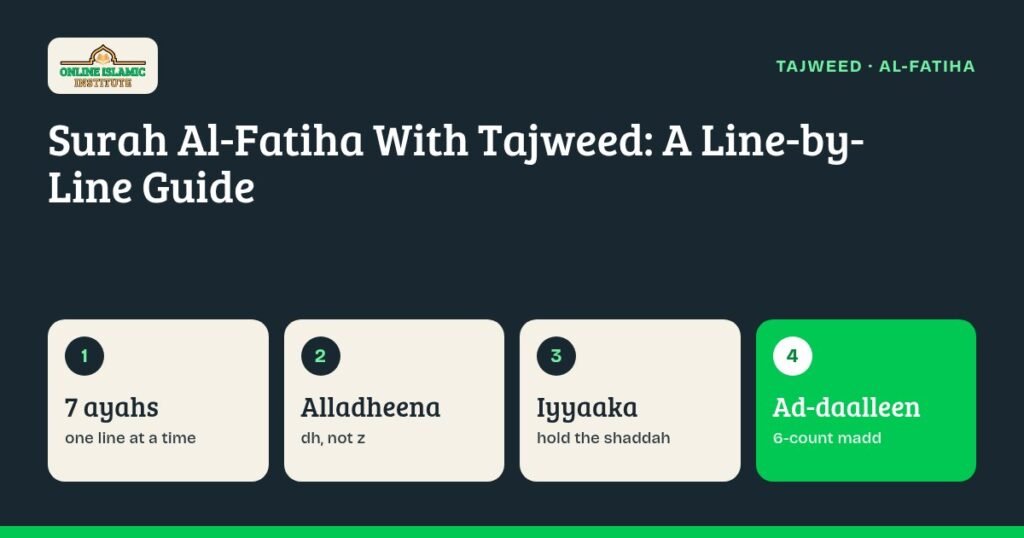
- Iyyaaka: the ي carries a shaddah. It must be doubled: “iy-yaa-ka”. Reading “iyaaka” with a single ya changes the word into a different one. Hold the shaddah, then give the long aa its two counts.
- Na’budu: the ع is from the throat again, and the ب has a sukoon, so it gets a light bounce, called qalqalah. Without it the ب tends to vanish. See qalqalah in Tajweed.
- Nasta’eenu: keep the س a light s (not ص), the ت light, and the ع clear.
Ayah 6: اهْدِنَا الصِّرَاطَ الْمُسْتَقِيمَ
- Ihdinaa: when you begin the ayah, start with “i”. The ه is soft and from the deepest part of the throat; do not turn it into ح.
- Ihdinas-siraat: the long aa of “naa” is written but not stretched when you join it to “as-siraat”, because the next sound has a shaddah. “Ihdinaa as-siraat” with a pause and a long aa is a common slip.
- As-siraat: ص and ط are both heavy letters, and the ر has a fatha, so it is heavy too. The whole word should sound full and deep.
- Al-mustaqeem: moon letter, so the lam is read. Keep the س light (it sits right next to the heavy letters and tends to borrow their weight), and make the ق from the back of the tongue, not a ك.
Ayah 7: صِرَاطَ الَّذِينَ أَنْعَمْتَ عَلَيْهِمْ غَيْرِ الْمَغْضُوبِ عَلَيْهِمْ وَلَا الضَّالِّينَ
- Alladheena: the ذ is made with the tip of the tongue between the teeth. “Allazeena” with a ز is probably the most common Al-Fatiha slip in India and Pakistan, because Urdu pronounces both letters the same way.
- An’amta: a noon sakin before ع, a throat letter, so the noon is read clearly with no nasal hiding. That is izhar, from the noon sakin and tanween rules.
- ‘Alayhim: the meem sakin is followed by غ and later by و, so it stays clear, lips closed firmly and opened, never hidden. See meem sakin rules.
- Ghayri: غ is heavy and from the upper throat; the ر has a kasra, so this ر is light, unlike the heavy ones earlier.
- Al-maghdoobi: moon letter, so “al-“. The ض is the hardest letter in the surah: made with the side of the tongue against the upper molars, heavy and full. It should not become a د, a ز or a ظ.
- Wa lad-daalleen: sun letter again, then a long aa followed directly by a doubled lam. This is the necessary madd (madd laazim), held for six counts. Cutting it short is very common when people pray quickly. The counts are explained in madd rules.
“Aameen” is said after Al-Fatiha, but it is not part of the surah, and it is not written in the mushaf.
A ten-minute practice plan
- Record yourself reading Al-Fatiha once at your normal speed. Do not listen yet.
- Go through this page ayah by ayah, saying each word slowly. Mark the points you were unsure of.
- Read the whole surah again slowly, stopping at the end of every ayah.
- Now listen to both recordings. Most people hear “allazeena”, a single ya in iyyaaka, or a short daalleen straight away.
- Pick just one fix for the week. Al-Fatiha is read many times a day in salah, so a fix practised daily settles quickly.
For more of these habits outside Al-Fatiha, see common mistakes in Quran recitation. Children who are memorising their first surahs can use the same method with the list in short surahs for kids.
Having a teacher listen
Reading a guide helps you know what to listen for. Hearing it corrected live is what actually changes the habit. Our online Tajweed classes are one-to-one and 30 minutes long, five days a week (20 classes a month), and many adult students start with exactly this: getting their Al-Fatiha right. Classes run 24/7, with male and female teachers available at any time. We are an online Islamic institute focused only on the Quran: Noorani Qaida, Nazra, Tajweed and Hifz. Fees are in the fee section: ₹4,000 a month, ₹21,000 for six months or ₹36,000 a year. If you want the bigger picture first, start with Tajweed rules for beginners.
Surah Al-Fatiha with Tajweed: FAQ
In India, reading alladheena with a z sound (“allazeena”) is one of the most common, along with a single ya in iyyaaka and cutting the six-count madd in wa lad-daalleen short.
Six counts. It is a necessary madd (madd laazim) because the long aa is followed by a doubled lam.
In the Hafs count used in Indian mushafs, the Bismillah is ayah 1 of Al-Fatiha, giving seven ayahs in total.
No. After a kasra, as in bismillaah and lillaah, the lam of Allah is light. It is heavy after a fatha or damma.
Want a teacher to listen to your Al-Fatiha and tell you honestly what needs work? Book 3 free trial classes, and pay only after the trial if you continue.