
Recite Surah Al-Falaq slowly and listen to the word مِنْ. In مِنْ شَرِّ مَا خَلَقَ the noon goes soft and nasal, almost hidden. Most of us have recited it that way since childhood without knowing why. The reason is one of the four noon sakin and tanween rules, and once you know all four, you start hearing them in every surah you know.
This post explains each rule with its letters and real examples from the Quran, written for students in India who can already read Arabic script. If you are still learning the letters, finish the Qaida first; our Noorani Qaida lessons guide shows where you are.
First, what are noon sakin and tanween?
Noon sakin is a ن with a sukoon on it (نْ), or a noon with no vowel at all. It can come in the middle of a word, as in أَنْعَمْتَ, or at the end, as in مِنْ.
Tanween is the double vowel mark at the end of a noun: ـً ـٍ ـٌ, read as “an”, “in”, “un”. It is not written as a noon, but it sounds like a noon sakin when you read on without stopping. That is why both follow the same rules. (When you stop on a word with tanween, the noon sound drops; that belongs to the rules of stopping.)
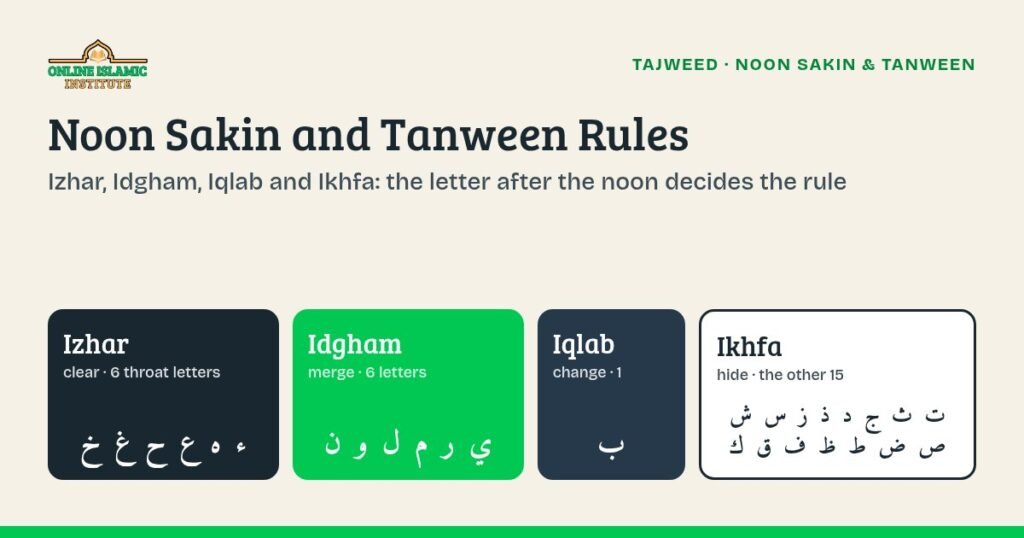
What decides the rule is the letter that comes after the noon sakin or tanween. There are four possibilities.
| Rule | Meaning | Letters after the noon | What you do |
|---|---|---|---|
| Izhar | Making clear | 6 throat letters: ء ه ع ح غ خ | Say the noon clearly, no extra nasal sound |
| Idgham | Merging | 6 letters: ي ر م ل و ن | Merge the noon into the next letter |
| Iqlab | Changing | 1 letter: ب | Change the noon into a hidden meem with ghunnah |
| Ikhfa | Hiding | The remaining 15 letters | Hide the noon with ghunnah |
6 + 6 + 1 + 15 = 28, every letter of the alphabet except alif, which never comes straight after a noon sakin. Ghunnah, the nasal hum, is held for about two counts wherever these rules call for it.
1. Izhar Halqi: say it clearly
When noon sakin or tanween is followed by one of the six throat letters, ء ه ع ح غ خ, the noon is pronounced clearly from its own place, without holding a ghunnah. The throat letters are far from the tip of the tongue where noon is made, so the two sounds stay separate. If the throat letters are new to you, the makharij al-huroof guide shows exactly where they sit.
| Letter | Example | Transliteration |
|---|---|---|
| ء | مَنْ آمَنَ | man āmana |
| ه | مِنْهُمْ | minhum |
| ع | أَنْعَمْتَ عَلَيْهِمْ (Al-Fatiha) | an’amta ‘alayhim |
| ح | عَلِيمٌ حَكِيمٌ | ‘alīmun ḥakīm |
| غ | مِنْ غِلٍّ | min ghillin |
| خ | مِنْ خَوْفٍ (Quraysh) | min khawf |
The Indian trap: Hindi and Urdu are full of nasal sounds (think of the bindu in Hindi or the noon ghunna ں in Urdu). That helps with ghunnah elsewhere, but here it hurts. Many students add a nasal hum before ع or ح out of habit. In Izhar, the noon is crisp.
2. Idgham: merge into the next letter
Idgham happens with six letters, which students remember with the word يَرْمَلُونَ (yarmalūn): ي ر م ل و ن. The noon sakin or tanween disappears into the next letter, which is then read as if it had a shaddah. There are two kinds.
Idgham with ghunnah: ي ن م و
These four letters are remembered as يَنْمُو (yanmū). The noon merges, but its nasal sound stays, held for two counts.
- مَنْ يَقُولُ (may-yaqūlu)
- خَيْرًا يَرَهُ (khayray-yarah), from Surah Az-Zalzalah
- مِنْ مَسَدٍ (mim-masad), the last words of Surah Al-Masad
- مِنْ وَالٍ (miw-wāl)
- مِنْ نِعْمَةٍ (min-ni’matin)
Idgham without ghunnah: ل ر
With ل and ر, the noon merges completely and the nasal sound goes too.
- مِنْ رَبِّهِمْ (mir-rabbihim)
- غَفُورٌ رَحِيمٌ (ghafūrur-raḥīm)
- هُدًى لِلْمُتَّقِينَ (hudal-lil-muttaqīn), Surah Al-Baqarah, verse 2
- هُمَزَةٍ لُمَزَةٍ (humazatil-lumazah), Surah Al-Humazah
The one-word exception
Idgham only happens between two words. If a noon sakin is followed by ي or و inside the same word, the noon is read clearly. This is called Izhar Mutlaq, and in the Quran it occurs in just four words: الدُّنْيَا (ad-dunyā), بُنْيَانٌ (bunyān), قِنْوَانٌ (qinwān) and صِنْوَانٌ (ṣinwān). Merging them would make each one sound like a different word with a doubled letter, so the noon stays clear.
3. Iqlab: noon turns into meem
When noon sakin or tanween meets ب, the noon sound changes into a meem, held with ghunnah for two counts. The lips close lightly, without pressing (follow your teacher here, as some teach the slightest gap). In the Madinah Mushaf and many other prints you will see a small م written above the noon or next to the tanween as a reminder.
- أَنْبِئْهُمْ (ambi’hum)
- مِنْ بَعْدِ (mim ba’di)
- سَمِيعٌ بَصِيرٌ (samī’um baṣīr)
- لَيُنْبَذَنَّ (layumbadhanna), Surah Al-Humazah
Listen for it in Surah Al-‘Alaq too: لَنَسْفَعًا بِالنَّاصِيَةِ. Once your ear catches the hidden meem, it is hard to miss.
4. Ikhfa: hide the noon
Ikhfa covers the remaining 15 letters: ت ث ج د ذ ز س ش ص ض ط ظ ف ق ك. The noon is neither fully pronounced nor fully merged. The tip of the tongue does not press firmly on the noon’s spot; the mouth gets ready for the next letter while the ghunnah comes through the nose for two counts.
| Example | Transliteration | Next letter |
|---|---|---|
| مِنْ شَرِّ (Al-Falaq, An-Nas) | min sharri | ش |
| إِنْ كُنْتُمْ | in kuntum | ك, then ت |
| مِنْ جُوعٍ (Quraysh) | min jū’ | ج |
| نَارًا ذَاتَ لَهَبٍ (Al-Masad) | nāran dhāta lahab | ذ |
| جَنَّاتٍ تَجْرِي | jannātin tajrī | ت |
| مِنْ قَبْلِ | min qabli | ق |
A common mistake is to turn Ikhfa into a full “n” with a touch of nasal, as in “min-sharri”. Another is to hide it so much that it sounds like “mi-sharri” with no hum at all. Your teacher’s ear is the best guide to the middle.
Practise with surahs you already know
Here is a small exercise that works for children and adults alike. Take the short surahs from Juz ‘Amma and hunt for the rules:
- Al-Falaq: مِنْ شَرِّ (ikhfa) and غَاسِقٍ إِذَا (izhar, tanween before hamzah).
- Al-Fil: طَيْرًا أَبَابِيلَ (izhar), بِحِجَارَةٍ مِنْ سِجِّيلٍ (idgham with ghunnah, then ikhfa) and كَعَصْفٍ مَأْكُولٍ (idgham with ghunnah).
- Al-Ikhlas: كُفُوًا أَحَدٌ (izhar).
- Quraysh: مِنْ جُوعٍ (ikhfa) and مِنْ خَوْفٍ (izhar).
Write the four rule names on a card and keep it in your Mushaf. Ten minutes after Maghrib, one surah at a time, is enough. When you are ready, the meem sakin rules follow the same logic with fewer letters. Our overview of Tajweed rules for beginners shows where noon sakin fits among the rest, and how to learn Tajweed online suggests an order to study them.
Learning these rules with a teacher
Reading the rules takes ten minutes. Applying them while reciting takes practice with someone listening. In our online Tajweed classes, a teacher listens one-to-one in live 30-minute lessons, five days a week, and stops you at each rule until it sits right. Students who need fluency first join Nazra, and the rules carry straight into Hifz later. You can see all our online Quran classes in India on the homepage.
Classes run 24/7 in IST with male and female teachers available any time. The fee is ₹4,000 a month, ₹21,000 for six months or ₹36,000 a year (see the fee plans), and every new student starts with 3 free trial classes, paying only after the trial.
Noon sakin and tanween: quick answers
Izhar (clear) before the 6 throat letters, Idgham (merging) before ي ر م ل و ن, Iqlab (changing to meem) before ب, and Ikhfa (hiding) before the remaining 15 letters.
The six throat letters: hamzah ء, ha ه, ‘ayn ع, ḥa ح, ghayn غ and kha خ.
ي ن م و (yanmū) are merged with ghunnah. ل and ر are merged without ghunnah.
Idgham only applies between two words. When noon sakin and ي or و are in the same word, the noon is read clearly. This happens in four words: دنيا, بنيان, قنوان and صنوان.
About two counts (harakat), the same as in Idgham with ghunnah.
Yes. Tanween sounds like a noon sakin at the end of a word when you read on, so the same four rules apply.
Want someone to listen to your مِنْ and tell you which rule is slipping? Book 3 free trial classes, bring Surah Al-Falaq, and start there.