
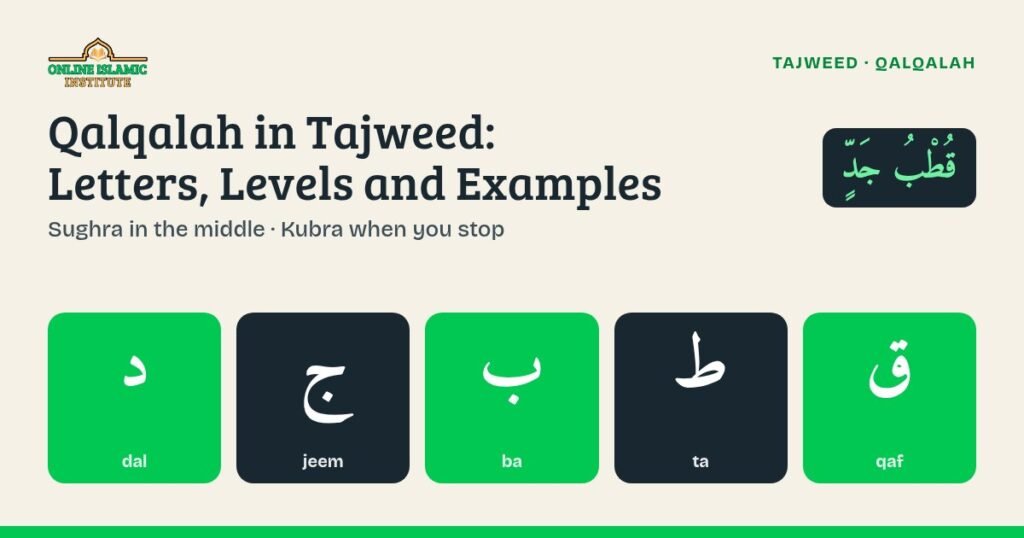
The five qalqalah letters first, since that is probably what you came for: ق ط ب ج د. Teachers in India and everywhere else bundle them into two words, قُطْبُ جَدٍّ (quṭbu jadd), and most children can rattle that off within a week.
Knowing the letters is the easy half. The harder half is hearing yourself. Picture a boy in Lucknow who has recited Surah Al-Ikhlas every night for years, and nobody has noticed that the د at the end of أَحَدْ simply vanishes when he stops. He is saying “aha”. One small bounce fixed it. That bounce is qalqalah.
What is qalqalah?
Qalqalah means a shaking or echo. In Tajweed it is a short, clean bounce of sound that you release when one of the five letters has a sukoon. You close the letter at its point in the mouth, then let it go with a slight echo, without adding a vowel.
Why only these five? Each of them has two qualities together. The sound is fully locked at its point (shiddah), and no breath escapes with it (jahr). Put those together on a letter with no vowel and there is nothing left to hear, so the letter would disappear. The bounce is what makes it audible. If you have read our makharij al-huroof guide, you already know where each of the five is made: ق at the back of the tongue, ج in the middle, ط and د at the tip, and ب on the lips.
Why not ت or ك?
Both are strong letters, but they let breath out. Say تَبَّتْ and you can feel a little puff on the final ت. That breath already carries the sound, so there is no qalqalah. Bouncing a sakin ت or ك is one of the most common slips we hear from beginners who have just learned the rule and are keen to use it everywhere.
When qalqalah happens (and when it does not)
Qalqalah needs a sukoon. That sukoon can be written in the mushaf, in the middle of a word or phrase, or it can appear because you stop on the last letter of an ayah. If the letter carries a fatha, kasra or damma and you are reading on, there is no qalqalah at all. The ق in قُلْ has a damma, so it is said normally.
This catches people in Al-Ikhlas. If you join the first two ayahs, as some reciters do, the د of أَحَدٌ keeps its tanween and runs into the next word, so there is no bounce. Stop on it, and the bounce comes back.
The levels of qalqalah: sughra and kubra
Many teachers explain two levels, and some add a third. The table below shows them with examples you can find in short surahs.
| Level | When it happens | Examples |
|---|---|---|
| Qalqalah Sughra (minor) | A written sukoon in the middle of a word or ayah. Light bounce. | يَدْخُلُونَ (An-Nasr), لَمْ يَلِدْ (Al-Ikhlas), اقْتَرَبَتِ (Al-Qamar), أَبْصَارُهَا (An-Nazi’at) |
| Qalqalah Kubra (major) | You stop on the letter at the end of an ayah or word. Clearer bounce. | أَحَدْ, الْفَلَقْ, لَهَبْ, الْبُرُوجْ, مُحِيطْ |
| Strongest (taught by some as Akbar) | You stop on a qalqalah letter that has a shaddah. | وَتَبّْ (Al-Masad), الْحَقّْ |
The difference between sughra and kubra is mostly about strength. In sughra the bounce is quick, because you are moving straight on to the next letter. In kubra you have stopped, so the echo is a touch fuller. In neither case should it become a vowel.
A note on the “colour” of the bounce
You may hear teachers describe the bounce slightly differently. Some let it lean towards the vowel before it, others keep it neutral. Both are taught, and your teacher will give you one way to follow. What every teacher agrees on is the limit: no “a”, no “u”, no extra syllable. أَحَدْ must not turn into “aḥada”.
How to make the sound, step by step
- Say the letter with its vowel first, slowly: “da”, “qa”, “ba”.
- Now say the word up to that letter and close the letter fully at its point. Tongue tip pressed for د, lips together for ب.
- Release it sharply, as if letting go of a spring. A short echo, nothing more.
- Record ten seconds on your phone and play it back. You will hear a vowel creeping in long before you feel it.
Children usually pick this up quickest by copying. Kids in our online Quran classes for kids often get it from the teacher saying أَحَدْ a few times and simply echoing it back. Adults tend to overthink it and add too much.
Practise with three short surahs
Here is something that surprises a lot of students: every ayah of Surah Al-Ikhlas, Surah Al-Falaq and Surah Al-Masad ends on a qalqalah letter. If you stop at each ayah, you get qalqalah kubra every single time.
- Al-Ikhlas: أَحَدْ, الصَّمَدْ, يُولَدْ, أَحَدْ, all on د, plus a sughra in لَمْ يَلِدْ.
- Al-Falaq: الْفَلَقْ, خَلَقْ, وَقَبْ, الْعُقَدْ, حَسَدْ.
- Al-Masad: وَتَبّْ, كَسَبْ, لَهَبْ, الْحَطَبْ, مَسَدْ. Notice that the first word of the surah, تَبَّتْ, ends in a sakin ت, which does not bounce.
Recite one of these at Isha for a week, paying attention only to the endings. It is a small habit, and the improvement in your recitation is easy to hear.
Where qalqalah sits among the Tajweed rules
Qalqalah is one of the letter qualities (sifaat), so it belongs early, alongside makharij, in our Tajweed rules for beginners. Many students learn it in the same weeks as stopping and the madd rules, because both change what happens at the end of an ayah. For a sensible order of study, see how to learn Tajweed online.
If you would like a teacher to listen, our online Tajweed classes are live and one-to-one, 30 minutes a day, five days a week. We offer online Quran classes in India 24/7 in IST, with male and female teachers available at any time. The fee is ₹4,000 a month, or less on the longer plans (₹21,000 for six months, ₹36,000 for a year); see the fees. You get 3 free trial classes first and pay only after the trial.
Qalqalah: quick answers
There are five: ق ط ب ج د (qaf, ta, ba, jeem, dal), remembered as قُطْبُ جَدٍّ (qutbu jadd).
Sughra is the light bounce on a qalqalah letter with a written sukoon in the middle of a word or ayah. Kubra is the clearer bounce when you stop on a qalqalah letter, usually at the end of an ayah.
No. Qalqalah only happens when the letter has a sukoon, either written or because you stop on it.
Want a teacher to check your أَحَدْ? Book 3 free trial classes and recite Al-Ikhlas in the first one.