
Try this before you read on. Say أَحْ slowly, then أَهْ. If both come out as the same breathy “h”, you have just found the reason makharij al-huroof exists.
Makharij (singular: makhraj) are the points in the throat, mouth, tongue, lips and nose where each Arabic letter is produced. Huroof simply means letters. Learn where each letter comes from and most pronunciation problems sort themselves out, because you stop guessing the sound and start placing it.
This is a beginner’s map. It will not replace a teacher who can hear you, but it will help you understand what your teacher keeps pointing at.
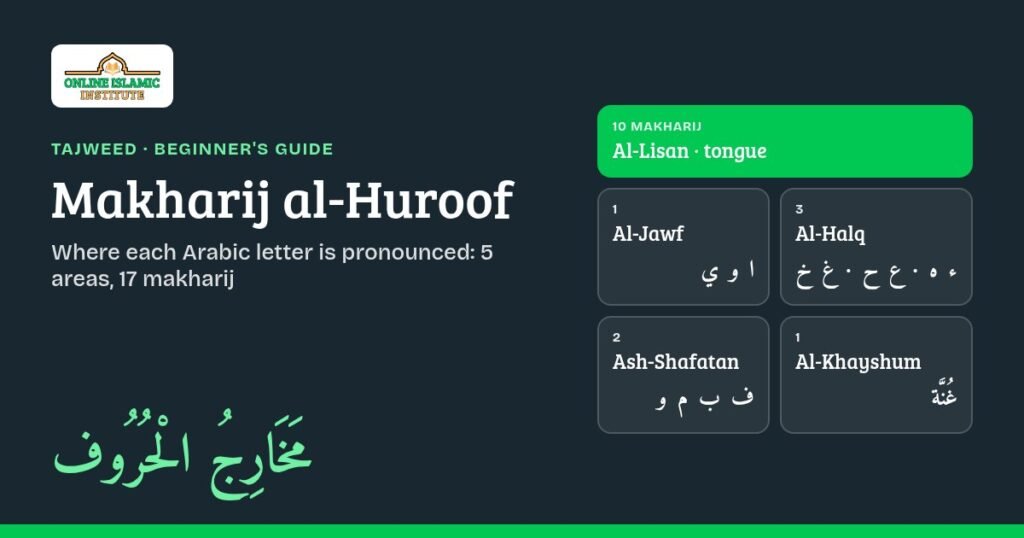
The five areas and the 17 makharij
Most Tajweed teachers follow the widely used scheme of 17 makharij, grouped into five main areas:
| Area | Number of makharij | Letters |
|---|---|---|
| Al-Jawf (the open space of the mouth and throat) | 1 | The three madd letters: ا after fatha, و sakin after damma, ي sakin after kasra |
| Al-Halq (the throat) | 3 | ء ه · ع ح · غ خ |
| Al-Lisan (the tongue) | 10 | ق ك ج ش ي ض ل ن ر ط د ت ص س ز ظ ذ ث |
| Ash-Shafatan (the lips) | 2 | ف · ب م و |
| Al-Khayshum (the nasal passage) | 1 | Ghunnah, the nasal sound in ن and م |
1 + 3 + 10 + 2 + 1 = 17. Now let us walk through them one area at a time.
Al-Jawf: the empty space
Al-Jawf is the hollow of the mouth and throat. It has no fixed touching point, which is why the madd letters can be stretched: the sound runs on air, not on a contact between tongue and teeth.
The three letters are ا with fatha before it (as in قَالَ), و sakin with damma before it (as in يَقُولُ), and ي sakin with kasra before it (as in قِيلَ). When و or ي carry their own vowel, they move to other makharij, which we will come to.
Al-Halq: three points in the throat
Put two fingers lightly on your throat. These six letters live there, in three pairs from deep to near:
- Deepest part: ء (hamzah) and ه (ha).
- Middle: ع (‘ayn) and ح (ḥa).
- Nearest to the mouth: غ (ghayn) and خ (kha).
This is where many learners in India slip, because everyday Urdu and Hindi speech often blends these sounds. ع turns into a plain “a”, and ح turns into the light ه. In the Quran, that small slip can change one word into another. The fix is slow, repeated practice with someone listening, not reading faster.
Al-Lisan: ten points on the tongue
The tongue does most of the work, so it has the most makharij. Think of moving from the back of the tongue to its tip.
The back of the tongue
- ق: the deepest part of the tongue against the soft palate.
- ك: a little further forward than ق. Keep these two apart; ق sits deeper and sounds heavier.
The middle and sides
- ج ش ي: the middle of the tongue against the hard palate above it (ي here is the non-madd one, as in يَوْم).
- ض: one or both sides of the tongue against the upper back teeth. It is one of the hardest letters to get right, and it is not a “z” or a “d”.
- ل: the front edges of the tongue against the gum line behind the upper front teeth.
The tip of the tongue
- ن: the tip of the tongue against the gum just above the upper front teeth.
- ر: very close to ن, using the tip and a little of the top of the tongue.
- ط د ت: the tip of the tongue against the roots of the upper front teeth.
- ص س ز: the tip of the tongue near the front teeth, leaving a small gap for the whistling sound.
- ظ ذ ث: the tip of the tongue against the edges of the upper front teeth, so the tongue peeps out slightly.
Two habits come up again and again with students here. ز ذ ض ظ all collapse into one “z”, and س ث ص into one “s”. In our own languages that is perfectly normal speech. In recitation, each of those letters needs its own place.
Ash-Shafatan: the lips
- ف: the inside of the lower lip touching the tips of the upper front teeth.
- ب م و: both lips. For ب and م the lips close; for و (the non-madd one, as in وَلَد) they round without fully closing.
Al-Khayshum: the nasal sound
The last makhraj is the nasal passage. It is the home of ghunnah, the humming sound you hear in نّ and مّ and in several noon sakin rules. Pinch your nose lightly while holding a ghunnah: if the sound stops, it really is coming through the nose. You will meet ghunnah again in the noon sakin and tanween rules.
A simple way to find any letter’s makhraj
Teachers use an old trick. Put a hamzah with fatha before the letter and give the letter a sukoon: أَبْ, أَتْ, أَقْ. Say it and stop. The place where your mouth closes or touches at the end of that sound is the letter’s makhraj.
Do this with a mirror on the dressing table, five or six letters a day, in the order of the Qaida. Ten quiet minutes before school or after Isha is plenty. If you are still working through the letters themselves, our guide to Noorani Qaida lessons shows where makharij fit in the very first stage.
Why a teacher still matters
You cannot fully hear your own mistakes. Most of us grew up with the sounds of Urdu, Hindi, Malayalam, Tamil, Bengali or another language, and our ears are tuned to those. A teacher listening one-to-one will catch the ح that slid into ه long before you do.
Makharij are the first piece of Tajweed. The next pieces, such as noon sakin, madd and qalqalah, are covered in Tajweed rules for beginners, and how to learn Tajweed online lays out a realistic order to study them in.
In our online Tajweed classes, makharij come first, letter by letter, in live 30-minute one-to-one lessons, 5 days a week. Beginners who cannot yet read start with our Noorani Qaida online course, and fluent reading is built in Nazra. Classes run 24/7 in IST, and male and female teachers are available at any time; read more about learning with a female Quran teacher online.
The fee is the same for every course: ₹4,000 a month, ₹21,000 for six months or ₹36,000 a year, with all plans in our fee section. Every new student gets 3 free trial classes and pays only after the trial. You can see all our online Quran classes in India on the homepage.
Makharij al-huroof: quick questions
Makharij al-huroof means the points of articulation of the letters: the exact places in the throat, mouth, tongue, lips and nose where each Arabic letter is pronounced.
The widely taught scheme counts 17 makharij in five main areas: Al-Jawf (1), Al-Halq (3), Al-Lisan (10), Ash-Shafatan (2) and Al-Khayshum (1).
Six letters: hamzah and ha from the deepest part, ‘ayn and ḥa from the middle, ghayn and kha from the part nearest the mouth.
In Urdu and Hindi they are usually said as a plain “z”, so the ear never learned the difference. With slow practice and correction they become clear.
Videos help you understand where a letter comes from, but you cannot easily hear your own mistakes. A teacher listening live corrects them early, before they become habits.
Yes. Makharij are the base of Tajweed. Rules such as ikhfa or idgham only make sense once each letter is coming from the right place.
If you want someone to listen to your letters and tell you honestly which ones need work, book 3 free trial classes with Online Islamic Institute. Bring a mirror. Your teacher will probably ask you to use it.