
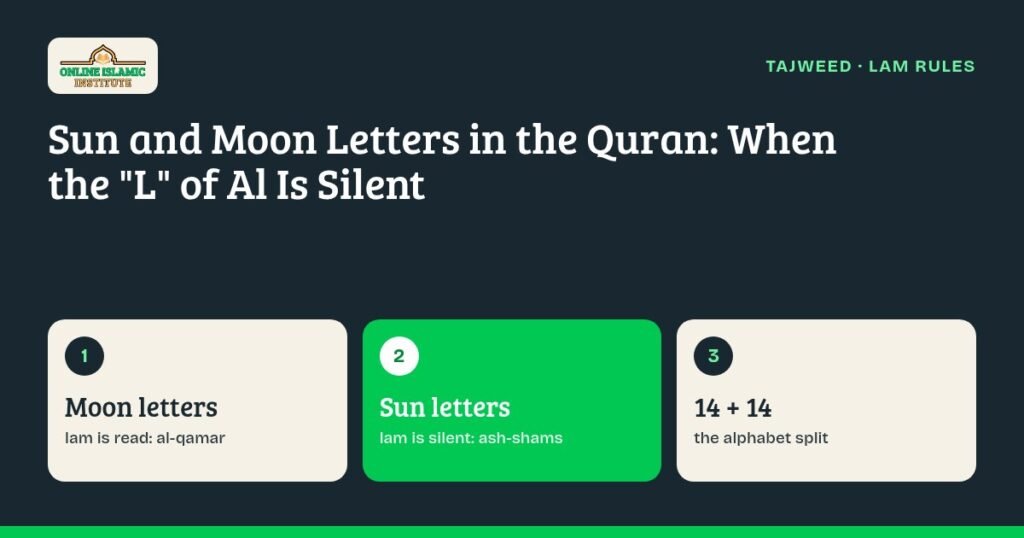
Ask a child to read الشَّمْس and there is a good chance you will hear “al-shams”. It looks right. There is an alif, there is a lam, so why not say both? Then the teacher gently corrects it to “ash-shams”, and the child looks at you as if the book is playing tricks.
It is not a trick. It is one of the first Tajweed rules most learners in India meet, usually around the end of the Noorani Qaida: the rule of the sun and moon letters. Once you see the pattern, you will spot it on almost every line of the Quran.
What the rule is about
Arabic makes a word definite (“the”) by putting ال (alif and lam) in front of it. The question is what happens to that lam when you read. There are only two answers:
- Moon letters (huroof qamariyyah): the lam is pronounced clearly. الْقَمَر is read “al-qamar”.
- Sun letters (huroof shamsiyyah): the lam goes silent and the next letter is doubled. الشَّمْس is read “ash-shams”, not “al-shams”.
The names simply come from those two example words, the moon (qamar) and the sun (shams). There is nothing more mysterious than that. Some Indian teachers say “lam qamari” and “lam shamsi”, which means the same thing.
The 14 moon letters
After these letters the lam stays and you read “al-“: ا ب ج ح خ ع غ ف ق ك م و ه ي.
A phrase many teachers use to remember them is اِبْغِ حَجَّكَ وَخَفْ عَقِيمَهُ (ibghi hajjaka wa khaf aqeemah). Every letter in it is a moon letter. Children do not need the meaning; the rhythm is what sticks.
A few moon-letter words you will meet early: الْحَمْدُ (al-hamdu), الْعَالَمِينَ (al-aalameen), الْمُسْتَقِيمَ (al-mustaqeem), الْكِتَابُ (al-kitaabu).
The 14 sun letters
After these letters the lam is silent and the next letter carries a shaddah: ت ث د ذ ر ز س ش ص ض ط ظ ل ن.
Examples from the first pages of the mushaf: الرَّحْمٰنِ (ar-rahmaani), الدِّينِ (ad-deeni), الصِّرَاطَ (as-siraata), الضَّالِّينَ (ad-daalleen), النَّاسِ (an-naasi).
If you count, the alphabet splits neatly in half: 14 and 14. That is a nice fact to tell a child who thinks there are “too many rules”.
How to tell them apart without a list
Lists are useful for a week. After that, train the eye and the tongue instead.
1. Look at the marks in your mushaf
In the Indo-Pak mushaf that most Indian families use, the lam before a moon letter usually carries a jazm (sukoon), so you read it. Before a sun letter the lam has no mark at all, and the very next letter has a shaddah. No mark on the lam plus a shaddah after it means: skip the lam, double the letter. If the names of those marks are still fuzzy, our guide to zabar, zer, pesh and the other marks covers jazm and shaddah in plain words. The Madani (Uthmani) print shows the same idea a little differently, as explained in Indo-Pak or Uthmani script.
2. Feel where the letter is made
Here is the part most lists skip. Almost every sun letter is made with the tip or front of the tongue, the same area where lam itself is made. Saying a clear lam and then jumping to a letter right next to it is clumsy, so the lam simply merges in. Moon letters are made elsewhere: the lips (ب م و), the throat (ع ح غ خ ه), the back of the tongue (ق ك). The lam has room to be heard. You can test this with the pointers in our makharij al-huroof guide.
3. Read it aloud both ways
Say “al-shams” and then “ash-shams”. The second one flows. Say “aq-qamar” and then “al-qamar”. Now the first one feels forced. Your mouth already knows the rule; the names just give it a label.
A short practice line from Surah Al-Fatiha
Al-Fatiha is perfect for this because both kinds appear in seven short ayahs. Have your child sort these as they read:
| Word | Lam | Read as |
|---|---|---|
| الْحَمْدُ | Moon (ح) | al-hamdu |
| الرَّحْمٰنِ | Sun (ر) | ar-rahmaan |
| الْعَالَمِينَ | Moon (ع) | al-aalameen |
| الدِّينِ | Sun (د) | ad-deen |
| الصِّرَاطَ | Sun (ص) | as-siraat |
| الْمُسْتَقِيمَ | Moon (م) | al-mustaqeem |
| الْمَغْضُوبِ | Moon (م) | al-maghdoob |
| الضَّالِّينَ | Sun (ض) | ad-daalleen |
Kids enjoy turning this into a game: sun words get a thumbs up, moon words get a hand over the mouth for the lam that disappears. Silly, yes, but it works far better than reading the list ten times.
Mistakes we hear most often
- Reading the lam before a sun letter. “Al-rahmaan” instead of “ar-rahmaan”. The fix is to look for the shaddah on the next letter and lean on it.
- Forgetting the shaddah. Some learners drop the lam correctly but then read the next letter single: “a-rahmaan”. The sun letter must be doubled, held for a moment.
- Swallowing the lam before a moon letter. This happens with fast readers: “a-hamdu”. Slow down and give the lam its clear sukoon.
- Applying the rule to a lam that is part of the word. The rule is only for the “al” of “the”. A lam that belongs to the root of the word, as in أَلْسِنَتِكُمْ, is read normally.
The lam in the name of Allah has its own rule (heavy or light depending on the vowel before it). That is a separate topic, covered in heavy and light letters in Tajweed.
Where this fits in your learning
Children usually meet sun and moon letters near the end of the Qaida, once they can read harakaat and sukoon confidently. Adults restarting the Quran often find it is one of the quickest wins: fix this one habit and your reading of Al-Fatiha and the short surahs suddenly sounds closer to what you hear in the masjid. If your child is still learning the letter shapes, start with Arabic letters for kids and come back to this later.
It is a small rule inside the bigger picture of Tajweed rules for beginners. Learn it well, then move on to noon sakin, madd and the rest one at a time.
Learning it with a teacher
A teacher catches the “al-shams” slip in the first ayah and makes you repeat the line until it sounds natural. That instant correction is the main reason families pick our online Quran classes in India: one-to-one, 30 minutes a day, five days a week (20 classes a month), with male and female teachers available at any hour, 24/7. Beginners can start with Noorani Qaida online; readers who want to polish rules like this one can join our online Tajweed classes. Fees are on the fee section: ₹4,000 a month, ₹21,000 for six months or ₹36,000 a year.
Sun and moon letters: quick answers
They are the two groups of Arabic letters that decide how the “al” (the) before a word is read. Before the 14 moon letters the lam is pronounced; before the 14 sun letters the lam is silent and the next letter is doubled.
ت ث د ذ ر ز س ش ص ض ط ظ ل ن. After these, the lam of “al” is not read and the letter takes a shaddah.
ا ب ج ح خ ع غ ف ق ك م و ه ي. A common memory phrase is ibghi hajjaka wa khaf aqeemah.
The lam has no jazm and the next letter has a shaddah. If the lam has a jazm, it is a moon letter and you read the lam.
Want someone to listen to your Al-Fatiha and tell you which words need fixing? Book 3 free trial classes and pay only after the trial if you decide to continue.