
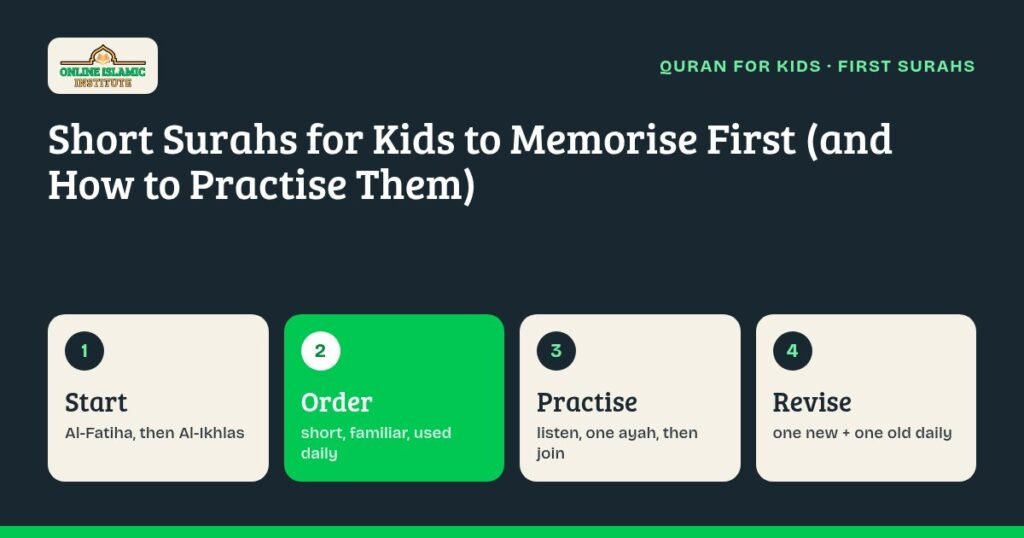
Most children in India learn their first surah the same way: sitting next to a grandparent, or standing behind a parent in salah, hearing the same few lines again and again until one day they say them alone. Nobody planned it. It just happened.
A little planning helps once you want to go further than that first surah. Which ones next? In what order? How do you stop them from mixing up two surahs that start the same way? Here is the list we suggest to parents, with a few honest tips on practising at home.
A good first list, in order
These are short, well known and used every day, so children hear them often and get to use them in salah. The order goes roughly from the most used to the slightly longer ones.
| # | Surah | Ayahs | Why it is a good pick |
|---|---|---|---|
| 1 | Al-Fatiha | 7 | Recited in every rak’ah of salah. Learn it first and learn it carefully. |
| 2 | Al-Ikhlas | 4 | Very short, and children love that it is “one-third of the Quran”, as described in a hadith in Sahih al-Bukhari. |
| 3 | Al-Falaq | 5 | Part of the three “Quls” many families recite before sleep. |
| 4 | An-Nas | 6 | Completes the three Quls. Learn it soon after Al-Falaq so the two are kept apart. |
| 5 | Al-Kawthar | 3 | The shortest surah in the Quran. A quick confidence win. |
| 6 | Al-Asr | 3 | Short, with a clear message children can understand. |
| 7 | An-Nasr | 3 | Three ayahs, with a gentle rhythm. |
| 8 | Quraysh | 4 | Pairs naturally with Al-Fil, which comes just before it. |
| 9 | Al-Fil | 5 | The story of the elephant. Tell the story first, then memorise. |
| 10 | Al-Masad | 5 | Short lines, good for practising qalqalah. |
| 11 | Al-Kafirun | 6 | Several lines look alike, so take it slowly. |
| 12 | Al-Ma’un | 7 | A good step up in length. |
After these, many families carry on with At-Takathur, Al-Humazah, Al-Qadr and the rest of the last juz (Juz Amma), usually moving backwards from the end of the mushaf. If you want the bigger picture of memorising at home, our guide to Hifz for kids at home picks up from here.
The pairs that get mixed up
A few surahs share their opening words, and children swap them all the time. Expect it, and plan for it.
- Al-Falaq and An-Nas both begin قُلْ أَعُوذُ بِرَبِّ. Point out the next word: الْفَلَقِ (the daybreak) in one, النَّاسِ (mankind) in the other. Some parents draw a sunrise and a group of people on a card.
- Al-Kafirun has lines that look almost the same, لَا أَعْبُدُ مَا تَعْبُدُونَ and وَلَا أَنتُمْ عَابِدُونَ مَا أَعْبُدُ. Have the child read it from the page for a few days before going by memory.
- Al-Fil and Quraysh are better learned as a pair, because the meaning runs from one into the other.
How to practise, without tears
Listen before you memorise
Pick one clear reciter and play the surah every day for a week before asking your child to learn it: in the car on the school run, while they get ready, at bedtime. When they finally start memorising, half the work is already done. Stick to one reciter so the rhythm stays the same.
One ayah, then join
Take the first ayah and repeat it three to five times, looking at the page if your child can read, or after you if they cannot. Then the second. Then join the two. Then the third, and join all three. It feels slow, but this is how the surah ends up in one piece instead of a pile of separate lines.
Use it the same day
A surah that is used stays. Ask your child to recite the new one in their next salah, or lead the family in the three Quls before bed. Children are proud of being asked, and using it beats any amount of repeating.
Revise the old ones too
This is where most home memorisation falls apart. Children learn surah five and quietly forget surah two. A simple fix: every day, recite one new surah and one old one. A chart on the fridge with a tick for each surah helps you see which ones have gone quiet; more ideas are in our post on keeping kids motivated.
Share a little meaning
Children hold on to what they understand. Before starting a new surah, tell them in a sentence or two what it is about, in Hindi, Urdu or English: Al-Asr swears by time and names the people who are not at a loss, Al-Fil is the story of the army with the elephant, Al-Ma’un is about being kind to orphans and the needy. It turns a string of sounds into something they can picture, and they will ask better questions too.
Pronunciation matters more than speed
When a child learns by ear, they learn exactly what they hear, mistakes included. If Al-Fatiha goes in with الْحَمْدُ said with a soft “h” or الصِّرَاطَ with a thin S, it is far harder to fix later than to get right at the start. Our line-by-line guide to Surah Al-Fatiha with Tajweed lists the slips to listen for. Our guide to heavy and light letters explains that particular slip, and the page on qalqalah letters uses Al-Ikhlas and Al-Falaq for practice.
This is the one part where a teacher really earns their place. In our online Quran classes for kids a teacher listens one-to-one, for 30 minutes a day, 5 days a week, and corrects a sound the moment it slips. Parents are welcome to sit in. Children who are ready for more can go on to the online Hifz classes.
What about age?
There is no fixed age. Three- and four-year-olds can pick up short surahs by listening long before they can read, and that is a lovely start. Older children can learn from the page as well. The main thing is to keep sessions short and friendly; our article on the right age to start learning Quran goes into more detail, and the guide on supporting Quran learning at home covers the home routine.
Fees for one-to-one classes are in the fee section, and you can read more about our online Quran classes in India.
Quick answers
Al-Fatiha, because it is recited in every rak’ah of salah. Many children also learn Al-Ikhlas very early because it is so short.
Al-Kawthar, with three ayahs. Al-Asr and An-Nasr also have three ayahs each.
One at a time is plenty. Move on when the current one is steady, and keep revising the earlier ones every day.
Want a teacher to check your child’s first surahs and fix pronunciation early? Book 3 free trial classes, and pay only if you decide to continue.