
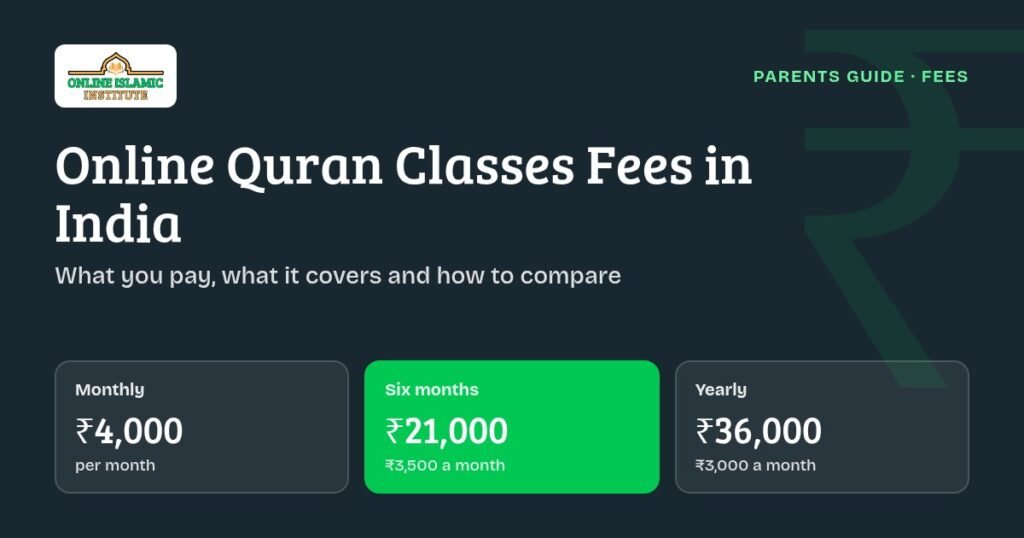
Let’s get the numbers out of the way first, because that’s what you came for.
| Plan | You pay | Works out to | Per class* |
|---|---|---|---|
| Monthly | ₹4,000 every month | ₹4,000 a month | ₹200 a class |
| Six months | ₹21,000 every 6 months | ₹3,500 a month | ₹175 a class |
| Yearly | ₹36,000 once a year | ₹3,000 a month | ₹150 a class |
*Based on 20 classes a month: 30-minute live one-to-one classes, 5 days a week.
These are the fees at Online Islamic Institute, and they are the same whichever course you pick: Noorani Qaida, Nazra, Tajweed or Hifz. Prices are per student, in rupees. Every new student gets 3 free trial classes, and you pay only after the trial.
The rest of this post is about the bigger question: how do you tell whether any online Quran class in India is fairly priced? Because the cheapest option and the right option aren’t always the same thing.
Why fees vary so much from one teacher to another
Ask three people what they pay and you’ll probably get three very different answers. The gap usually comes down to a handful of things.
Group or one-to-one
This is the big one. A group class splits the teacher’s time between several children, so it costs less. In a one-to-one class, your child gets the whole session. For learning to read and pronounce correctly, that matters a lot.
How many classes, and how long
A quote like “₹1,500 a month” sounds much cheaper than ₹4,000, until you find out it means two 20-minute classes a week. Always ask for the number of classes per month and the length of each one, then do the maths.
What is actually being taught
Basic reading is one thing. Correct Tajweed, or a structured Hifz plan with regular revision, takes more from the teacher. If a fee looks very low for Hifz, ask how revision is handled. Parents weighing memorisation can also read our guide to online Hifz classes for kids.
Flexibility
Fixed batch timings are easier for a teacher to run. Being able to pick your own slot, or switch timings during exams, is worth something, especially for families juggling school, tuition and office hours.
The simple way to compare: price per class
Take the monthly fee and divide it by the number of classes in a month. Then look at the length of each class. Here’s an example with made-up numbers for two imaginary options:
- Option A: ₹1,200 a month for 8 group classes of 30 minutes. That’s ₹150 per class, shared with other students.
- Option B: ₹4,000 a month for 20 one-to-one classes of 30 minutes. That’s ₹200 per class, and the whole half hour is your child’s.
Option A looks a third of the price. Per class, the difference is small, and the kind of class is completely different. Which one is “better value” depends on what your child needs, but at least now you’re comparing like with like.
What our fee covers
- Live one-to-one classes with a teacher, never a recorded video.
- 30 minutes a class, 5 days a week, 20 classes a month.
- Any of the four courses: Noorani Qaida, Nazra, Tajweed or Hifz.
- Classes at any time of day or night in IST, because we teach 24/7.
- A male or female teacher, whichever you prefer, available any time (more on female Quran teachers online).
- 3 free trial classes first, with payment only after the trial.
Beyond the fee, you only need what most homes already have: a phone, tablet or laptop, a stable internet connection, and ideally a headset with a microphone so the teacher hears every letter clearly. A printed Noorani Qaida or mushaf is handy too.
You can see the same plans laid out in our fee structure on the homepage.
Monthly, six months or yearly: which plan makes sense?
There’s no trick here. A longer plan costs less per month, and a monthly plan keeps things flexible.
- Monthly (₹4,000): good if you’re trying online classes for the first time, or your schedule is uncertain.
- Six months (₹21,000): a sensible choice once your child has settled in with a teacher. It covers a good stretch of Noorani Qaida or Nazra and saves ₹500 a month compared with paying monthly.
- Yearly (₹36,000): makes sense for longer goals like Tajweed or Hifz, where you already know you’ll keep going. It works out to ₹1,000 a month less than the monthly plan.
Our honest suggestion: take the free trial, then start monthly if you’re unsure. Once you know the teacher is right for your child, a longer plan is worth a look.
Questions to ask before paying anyone
Whoever you choose, a few questions save a lot of regret. How many students are in the class? How many classes per month, and how long is each one? Can I try before paying? Who will actually teach my child? We’ve put together a longer list in our post on how to choose an online Quran teacher.
Fees: frequently asked questions
It varies a lot with group versus one-to-one classes, class length and frequency. At Online Islamic Institute, live one-to-one classes cost ₹4,000 a month, ₹21,000 for six months or ₹36,000 for a year, for 20 classes of 30 minutes a month.
No. All four courses, Noorani Qaida, Nazra, Tajweed and Hifz, have the same fee.
No. Every new student gets 3 free trial classes, and you pay only after the trial, once you are happy with the classes.
Fees are per student. If two children join, each has their own one-to-one classes and their own fee.
The yearly plan, at ₹36,000 a year, which works out to ₹3,000 a month. The six-month plan works out to ₹3,500 a month and the monthly plan is ₹4,000.
Before you decide
Price matters, but a teacher your child connects with matters more, and three classes are usually enough to tell. If your child is just starting out, our Noorani Qaida guide shows what the first few months look like; if they already read, the Tajweed basics post shows what comes next.
When you’re ready, book your 3 free trial classes. No payment until the trial is done.