
Listen to a class of eight-year-olds reading Al-Fatiha in almost any Indian city and you will hear the same thing at ayah six. الصِّرَاطَ comes out as “siraat” with the thin S of sabun. The vowels are right, yet the word sounds flat. What is missing is weight.
That weight has a name in Tajweed. Some letters are read heavy, with a full and deep sound (tafkheem), and the rest are read light and thin (tarqeeq). Once you know which is which, a lot of “something sounds off” moments in your child’s reading, or your own, start to make sense.
What “heavy” and “light” actually mean
A heavy letter is not a louder letter. The difference is the shape of the mouth. For a heavy letter the back of the tongue rises towards the roof of the mouth, the space inside fills up, and the sound comes out deeper. For a light letter the tongue stays low and the sound stays thin.
A quick test: say “sa” and then “ṣa” with a finger under your chin. On the second you should feel the tongue lift at the back.
The seven letters that are always heavy
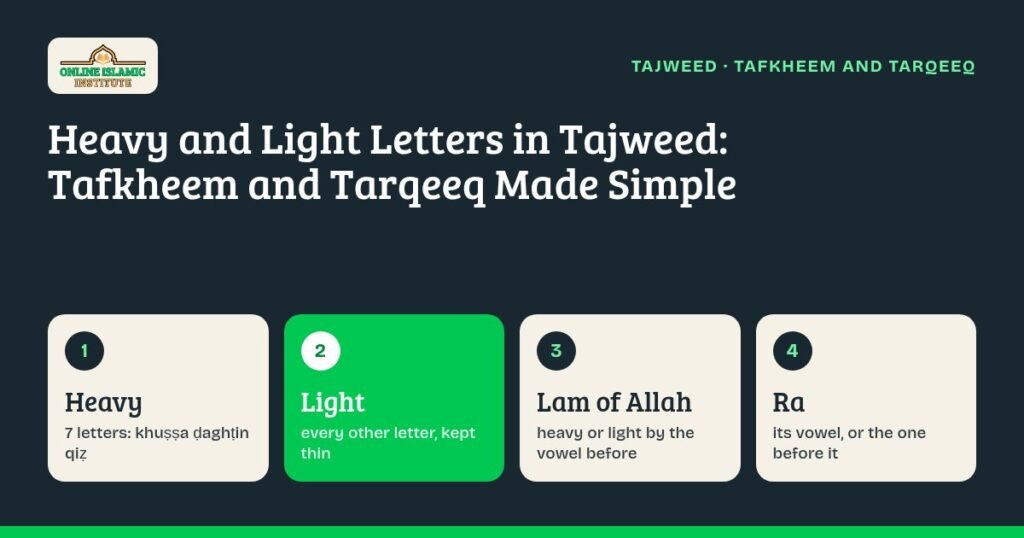
Seven letters are heavy every time they appear, whatever vowel they carry. Teachers collect them in a short phrase that children learn quickly: خُصَّ ضَغْطٍ قِظْ (khuṣṣa ḍaghṭin qiẓ). The letters are خ ص ض غ ط ق ظ.
For many of us in India the trouble is that Urdu and Hindi do not separate these sounds the way Arabic does, so each heavy letter has a light “twin” it tends to slide into. This table shows the pairs we hear mixed up most, with words from surahs your child probably already knows.
| Heavy letter | Often confused with | Practise it in |
|---|---|---|
| ص | س (as in sabun) | الصِّرَاطَ (Al-Fatiha) |
| ط | ت | طَيْرًا أَبَابِيلَ (Al-Fil) |
| ق | ك | قُلْ يَا أَيُّهَا الْكَافِرُونَ (both in one line) |
| ض | د or ز | وَلَا الضَّالِّينَ (Al-Fatiha) |
| ظ | ز or ذ | أَنقَضَ ظَهْرَكَ (Ash-Sharh) |
| خ | ه or a soft kh | خَيْرٌ مِّنْ أَلْفِ شَهْرٍ (Al-Qadr) |
| غ | a hard Hindi “g” | غَيْرِ الْمَغْضُوبِ (Al-Fatiha) |
ض and ظ also need their starting point (makhraj) fixed, so our makharij al-huroof guide is a good companion to this one.
Not all heavy letters are equally heavy
Four of the seven, ص ض ط ظ, are the heaviest, because the tongue presses up against the roof of the mouth as well as rising at the back. ط is usually described as the strongest of all. ق خ غ are heavy too, just a step lighter.
The vowel matters as well. A heavy letter with a fatha, especially when an alif follows, is at its fullest, as in قَالَ or طَالَ. With a damma it is a little less full, and with a kasra it is at its lightest, as in قِيلَ, although it never becomes truly light. When the letter has a sukoon, it takes its level from the vowel before it. Some teachers count three levels, some five; the idea is the same.
The light letters, and the slip that catches everyone
Apart from the seven heavy letters and three special cases below, every letter is light. That sounds easy, but two slips are very common.
- Heaviness leaking into the next letter. After a heavy letter, the next light letter must snap back to thin. In الصِّرَاطَ الْمُسْتَقِيمَ the ت sits right before a ق, and it must still be a light “t”, not a “ṭ”.
- Rounding the lips. Many beginners try to make a letter heavy by pushing the lips forward. The result is “qōla” instead of قَالَ and “ṭōla” instead of طَالَ. The fatha is still an “a” sound. The weight comes from the tongue, not the lips.
Three letters that change: alif, the lam of Allah, and ra
Alif follows the letter before it
Alif has no weight of its own. After a heavy letter it is heavy, as in قَالَ. After a light letter it is light, as in إِنَّهُ كَانَ تَوَّابًا at the end of An-Nasr. Reading every alif heavy makes recitation sound put on.
The lam in the name Allah
Only the lam of the word اللَّه (and اللَّهُمَّ) changes. Every other lam is light. The rule depends on the vowel just before it:
- After a fatha or a damma, the lam is heavy: قُلْ هُوَ اللَّهُ أَحَدٌ and إِذَا جَاءَ نَصْرُ اللَّهِ. If you start a sentence with the name of Allah, as in اللَّهُ الصَّمَدُ, the opening hamza is read with a fatha, so the lam is heavy there too.
- After a kasra, the lam is light: بِسْمِ اللَّهِ, الْحَمْدُ لِلَّهِ and فِي دِينِ اللَّهِ أَفْوَاجًا.
Surah An-Nasr is a nice one to practise with, because the first ayah has the heavy lam and the second has the light one.
Ra, the letter with the most rules
Ra is where most students need a teacher’s ear for a while. The basics fit in a few lines:
- Ra with a fatha or damma is heavy: بِرَبِّ النَّاسِ, الرَّحْمَٰنِ.
- Ra with a kasra is light: مِن شَرِّ الْوَسْوَاسِ when you read on.
- Ra with a sukoon looks back at the letter before it. A fatha or damma before it makes it heavy, as in الْقُرْآنُ. A kasra before it makes it light, as in فِرْعَوْنَ.
- Two exceptions to that last point. If the kasra before it is only the temporary kasra of a starting hamza, the ra stays heavy: ارْجِعِي إِلَىٰ رَبِّكِ (Al-Fajr). And if a heavy letter follows it in the same word, it stays heavy: كَانَتْ مِرْصَادًا (An-Naba).
Stopping changes things too, because the ra becomes sakin when you stop. Look back past any sakin letter to the last vowel. Stop on وَالْعَصْرِ and you get a heavy ra, because the vowel before it is the fatha on ع. Stop on خَيْرٌ and the ra is light, because a ya sakin comes before it.
A small number of words are read both ways by recognised teachers, فِرْقٍ in Surah Ash-Shu’ara being the usual example. Follow your teacher on these as you meet them.
A ten-minute practice for home
- Read these pairs slowly, light then heavy: سَ / صَ, تَ / طَ, كَ / قَ, ذَ / ظَ, دَ / ضَ. Finger under the chin.
- Read Al-Fatiha once, stopping at every heavy letter to check it. There are a lot of them, so this is a good workout.
- Read An-Nasr and say whether each lam of Allah is heavy or light before you read it.
- Record yourself on the phone, then play a well-known reciter reading the same surah. Listen only for weight, nothing else.
Children usually enjoy the pairs as a game of “thin or fat?” at the dinner table, which works better than a worksheet.
Where this fits in learning Tajweed
Heavy and light letters come after pronunciation and before the bigger rules. Weight is one quality of a letter; qalqalah is another. Our overview of Tajweed rules for beginners shows the full map, and the list of common mistakes in Quran recitation has a self-check you can use alongside this one.
Weight is hard to judge in your own voice, because most of us hear what we meant to say. In our online Tajweed classes the teacher hears every heavy letter one-to-one, in 30-minute classes, 5 days a week. Children who are still on the alphabet start with Noorani Qaida, where heavy letters are first introduced. You can see the plans in the fee section, or read more about our online Quran classes in India.
Questions parents ask
There are seven letters that are always heavy: kha, sad, dad, ghayn, ta (the heavy ṭ), qaf and dha (the heavy ẓ). They are remembered with the phrase khuṣṣa ḍaghṭin qiẓ.
Three: alif, which follows the letter before it; the lam in the name Allah, which is heavy after a fatha or damma and light after a kasra; and ra, which depends on its own vowel or the vowel before it.
No. The weight comes from raising the back of the tongue so the mouth fills with sound. The volume stays the same, and the lips should not be pushed forward.
Urdu and Hindi speakers often use the same thin “s” for both letters, so the habit comes from everyday speech. Short daily practice with pairs like sa and ṣa, plus a teacher who points it out each time, usually fixes it.
If you would like a teacher to listen for the heavy letters in your child’s reading, book 3 free trial classes and see how it goes before you pay anything.