
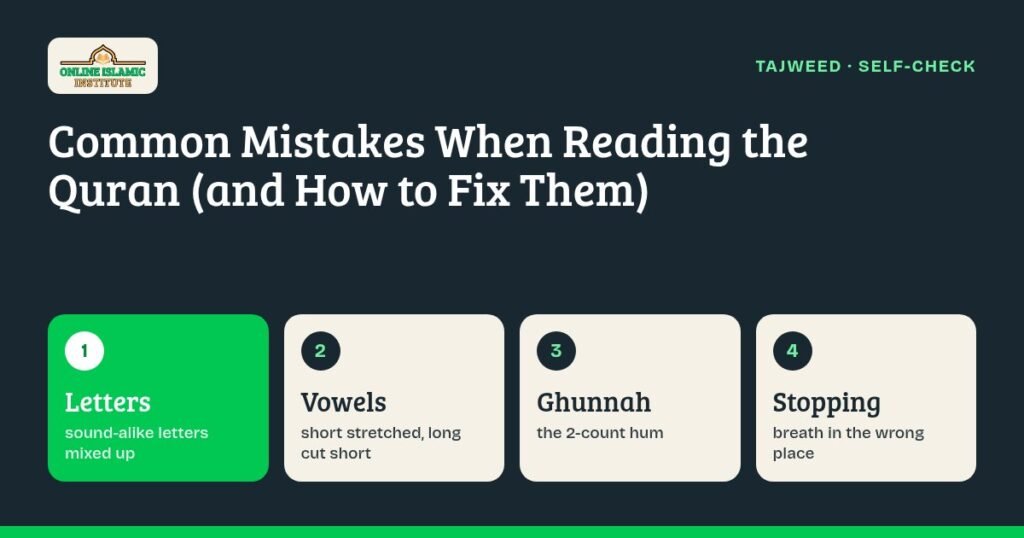
Most people who read the Quran with mistakes have no idea they are making them. That is not carelessness. If you learned as a child from someone who read the same way, or picked it up by ear from family, the mistake simply sounds normal to you.
So this is a self-check. Below are the mistakes Quran teachers in India hear most often, roughly from the most serious to the more subtle, with a simple way to test yourself and a first step to fix each one.
Two kinds of mistakes
Scholars of Tajweed divide recitation errors into two groups, and it helps to know the difference:
- Lahn jali (clear mistakes): changing a letter, a vowel or the length of a vowel. These can change the meaning of a word, so they come first.
- Lahn khafi (hidden mistakes): missing the finer rules, such as a ghunnah held too short or a heavy letter read light. The meaning usually stays, but the recitation is not complete.
A classic example of a clear mistake is in Surah Al-Fatiha: أَنْعَمْتَ (an’amta, “You have favoured”) read as أَنْعَمْتُ (an’amtu, “I have favoured”). One small vowel, and the sentence now says something else entirely. For an ayah-by-ayah check of the whole surah, see Surah Al-Fatiha with Tajweed.
1. Swapping letters that sound alike
This is the big one for Urdu and Hindi speakers, because our languages merge sounds that Arabic keeps apart. The usual pairs:
| Often mixed up | What goes wrong |
|---|---|
| ح and ه | Both come out as a soft “h”. ح is from the middle of the throat, tighter and breathier. |
| ع and ء | The ع is dropped or turned into a plain “a”. |
| ق and ك | ق is made deeper, at the very back of the tongue. قَلْب (heart) is not كَلْب (dog). |
| س / ص and ت / ط | The heavy letter (ص, ط) is read light, like its partner. |
| ذ, ز and ظ | All three become an Urdu “z”. |
| ث and س | ث needs the tongue tip at the front teeth, not an “s”. |
| ض and د | ض is read as a “d” or a “z”. |
Self-check: record yourself reading Surah Al-Ikhlas and Surah Al-Falaq, then listen only for ح, ق and ذ. First fix: learn where each letter is made. Our guide to makharij al-huroof maps them out.
2. Short vowels stretched, long vowels cut short
A short vowel should be short. Reading بِسْمِ as “bees-mi” stretches a kasra into a long “ee” that is not written there, and a stretched fatha can look like an alif that does not exist. The reverse is just as common: a long vowel (a madd letter), like the “ee” in الرَّحِيمِ, rushed so it sounds short, especially when reading fast.
Self-check: tap a finger for each count. A short vowel gets no stretch; a natural madd gets two even counts. First fix: slow down and count. The madd rules guide covers the longer stretches.
3. Adding a vowel to a sakin letter
A letter with a sukoon should stop cleanly. Many readers add a tiny “uh” after it, so قُلْ comes out as “qulu”. It is small, but it adds a sound that is not there.
First fix: practise sakin letters in Noorani Qaida joining lessons until stopping on them feels natural.
4. Missing the ghunnah
Noon and meem with a shaddah (إِنَّ, ثُمَّ) carry a nasal hum held for about two counts. In fast reading the hum often disappears. The same hum is needed in ikhfa, iqlab and idgham with ghunnah in the rules of noon sakin and tanween and in two of the meem sakin rules.
Self-check: pinch your nose while reading إِنَّ. If the sound is not blocked, there was no ghunnah.
5. Qalqalah missed, or added where it does not belong
The five qalqalah letters (ق ط ب ج د) “bounce” slightly when they carry a sukoon. Some readers never bounce them; others bounce everything, so every sakin letter echoes. Both are mistakes. Our page on the qalqalah letters has practice lines from Al-Ikhlas and Al-Falaq.
6. Heavy letters read light (and light ones heavy)
Some letters are always full-mouthed: خ ص ض غ ط ق ظ. Read them light and صَبْر starts to sound like سَبْر. The opposite also happens: a light letter next to a heavy one gets pulled heavy. The name of Allah has its own rule, read heavy after a fatha or damma and light after a kasra. Our guide to heavy and light letters in Tajweed goes through all seven heavy letters and the rules for ra.
7. Stopping in the wrong place
Running out of breath mid-ayah and stopping wherever it happens can cut a sentence so that it means something odd, and starting again from the middle of a phrase makes it worse. Watch the stopping signs printed in your mushaf; in Indo-Pak mushafs these marks are very visible. When you have to take a breath, go back a word or two and start again from a sensible place. Here is what each waqf sign in the Quran means.
8. Reading faster than your accuracy allows
Speed is not a mistake by itself. Fast recitation (hadr) is a recognised style. The problem is reading faster than your letters can keep up with, which is when all the mistakes above multiply. Ramadan khatm targets are the usual culprit.
Read at the speed where you make no mistakes. Then, slowly, raise the speed.
How to actually fix them
- Record before you correct. Five minutes of your own voice on a short surah shows you more than a chart. Our guide on learning Tajweed online uses this as the starting point.
- Fix one thing at a time. A week on ح versus ه does more than a day on ten rules.
- Go back to letters if you need to. If several letter mistakes show up, a short Noorani Qaida refresher is quicker than patching words one by one. Adults do this all the time; see learning Quran as an adult.
- Have someone listen. You cannot hear your own habits easily. That is the whole point of a teacher.
If you are new to the rules, start with the Tajweed rules for beginners overview. If your reading is still slow from the page, Nazra practice comes first; here is what Nazra involves.
Classes that listen to every letter
Our online Tajweed classes are live and one-to-one, 30 minutes a day, five days a week, at any time 24/7 in IST, with male and female teachers. The teacher listens to you read and corrects as you go, which is exactly what a self-check cannot do. Fees are ₹4,000 a month, or less per month on six-month and yearly plans (see the fee section), and part of our online Quran classes in India.
Questions about recitation mistakes
For readers in India, mixing up letters that sound alike in Urdu or Hindi, such as ح and ه, ق and ك, or ذ, ز and ظ. These are clear mistakes that can change the meaning, so they are fixed first.
Lahn jali is a clear mistake, such as changing a letter or vowel, which can change the meaning. Lahn khafi is a hidden mistake against the finer Tajweed rules, such as a missing ghunnah.
You can find many mistakes by recording yourself and checking against a good reciter, but it is hard to hear your own habits. A teacher who listens to you read is the quickest way to fix them.
Want to know which of these you make? Book 3 free trial classes, read a short surah to the teacher, and ask for an honest list. You pay only after the trial.