
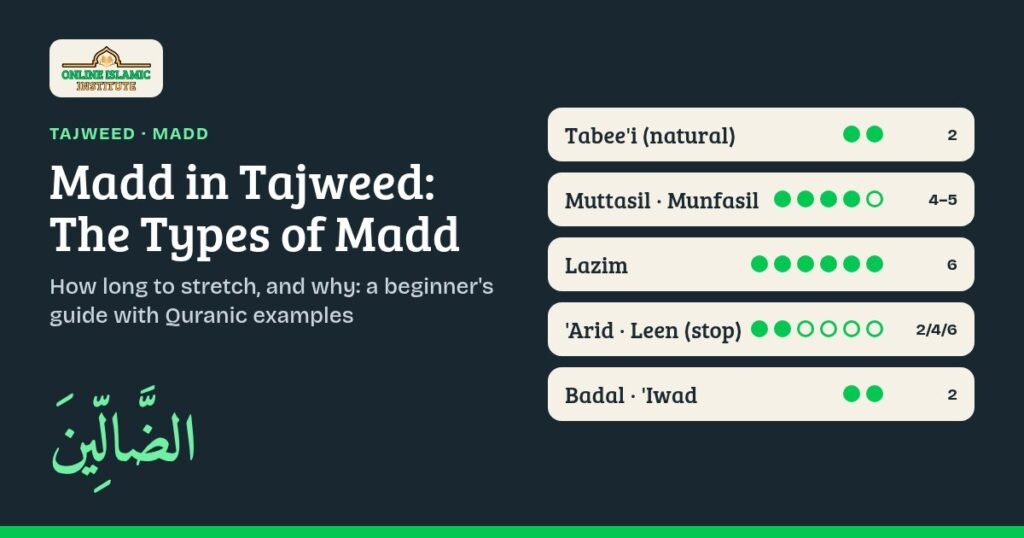
Most of us in India have heard it in Fajr or Taraweeh. The imam reaches وَلَا الضَّالِّينَ and holds that long “aaa” in the middle, and the whole masjid waits before saying Ameen. It is not the imam’s style, though. It is a Tajweed rule, and it has a name.
That rule belongs to madd, the part of Tajweed that tells you how long to stretch a vowel. This guide takes the types of madd one at a time, with examples from surahs most Indian families already know by heart.
What madd means, and the three madd letters
Madd simply means lengthening. In Tajweed it happens on three letters, and only when they sit in a particular way:
- Alif with a fatha before it, as in قَالَ (qāla)
- Waw sakin with a damma before it, as in يَقُولُ (yaqūlu)
- Ya sakin with a kasra before it, as in قِيلَ (qīla)
Teachers often give one word that holds all three: نُوحِيهَا (nūḥīhā), from Surah Hud. These sounds come from the open space of the mouth and throat, called al-jawf, which is why they can be stretched at all (our makharij al-huroof guide explains it).
How long is one “count”?
Madd is measured in counts, called harakat. One count is roughly the time it takes to fold one finger at your normal reading speed. What matters is that your counts stay the same size through the whole surah.
Madd Tabee’i: the natural madd (2 counts)
This is the madd you meet on almost every line. Whenever a madd letter is not followed by a hamza or a sukoon, you stretch it for exactly two counts. It is also called Madd Asli, the original madd, because every other madd is built on top of it. One exception catches people out: a long vowel at the end of a word is not stretched when the next word begins with a connecting alif, as in fil-ard; our guide to hamzatul wasl rules explains why.
Two counts means two. Not one, which clips the word, and not three or four, a common habit among people who learned to recite by ear from naats.
When madd grows longer: hamza and sukoon
Every longer madd, called Madd Far’i (secondary madd), has one of two causes: a hamza or a sukoon near the madd letter. Here is the whole picture first.
| Type | What causes it | Counts |
|---|---|---|
| Madd Tabee’i (natural) | No hamza or sukoon after the madd letter | 2 |
| Madd Muttasil (wajib) | Hamza after the madd letter, in the same word | 4 or 5 |
| Madd Munfasil (ja’iz) | Madd letter ends a word, hamza starts the next | 4 or 5 |
| Madd Lazim | A permanent sukoon or shaddah after the madd letter | 6 |
| Madd ‘Arid lis-Sukoon | A sukoon that appears only because you stop | 2, 4 or 6 |
| Madd Leen | Waw or ya sakin after a fatha, when you stop on the next letter | 2, 4 or 6 |
| Madd Badal | Hamza comes before the madd letter | 2 |
| Madd ‘Iwad | Stopping on a fathatain (tanween with fatha) | 2 |
These counts follow Hafs as commonly taught in India. Your teacher settles on one length for each type, and you keep to it.
Madd Muttasil: hamza in the same word
When a madd letter is followed by a hamza inside the same word, the madd is called muttasil (connected) or wajib (obligatory), because every reciter lengthens it. In Hafs it is read for four or five counts. Examples: جَاءَ at the start of Surah An-Nasr (إِذَا جَاءَ نَصْرُ اللَّهِ) and السَّمَاءِ.
Madd Munfasil: hamza in the next word
Here the madd letter sits at the end of one word and the hamza begins the next, so the two are separated (munfasil). The first ayah of Surah Al-Kawthar has one: إِنَّا أَعْطَيْنَاكَ, where the alif of “innā” meets the hamza of “a’ṭaynāka”. So does every يَا أَيُّهَا.
It is also called ja’iz, permissible, because some routes of recitation allow it to be shortened to two counts. In the Hafs most of us learn, it is read for four or five, and a common teaching point is to keep it no longer than your muttasil.
Madd Lazim: the fixed six counts
When a madd letter is followed by a sukoon or shaddah that is always there, whether you stop or keep reading, the madd is lazim, necessary, and it is six counts. This is the one from the masjid story: in الضَّالِّينَ the alif is followed by a lam with shaddah, so it is held for six. Others: الْحَاقَّةُ and دَابَّةٍ. A rarer form with a plain sukoon appears in آلْآنَ, twice in Surah Yunus.
Madd Lazim also shows up in the separate letters that open some surahs. Our guide to huroof muqatta’at covers how to read Alif Lam Meem and the other openings. In الٓمٓ you read “alif lām mīm”: no stretch on alif, six counts on lām and on mīm. The six-count letters are gathered in نَقَصَ عَسَلُكُمْ (‘ayn may be four or six); the letters of حَيٌّ طَهُرَ take only two, so طه is a short “ṭā hā”.
Madd ‘Arid lis-Sukoon: stopping makes it
Stop at the end of الرَّحِيمِ and the last letter becomes sakin: “ar-raḥīm”. That temporary sukoon, right after a madd letter, lets you stretch the ya for two, four or six counts. Al-Fatiha has it at almost every stop: الْعَالَمِينَ, الدِّينِ, نَسْتَعِينُ. Choose one length and keep it for every stop in that recitation.
Three smaller madds worth knowing
Madd Leen. A waw or ya sakin with a fatha before it, as in خَوْفٍ and بَيْتٍ, is a “soft” letter. It is only stretched when you stop on the letter after it. Surah Quraysh is full of them: قُرَيْشٍ, الصَّيْفِ, الْبَيْتِ, خَوْفٍ, each two, four or six counts at the stop. Read through without stopping and there is no stretch at all, which is why يَوْمِ in Al-Fatiha stays short.
Madd Badal. Here the hamza comes before the madd letter: آمَنُوا, إِيمَانًا, أُوتُوا. In Hafs it is two counts, like a natural madd.
Madd ‘Iwad. When you stop on a word ending in fathatain, the tanween turns into a plain alif held for two counts. Surah An-Nasr ends on two of them: أَفْوَاجًا becomes “afwājā” and تَوَّابًا becomes “tawwābā”. The exception is a word ending in ta marbuta, such as رَحْمَةً, where you stop on a soft “h” instead.
Spotting madd in an Indian mushaf
Most mushafs printed in India use the Indo-Pak script. A wavy madd sign (~) sits over the madd letter wherever a long madd is due: muttasil, munfasil and lazim. The standing fatha, or khari zabar, that many of us learned in Urdu-medium maktabs marks an alif sound, normally a natural two-count madd.
Mistakes we hear all the time
- Stretching every natural madd to three or four counts, so the recitation sounds sung rather than read.
- Rushing the muttasil and munfasil in fast prayers, until السَّمَاءِ sounds like “as-sama”.
- Stretching عَلَيْهِمْ or غَيْرِ as if they were madd. A leen letter only stretches when you stop on the next letter.
Learning madd with a teacher
Madd usually comes after makharij and the joining rules (noon sakin and tanween, meem sakin), because a long vowel only sounds right when the letters around it are clean. Our Tajweed rules for beginners shows the order, and how to learn Tajweed online covers practice between lessons.
In our online Tajweed classes, a teacher listens live, one-to-one, in 30-minute lessons five days a week (20 classes a month), and stops you on the word where a count slipped. Newer readers begin with Noorani Qaida or Nazra. Online Islamic Institute runs classes 24/7 in IST, with male and female teachers available at any hour. Fees are ₹4,000 a month, ₹21,000 for six months (₹3,500 a month) or ₹36,000 a year (₹3,000 a month); all three are in our fee section. You start with 3 free trial classes and pay only after the trial.
Madd in Tajweed: common questions
Two main groups: the natural madd (2 counts) and the secondary madds caused by a hamza or a sukoon, usually taught as muttasil, munfasil, lazim, ‘arid lis-sukoon, leen, badal, ‘iwad and silah. Books group them slightly differently.
Two counts, always. It is held whenever a madd letter is not followed by a hamza or a sukoon.
Muttasil has the hamza in the same word (جَاءَ); munfasil has it at the start of the next word (إِنَّا أَعْطَيْنَاكَ). In Hafs as commonly taught, both are four or five counts.
Because the sukoon or shaddah after the madd letter is permanent, whether you stop or continue. Reciters read it for six counts, as in الضَّالِّينَ.
Tonight, count on your fingers at الضَّالِّينَ. If six feels strange, book your 3 free trial classes and ask a teacher to listen.