
Here is a small puzzle that trips up a lot of adult learners. In اهْدِنَا الصِّرَاطَ الْمُسْتَقِيمَ you start with “ihdinaa”. But read the ayah before it straight through, without stopping, and that “i” disappears: “…nasta’eenu-hdinas-siraat”. Same alif, two different behaviours. Why?
Because that alif is a hamzat al-wasl, the connecting hamza. It only speaks when you begin with it. When you join it to the word before, it steps aside. Learn when to sound it, which vowel to give it, and what to do when you skip it, and a whole category of “I keep stumbling at the start of words” problems goes away.
Two kinds of hamza
Arabic has two hamzas, and the mushaf tells you which one you are looking at.
- Hamzat al-qat’ (the cutting hamza) is always pronounced, at the start of reading or in the middle. It is written with the small hamza sign: أَنْعَمْتَ, إِيَّاكَ.
- Hamzat al-wasl (the connecting hamza) is pronounced only if you start reading from that word. When you continue from the previous word, it is silent and you jump straight to the letter after it.
In the Indo-Pak mushaf that most Indian homes have, a hamzat al-wasl is a plain alif with no vowel mark on it, usually followed by a letter with a jazm or a shaddah. In the Madani (Uthmani) print it has a tiny head of the letter saad on top. If you switch between the two prints, our comparison of Indo-Pak and Uthmani script shows where the marks differ.
Starting with hamzat al-wasl: which vowel?
Since the alif has no mark of its own, you have to know which vowel to begin with. There are three simple cases.
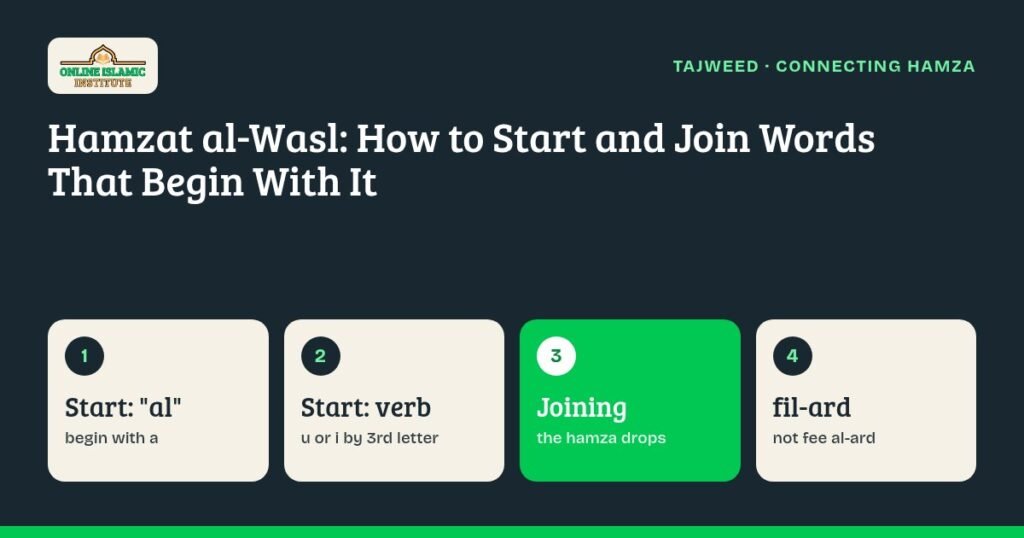
1. The “al” of “the”: start with fatha
If the word starts with the definite article ال, begin with “a”. Starting at الْحَمْدُ you say “al-hamdu”. Starting at الرَّحْمٰنِ you say “ar-rahmaan”, because ر is a sun letter. That second part is its own rule, explained in sun and moon letters in the Quran.
2. Verbs: look at the third letter
For verbs, count the hamza as the first letter and look at the third one:
- If the third letter has a damma (pesh), start with damma: اُدْعُ is “ud’u”, اُنْظُرْ is “unzhur”.
- If the third letter has a fatha or kasra, start with kasra: اِهْدِنَا is “ihdinaa”, اِذْهَبْ is “idh-hab”, اِعْلَمُوا is “i’lamoo”.
There is one catch your teacher will point out: a few verbs, such as امْشُوا and ائْتُوا, show a damma on the third letter only because of the plural ending. That damma does not really belong to the verb, so these still start with kasra: “imshoo”, “i’too”. You do not need to memorise a list on day one; just know that the exception exists so it does not confuse you later.
3. Other nouns: start with kasra
A small group of nouns begin with hamzat al-wasl, and they start with kasra: اِبْنٌ (ibn, son), اِمْرَأَةٌ (imra’ah, woman), اِثْنَانِ (ithnaan, two), اِسْمٌ (ism, name), and a few more like them. The verbal nouns of longer verbs also start with kasra, for example اِسْتِغْفَارٌ (istighfaar).
| Word starts with | Begin with | Example |
|---|---|---|
| “al” (the) | fatha: a | al-hamdu, ar-rahmaan |
| Verb, 3rd letter has damma | damma: u | ud’u, unzhur |
| Verb, 3rd letter has fatha or kasra | kasra: i | ihdinaa, idh-hab |
| Noun like ibn, ism, imra’ah | kasra: i | ibnu, ismu |
Joining: what happens when you do not stop
This is where most mistakes live. When you read straight on from the word before, the hamzat al-wasl is not pronounced. The last vowel of the previous word slides directly into the next sound.
- وَاتَّقُوا is “wattaqoo”, not “wa-ittaqoo”.
- بِسْمِ اللّٰهِ is “bismillaah”: the hamza of the name of Allah is never sounded in the middle.
- Joining Al-Fatiha ayah 5 to 6 gives “nasta’eenu-hdinas-siraatal-mustaqeem”. The “i” of ihdinaa drops out.
When the previous word ends in a long vowel
If the word before ends in a madd letter (a long aa, ee or oo) and the next word starts with hamzat al-wasl followed by a letter with sukoon or shaddah, the long vowel is shortened in speech. You still see it written; you just do not stretch it.
- فِي الْأَرْضِ is read “fil-ard”, not “fee al-ard” and not “feel-ard” with a long ee.
- قَالُوا اتَّخَذَ is read “qaalut-takhadha”.
This is one reason the madd counts in our madd rules guide always talk about what comes next: a long vowel only gets its length when it can actually be pronounced.
When the previous word ends in sukoon or tanween
Two silent sounds cannot sit side by side, so Arabic adds a helping vowel, usually a kasra. In the mushaf you often see it printed for you: قُلِ ادْعُوا is “qulid-‘oo”. With tanween, the Indo-Pak mushaf prints a small noon (often called noon qutni) to remind you: نُوحٌ ابْنَهُ is read “noohu-nibnahu”. When you see that small noon, read it with a kasra and carry on.
Common slips we hear in class
- Sounding the hamza mid-reading. “Wa-al-ladheena” instead of “walladheena”. It breaks the flow and adds a sound that is not there.
- Starting a verb with the wrong vowel. “Uhdinaa” or “adhab”. Check the third letter.
- Stretching a long vowel before a connecting hamza. “Fee al-ard” is the classic one in India, especially among people who learned by ear.
- Ignoring the small noon. Reading “noohun ibnahu” with a fresh hamza instead of “noohu-nibnahu”.
Most of these show up when a learner stops in the middle of an ayah, takes a breath, and then restarts from the wrong place. Our guide to waqf signs in the Quran helps you choose good places to stop, and common mistakes in Quran recitation lists the other habits worth fixing at the same time.
A short practice routine
- Take Al-Fatiha. Read ayahs 5 and 6 once with a stop between them (“nasta’een. Ihdinaa…”) and once joined (“nasta’eenu-hdinaa”). Feel the difference.
- Find three فِي الْ phrases on any page and read each without stretching the ee.
- Open Surah Al-Baqarah, find any word starting with اتَّقُوا or اعْلَمُوا, and practise starting there and joining into it.
- Ask your teacher to stop you every time the hamza sneaks into the middle of a reading. Two weeks of that and it stops happening.
Hamzat al-wasl is a small piece of the bigger set of Tajweed rules for beginners, and it builds on the marks explained in zabar, zer and pesh. Once it clicks, reading longer passages without breaks feels much calmer.
Getting it checked by a teacher
You can read about this rule in ten minutes, but your ear will keep accepting “fee al-ard” until someone corrects it on the spot. In our online Tajweed classes the teacher listens live, one-to-one, for 30 minutes, five days a week (20 classes a month), at any hour that suits your family, with male and female teachers available 24/7. As an online Quran institute we teach Noorani Qaida, Nazra, Tajweed and Hifz only. Fees are listed in our fee section: ₹4,000 a month, ₹21,000 for six months or ₹36,000 a year.
Hamzat al-wasl: FAQ
It is the connecting hamza: an alif at the start of some words that is pronounced only when you begin reading from that word. When you join it to the word before, it is silent.
For “al” start with fatha. For verbs, start with damma if the third letter has a damma, otherwise kasra. For nouns like ibn, ism and imra’ah, start with kasra.
As a plain alif with no vowel mark. The Madani print adds a small saad head above it.
When the next word starts with hamzat al-wasl and a sukoon, the long ee of fee is not stretched and the hamza is dropped, so it is read “fil-ard”.
It is a reminder used in Indo-Pak mushafs: when tanween meets hamzat al-wasl, read the tanween as noon with kasra and join, as in noohu-nibnahu.
Want someone to hear how you join ayahs and tell you what to fix? Book 3 free trial classes, and pay only after the trial if you want to continue.