
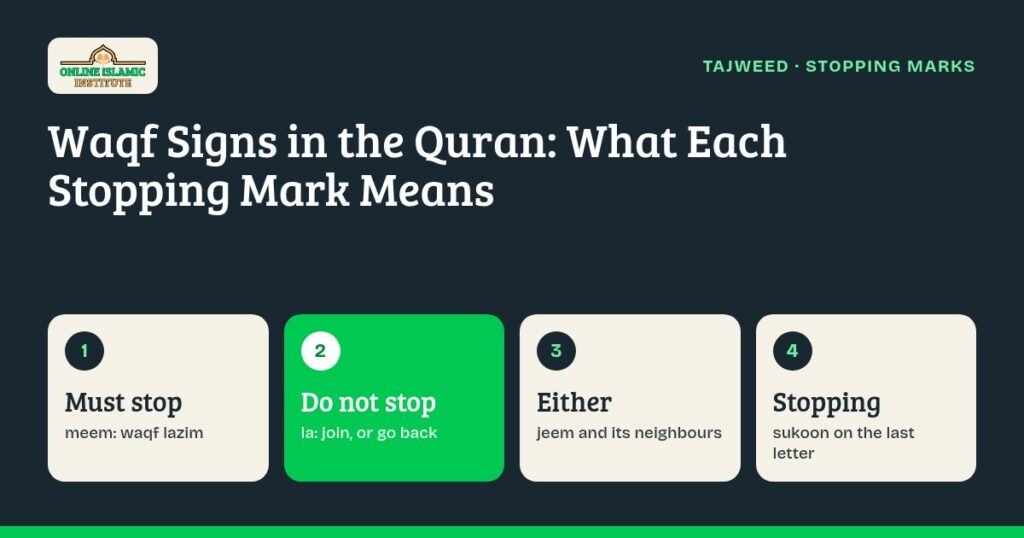
Open the mushaf on your shelf and look between the words. Besides the vowel marks you will see small letters sitting above the line: a م here, a لا there, a ط or a ج, sometimes three dots. These are the waqf signs, the stopping marks. They tell the reader where a pause keeps the meaning clear and where a pause would break it.
Most of us were taught to stop wherever we ran out of breath. That works until the breath runs out in the wrong place. This guide goes through the signs you will actually meet, in the Indian (Indo-Pak) copies most families in India own and in the Madani print many apps use, and how to stop properly once you know where.
Why stopping matters at all
Arabic sentences in the Quran often run across several phrases. Stop in the wrong spot and the next phrase can seem to belong to the one before it. A well-known example is in Surah Ya-Sin, ayah 76: فَلَا يَحْزُنكَ قَوْلُهُمْ ۘ إِنَّا نَعْلَمُ. The mark after قَوْلُهُمْ is a required stop. Joining the two parts can make “We know what they conceal” sound like part of what the disbelievers say, which is not the meaning.
Cases like that are rare, and Allah is merciful to a learner who stumbles. Still, the signs exist so that we do not have to guess, and following them is part of reading well.
The six signs in the Madani mushaf
The Madani print, from the King Fahd Complex, keeps the system small. If your child reads from an app, these are most likely the signs on the screen.
| Sign | Name | What to do |
|---|---|---|
| م | Waqf lazim | Stop here. Joining can change the meaning. |
| قلى | Al-waqf awla | Stopping is better, but joining is allowed. |
| ج | Waqf ja’iz | Stopping and joining are equally fine. |
| صلى | Al-wasl awla | Joining is better, but stopping is allowed. |
| لا | La taqif | Do not stop here. If you must, go back a word or two and join. |
| Two sets of three dots (ۛ) | Mu’anaqah | A pair of marks: stop at one of them, not both. |
The pair of dots is easiest to understand with the example every teacher uses, near the start of Al-Baqarah: ذَٰلِكَ الْكِتَابُ لَا رَيْبَ ۛ فِيهِ ۛ هُدًى لِّلْمُتَّقِينَ. You can stop after رَيْبَ or after فِيهِ. Either reading is correct. Stopping at both would leave فِيهِ hanging on its own.
The signs in Indian (Indo-Pak) copies
Copies printed in India and Pakistan carry more marks, and the meanings are written in Urdu notes at the back of many editions. It is worth reading that page in your own copy, because publishers do not all print exactly the same set. The word “sajdah” in the margin is a different marking altogether; our guide to sajdah tilawat explains what to do when you reach one. These are the ones you will see most often.
| Sign | Commonly taught meaning |
|---|---|
| Small circle with the ayah number | End of an ayah. You may stop here, and most teachers encourage it. |
| م | Required stop (lazim), the same as in the Madani print. |
| ط | Waqf mutlaq: stop here. |
| ج | Waqf ja’iz: stopping is allowed; many teachers prefer that you stop. |
| ز | Stopping is allowed, but joining is better. |
| ص | Join if you can; stopping is excused if you need breath. |
| صلے | Joining is better. |
| ق | Some scholars said stop here; most readers join. |
| قف | Stop. |
| لا | Do not stop. At the end of an ayah, scholars differ, and many teachers allow a stop there. |
| ک | Same instruction as the previous sign. |
| سکتہ / س | Saktah: a very short pause without taking a breath. |
| وقفہ | A slightly longer pause, still without taking a breath. |
If a sign in your copy is not listed here, check the explanation page in that copy or ask your teacher. Small differences between publishers are normal and are not mistakes.
Saktah in the recitation of Hafs
A saktah is a short break in the sound without breathing. In the Hafs recitation, which is what nearly every mushaf in India follows, four places are commonly taught as a saktah: after عِوَجًا in Al-Kahf (ayah 1), after مِن مَّرْقَدِنَا in Ya-Sin (ayah 52), at مَنْ ۜ رَاقٍ in Al-Qiyamah (ayah 27) and at بَلْ ۜ رَانَ in Al-Mutaffifin (ayah 14). The Madani print marks them with a small س.
How to stop once you know where
Stopping is not just going quiet. The last word changes slightly:
- The last letter gets a sukoon. الرَّحِيمِ becomes “ar-raḥīm”.
- A word ending in a fathatan (double fatha) ends with a long “a”: عَلِيمًا is read “ʿalīmā” when you stop.
- A round ta (ta marbuta) turns into a soft “h”: رَحْمَةً becomes “raḥmah”.
- If a long vowel comes just before the last letter, you may stretch it a little more. That is the madd you get from stopping, covered in our madd rules guide.
Stopping also brings other rules into play. A ra at the end, for example, is read heavy or light depending on what comes before it once it loses its vowel; the heavy and light letters guide explains how.
Starting again after a stop
Where you restart matters as much as where you stop. After a stop at a sign, begin at the next word. If you had to stop somewhere unsuitable, such as at a لا or in the middle of a phrase, go back a word or two to a sensible starting point and read on from there. Teachers call this ibtida, and it is a normal part of reading, not a failure. If the word you restart on begins with a connecting alif, our guide to hamzat al-wasl shows which vowel to start with.
Teaching children the signs
Children do not need all thirteen signs on day one. A gentle order that works for most families:
- First, the ayah-end circle. Stop and breathe there, every time.
- Then م (always stop) and لا (do not stop). These two cover most of the meaning cases.
- Then the “either is fine” signs, ج and its neighbours, once your child reads whole lines smoothly.
- Saktah and the pair of dots last, when they come up in the surahs your child is reading.
This fits naturally into Nazra, the stage of reading the Quran fluently from the mushaf. If you are not sure what Nazra covers, see what is Nazra Quran; our Nazra Quran online classes are where students usually meet the waqf signs properly, with the teacher pointing them out as they read. Students working on Tajweed go through them again in the online Tajweed classes, and our Tajweed rules for beginners puts them in context.
All our classes are one-to-one and 30 minutes long, 5 days a week, at any time of day in IST, with male and female teachers. Fees are in the fee section, and you can read more about our online Quran institute on the homepage.
Questions
It marks a required stop (waqf lazim). Stopping there keeps the meaning clear, because joining the next words could change it.
Scholars differ on this. Many teachers allow a stop at the end of an ayah even with la, and treat la in the middle of an ayah as a firm “do not stop”. Follow your teacher.
Indian (Indo-Pak) copies use a larger set of signs, while most apps use the Madani print with six. The Quran is the same; only the marking system differs. Check the explanation page in your copy.
Stop, take a breath, then go back a word or two to a sensible starting point and continue. That is the accepted way to recover.
If you would like someone to read alongside your child and point out each sign as it comes, book 3 free trial classes. You pay only if you decide to continue.