
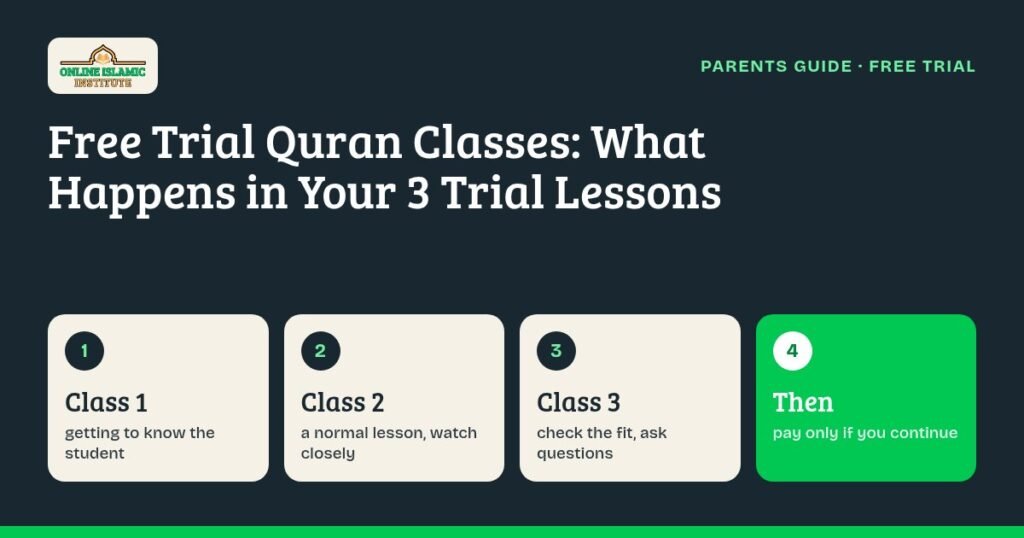
“Free trial” can mean almost anything. Sometimes it is a ten-minute sales call. Sometimes it is one real class followed by a payment link before you have had time to think. So it is fair to ask what you are actually signing up for.
Here is exactly how the free trial works at Online Islamic Institute: what happens in each of the three classes, what you should be watching for as a parent or adult learner, and what happens afterwards, whichever way you decide.
The short version
- 3 free trial classes, live and one-to-one with a teacher, not a recorded demo.
- No payment before or during the trial. You pay only after the trial, and only if you want to continue.
- Any time, 24/7 in IST, with male and female teachers available at any hour.
- Each class is 30 minutes, the same length as a regular class, so you see the real thing.
That is it. No card details up front, and nothing to cancel if you decide it is not for you. (Looking for free online Islamic courses instead? Here is an honest look at what works for free.)
Before the first class
When you book through the contact form, we ask a few simple things: who is learning, roughly where they are (never opened a Qaida, reads slowly, reads well but wants Tajweed, wants to memorise), and which times suit you. If you would prefer a female teacher, say so here. It costs nothing extra and nobody will ask why.
The day before, spend fifteen minutes on the setup: a charged device on a stand, earphones with a mic, and a quiet corner. Our first online Quran class checklist walks through it. Most “this isn’t working” moments in a first class are really sound problems, not teaching problems.
Class 1: getting to know the student
The first class is mostly listening. The teacher wants to hear where the student really is, which is often a little different from what the family thinks. A child who “knows the Qaida” may still mix up ث and س; an adult who “can’t read at all” sometimes remembers more from childhood than they expect.
Expect a bit of gentle testing: reading a few letters or a line, saying some sounds back, maybe reciting a short surah the student already knows. For a small child the teacher will keep it light, with lots of praise and short turns. Nobody is marked or failed.
By the end, the teacher usually has a sense of where to start: Noorani Qaida from the beginning, a quick Qaida refresher, Nazra (fluent reading from the mushaf), Tajweed or Hifz.
Class 2: a normal lesson
The second class looks like an ordinary lesson. The teacher teaches something new, corrects mistakes as they happen, and has the student repeat until it sounds right. This is the class to watch most closely, because it shows you what the next months would feel like.
If you are a parent, sit nearby, or in the room if your child is little. You are allowed to watch. In fact we would rather you did.
Class 3: checking the fit
By the third class the student has had one lesson to practise, so the teacher can see how the previous day’s work stuck, adjust the pace, and talk to you about a plan. It is also the right time for your questions: the timing, the book or mushaf to use, how progress will be shared, and anything else on your mind.
What to watch for during the trial
A trial is for you to judge the teacher as much as for the teacher to judge the student. A few things are worth noticing:
| Watch for | Why it matters |
|---|---|
| How mistakes are corrected | A good teacher stops the mistake, models the right sound and has the student repeat, kindly. Small errors left alone turn into habits. |
| Who does the talking | In a one-to-one class the student should be reading aloud for much of the 30 minutes, not just listening. |
| The student’s face | Relaxed and a little challenged is good. Bored or frightened is not. |
| The timing | Does the slot still work on a school day, in exam season, or after a long day at the office? |
| Sound and connection | Can the teacher hear every letter clearly? If not, fix the setup before blaming anyone. |
Our longer guide on how to choose an online Quran teacher has more questions to ask, and the post on one-to-one Quran classes explains why reading time matters so much.
After the trial
If you want to continue, you pick a plan and pay then. There are three, all for the same classes (30 minutes, five days a week, 20 classes a month):
- ₹4,000 a month
- ₹21,000 for six months (works out to ₹3,500 a month)
- ₹36,000 for a year (works out to ₹3,000 a month)
If you are not sure, start monthly. You can see the plans in our fee section, and the post on online Quran class fees in India shows how to compare any two quotes fairly, per class rather than per month.
If it does not feel right, tell us. Sometimes it is the timing, sometimes it is the teacher, and both can usually be changed. And if you decide not to go ahead at all, that is fine too. You owe nothing for the trial.
A few honest notes
- Three classes show you the teacher and the format. They will not teach a child to read; real progress comes from the steady weeks after.
- Try it at the time you will really use. A Sunday afternoon trial tells you little if the real slot is 9 pm on a school night.
- Let the actual learner do the trial. If it is for your 7-year-old, the 7-year-old should be in the chair, not an older sibling.
- Adults are welcome too. Plenty of trials are for parents themselves; see learning Quran as an adult.
Not sure your child is old enough? Our guide to the right age to start learning Quran may help, and the online Quran classes for kids page explains how children’s lessons run. Women who want a female teacher can read about our online Quran classes for ladies.
The trial works the same for every course in our online Quran classes in India: Noorani Qaida, Nazra, Tajweed and Hifz.
Questions about the free trial
Three. Each one is a live, one-to-one 30-minute class with a teacher, the same as a regular lesson.
No. You pay only after the trial, and only if you decide to continue.
Yes. Male and female teachers are available at any time, 24/7 in IST. Mention your preference when you book.
Yes, and we encourage it, especially for young children. It is the best way to see how the teacher works.
Nothing. Just let us know. If the timing or the teacher was the problem, we can try to change it; if not, there is nothing to pay.
Whichever fits the student: Noorani Qaida, Nazra, Tajweed or Hifz. The teacher checks the level in the first class.
Ready to see for yourself? Book your 3 free trial classes at a time that suits you, and sit in on the first one.