
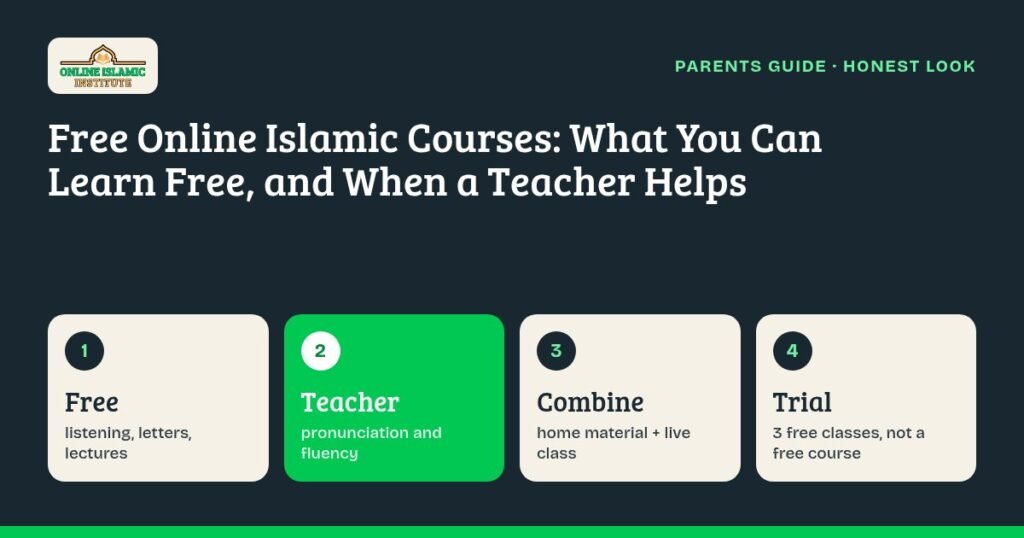
There is a lot of free Islamic learning online, and some of it is excellent. Recitations by well-known qaris, lectures, apps that teach the Arabic alphabet, printable Qaida pages. If money is tight, or you just want to explore before committing, you can learn a surprising amount without paying anything.
There are also things free material does badly, and it is worth knowing which is which before you spend months on the wrong one. This guide is an honest look at both, from people who run paid classes, so take that into account. We will try to be fair.
What you can learn well for free
- Listening to the Quran. Recordings of skilled reciters are freely available and are one of the best ways to train your ear. Play the same short surah daily and children pick up the rhythm naturally.
- General knowledge. Seerah, stories of the prophets, the basics of wudu and salah, and introductory talks on many Islamic topics are widely available as lectures and articles. Check who is speaking and which school of thought they follow.
- Letter recognition. Alphabet apps, flashcards and printable charts help young children learn the shapes and names of Arabic letters.
- Rule explanations. Written guides and videos explain Tajweed rules clearly. Our own articles, such as the makharij al-huroof guide, are free too.
Where free material struggles
The problem is not the quality of the content. It is that some skills need someone to listen to you.
- Correct pronunciation. A video can show how ح should sound. It cannot tell you that yours sounds like ه. Many readers carry the same mistakes for years because nobody ever corrected them; here are the most common ones.
- Reading fluency. Moving from letters to smooth reading needs lots of reading aloud with feedback, line by line.
- Staying consistent. Free courses are easy to start and easy to drop. A fixed class time with a real person waiting makes a big difference, especially for children.
- Knowing what to do next. With hundreds of free videos, it is hard to know the right order. A teacher simply tells you, and adjusts the next step to what they heard you read today.
A sensible way to combine them
| Goal | Free resources | Where a teacher helps |
|---|---|---|
| Learn the letters | Apps, charts, alphabet songs | Checking each sound is made correctly |
| Read the Quran | Listening to recitations | Reading aloud with corrections, every day |
| Tajweed | Rule explanations and videos | Hearing whether you apply the rules |
| Islamic knowledge | Lectures, books, articles | Questions and guidance, if you want a course |
In practice many families use free material at home, such as a recitation playing in the car, an alphabet app for the little one and stories at bedtime, and pay only for the part that needs a teacher: reading the Quran aloud and being corrected. Our guide on supporting Quran learning at home shows how that home side can work.
Checking who you are learning from
Free content has no admissions desk, so the checking falls to you. For anything beyond recitation, look at who is speaking, where they studied and whether they name their sources. For practical rulings, such as how to pray or fast, notice which school of thought they follow; many families in India follow the Hanafi madhhab, and a video from another school may describe things a little differently without being wrong. When two sources disagree, ask a local scholar or imam you trust rather than picking the one you like better.
If you are an adult with very little time
Free material is tempting when your week is full, because there is no fixed slot. The catch is that “whenever I have time” often becomes never. If reading the Quran is the goal, a short fixed class, even 30 minutes at 6 am or 11 pm, tends to achieve more in a month than a year of saved videos. Use the free material on the commute, and protect the class time for reading aloud.
Questions to ask about any “free course”
- Is anyone actually listening to the student read, or is it recorded only?
- Is it really free, or free for a week before a payment request?
- Who is teaching, and what are they teaching from?
- Is there a clear order of lessons, or just a playlist?
Free trial, not a free course
We should be clear about our own offer. Online Islamic Institute does not run free courses. What we offer is 3 free trial classes: real, live, one-to-one lessons with a teacher, so you can judge the teaching before paying anything. If you continue, fees are ₹4,000 a month, ₹21,000 for six months or ₹36,000 a year for 20 classes a month (see the fee section, and our fees guide on comparing prices fairly).
Our online Islamic courses are Quran courses only: Noorani Qaida, Nazra, Tajweed and Hifz, taught 24/7 in IST with male and female teachers. If you are not sure where to start, see online Islamic courses for beginners; if you are looking for broader subjects like fiqh or seerah, our post on Islamic studies courses explains how they differ.
If you are ready to pay for a teacher, read how to choose online Islamic courses in India first.
Questions
You can learn a lot from free apps, charts and recitations, especially letter recognition and listening. Correct pronunciation and fluent reading are much easier with a teacher who listens to you and corrects mistakes.
Yes, many free videos, apps and printables exist. They work best alongside a live teacher or an adult at home who listens to the child read.
No. We offer 3 free trial classes, live and one-to-one, and you pay only after the trial if you want to continue.
Use the free material, and when you want someone to listen to you read, book 3 free trial classes.