
Picture a seven-year-old in Hyderabad who has spent a year in a group class at the masjid. He can recite Al-Fatiha along with everyone else. But when his mother opens the Qaida at home and points to a single letter, he looks at her blankly. Many parents will recognise that child. Nothing is wrong with him, and nothing is necessarily wrong with his teacher. He has simply learned to follow the voices around him.
That is the heart of the one-to-one vs group question. Both formats can produce good readers. They just work in different ways, and they suit different children at different stages. Here is an honest comparison, written for parents who are trying to decide and do not want a sales pitch.
First, what each format actually looks like
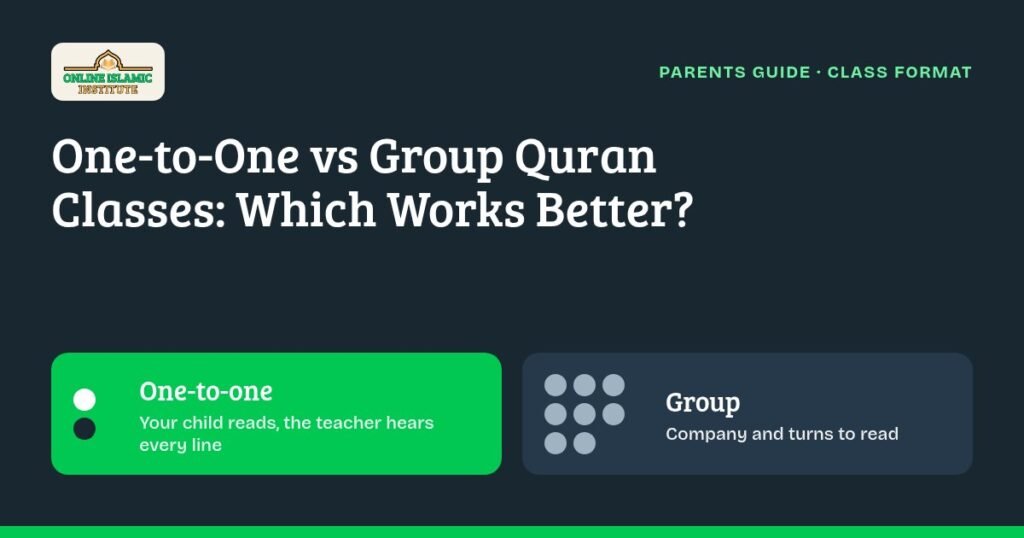
A group Quran class usually has one teacher and several students, anything from four children on a video call to twenty in a masjid hall. The teacher reads, the class repeats, and then students take turns reading alone while the others wait or practise quietly.
One-to-one Quran classes have one teacher and one student. Online, that means a live video lesson where the teacher shares the page, listens to every line the student reads and corrects it there and then. Ours run for 30 minutes, five days a week.
The simple maths of reading time
Quran reading is learned by reading aloud and being corrected. Listening helps, but the real progress happens when the student’s own voice is heard.
Picture a 45-minute group class with eight children. Take away a few minutes for greetings, attendance and the group recitation, and split the rest eight ways. Each child might read alone for four or five minutes. In a 30-minute one-to-one class, the student reads for most of the lesson, with the teacher stopping them at every slip.
That gap matters most at the start. A child learning the difference between س and ص, or how a shaddah changes a word, needs that correction many times over. If you want to see how fine these differences are, our guide to makharij al-huroof shows where each letter is pronounced.
Where group classes genuinely do well
It would be unfair to pretend group classes have nothing going for them. They do, and some families should choose them.
- Friends and a sense of belonging. Children who learn together at the masjid often stay connected to it. That is not a small thing.
- Healthy competition. Some children read better when a classmate has just finished the page before them.
- Lower cost. Group classes, especially community ones, usually cost less per child.
- Listening practice. Hearing others read, and hearing their mistakes corrected, teaches something too.
If your local masjid runs a good group class at a time that works, it can be a fine choice, particularly for a confident child who already reads. We compared that option in more detail in online Quran classes vs a local madrasa.
Where one-to-one classes pull ahead
Beginners at the letter stage
In the Noorani Qaida stage every sound is new. A teacher who hears only a few minutes of each child cannot catch every wrong letter, and wrong letters harden into habits. One-to-one teaching catches them on the first day.
Quiet or shy children
Every group has the child who reads loudly and the child who mumbles and hopes nobody notices. The quiet one often falls behind without anyone realising. Alone with a teacher, there is nowhere to hide, and, just as important, nobody to feel embarrassed in front of.
Children who learn faster or slower than the class
A group moves at the pace of the middle. The quick child gets bored and the slower one gets lost. In a private class the lesson moves exactly as fast as your child does, whether that means three lines a day or a full page.
Tajweed and Hifz
Once students reach Tajweed, the details become finer: the length of a madd, a light ghunnah, a hidden noon. In Hifz, the teacher must hear the new lesson and the revision every day. Both work far better when the teacher is listening to one person.
Families with tricky timings
A group class starts when the group starts. If your daughter’s school bus drops her at 3:15 and tuition begins at 4:30, the 4:00 masjid batch is out of reach. A one-to-one class can sit wherever there is a free half hour, because we run classes 24/7 in IST.
A quick way to decide
| Your child… | Usually better in |
|---|---|
| is just starting the Arabic letters | One-to-one |
| is shy or easily distracted in a group | One-to-one |
| reads confidently and enjoys company | Either; a group can work well |
| is learning Tajweed rules or doing Hifz | One-to-one |
| has a packed school and tuition timetable | One-to-one, at a time you choose |
| needs a female teacher and none is local | One-to-one online |
Some families do both: a weekend group at the masjid for company and adab, and a weekday private class for focused reading. That mix often works beautifully.
What to look for in a one-to-one teacher
Private teaching is only as good as the teacher. Watch whether they let your child read most of the time, or talk most of the time. Ask how they correct mistakes and what they ask your child to practise before the next class. Our list of questions to ask an online Quran teacher covers this properly. If you want a lady teacher for your daughter or for yourself, read about learning with a female Quran teacher online; at Online Islamic Institute, male and female teachers are available at any time.
How our one-to-one classes work
We only teach one-to-one. Every class is live, 30 minutes long, five days a week, which comes to 20 classes a month. Students start with Noorani Qaida, move to Nazra Quran online for fluent reading, and can go on to Tajweed and Hifz. You can see all our online Quran classes in India on the homepage.
The fee is ₹4,000 a month, ₹21,000 for six months (₹3,500 a month) or ₹36,000 a year (₹3,000 a month), the same for every course. Our guide to online Quran class fees in India explains how that compares, and the full plans are in the fee section. Before you pay anything, your child gets 3 free trial classes.
One-to-one Quran classes: parents’ questions
For beginners, shy children, Tajweed and Hifz, usually yes, because the teacher hears every line. Confident readers who enjoy company can do well in a good group class too.
Our classes are 30 minutes, live, five days a week, which makes 20 classes a month.
For most children, yes. Thirty focused minutes of reading aloud with correction is often more useful than a longer class spent waiting for a turn.
Yes. The teacher checks your child’s reading during the free trial and picks up from where they really are, which may mean revising a few Qaida lessons first.
They usually cost more per child than community group classes. With us the fee is ₹4,000 a month, less on six-month or yearly plans, and you pay only after 3 free trial classes.
The easiest way to settle the question is to watch it happen. Book 3 free trial classes, sit beside your child for the first one, and count how many minutes they actually read aloud. That number usually tells you everything.