
Type “online Islamic courses for beginners” into Google and you get a wall of options: Arabic grammar, fiqh, seerah, aqeedah, hadith, “complete Islamic studies” diplomas. For someone starting out, or a parent choosing for a child, it is hard to know where the first step actually is.
Our view, and we will be upfront that it is also the only thing we teach, is that for most beginners the first step is the Quran itself: learning to read it correctly. Here is why, what a beginner’s Quran course looks like, and how to tell whether you are ready for something more.
What “beginner” usually means
People searching for beginner Islamic courses tend to fall into a few groups:
- Parents of young children, looking for a first structured class.
- Adults who never learned to read Arabic, or learned as children and forgot.
- Reverts and people returning to practice, who want to start properly this time.
- Women at home who want a private, flexible class with a female teacher.
What almost all of them share is that they cannot yet read the Quran comfortably from the page. That is the gap a beginner course should close first.
Why start with reading the Quran
A few practical reasons, beyond the obvious one that the Quran is the centre of everything else:
- You use it every day. Salah is recited from the Quran. Reading correctly improves something you already do five times a day.
- Other subjects build on it. Tafseer, Arabic and most Islamic studies courses assume you can at least read the Arabic text.
- It is a skill, not just knowledge. You can learn facts from a book or a video. Reading aloud correctly needs a teacher who listens and corrects, which is exactly what a live class is good for.
- Progress is visible. Going from letters to joined words to a full ayah is motivating, especially for children.
The beginner path, step by step
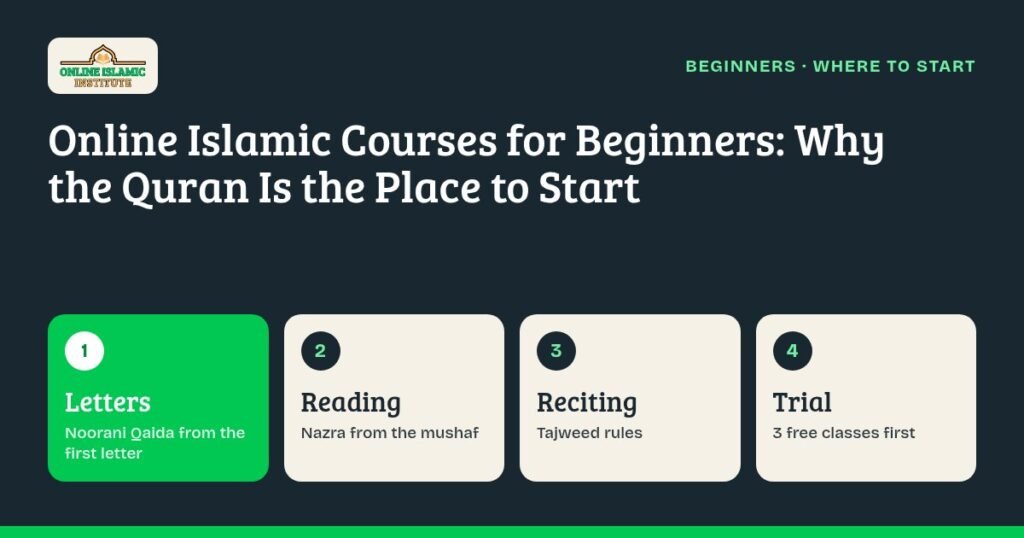
| Stage | What you learn | Our course |
|---|---|---|
| 1. Letters and sounds | Arabic letters, where each sound is made, short vowels, sukoon, shaddah, long vowels | Noorani Qaida online |
| 2. Reading from the mushaf | Moving from exercises to real pages, slowly then smoothly | Nazra Quran online |
| 3. Reciting correctly | Tajweed rules: ghunnah, madd, qalqalah, noon sakin and more | Online Tajweed classes |
You do not need to finish one stage perfectly before thinking about the next, but you do need the letters to be solid before moving on. Our guide to Noorani Qaida lessons shows the usual order, and how to learn Noorani Qaida online covers how the classes work.
What the first weeks look like
In a one-to-one class five days a week, the start usually goes like this. In the trial the teacher works out where you are: some “complete beginners” turn out to remember a lot. Then come the letters, a few at a time, with lots of saying them back, followed by the short vowels and, step by step, joining letters into words. Nobody hands you a timetable on day one, and that is a good sign; how fast it goes depends on things like practice and attendance; how long it takes to learn to read the Quran explains the factors.
A first class needs very little: a phone, tablet or laptop on a stand, earphones with a mic, and a quiet corner (here is a setup checklist).
For reverts and people coming back to practice
If you have recently accepted Islam, or are returning after years away, it is easy to feel you have to learn everything at once. You do not. Salah, a few short surahs and the ability to read the Quran slowly from the page will carry you a long way, and a patient teacher can start exactly where you are, without judgement.
For adults starting late
If you are an adult beginner, you are in very good company. Many people start, or restart, in their 30s, 40s and later. One-to-one classes mean no classroom of children and no one hearing your mistakes but the teacher. See learning Quran online as an adult and Noorani Qaida for adults. Women who would like a female teacher can read about our online Quran classes for ladies.
For children
Children usually start with the Qaida too, in short, cheerful lessons with a parent nearby. Our online Quran classes for kids page explains how children’s classes run, and our post on online Islamic courses for kids looks at the choices parents face.
What we teach, and what we do not
To be clear about it: Online Islamic Institute teaches Quran courses only. Our online Islamic courses are Noorani Qaida, Nazra, Tajweed and Hifz. We do not run Arabic grammar, fiqh or general Islamic studies programmes. If those are what you are after, look for a teacher who specialises in them. Many people find a reading foundation makes those classes far easier, so the two often go well together.
How to choose a beginner course
- Live and one-to-one, so someone hears every letter you say.
- A trial before paying, so you can judge the teacher.
- Timings that fit your real week, including late nights or early mornings.
- Clear fees, with the number and length of classes stated.
- A choice of male or female teacher, if that matters to you.
Our classes are 30 minutes, five days a week, at any time 24/7 in IST, with male and female teachers available any time. Fees are ₹4,000 a month, ₹21,000 for six months or ₹36,000 a year (see the fee section), and every beginner starts with 3 free trial classes.
Most beginners start with our Noorani Qaida online course. It is the first of four Quran courses at our online Islamic institute, taught one-to-one in IST.
Comparing providers? Our guide to choosing online Islamic courses in India lists six things to check before you pay.
Beginner questions
For most beginners, a course that teaches you to read the Quran correctly, starting with Noorani Qaida. Reading the Quran is used every day in salah and is the base for most other Islamic subjects.
No. A Noorani Qaida course starts from the very first letter, and you do not need to understand Arabic to learn to read the Quran correctly.
No. We teach Quran courses only: Noorani Qaida, Nazra, Tajweed and Hifz, live and one-to-one.
Starting from zero is fine. Book 3 free trial classes and read your first letters with a teacher this week.