
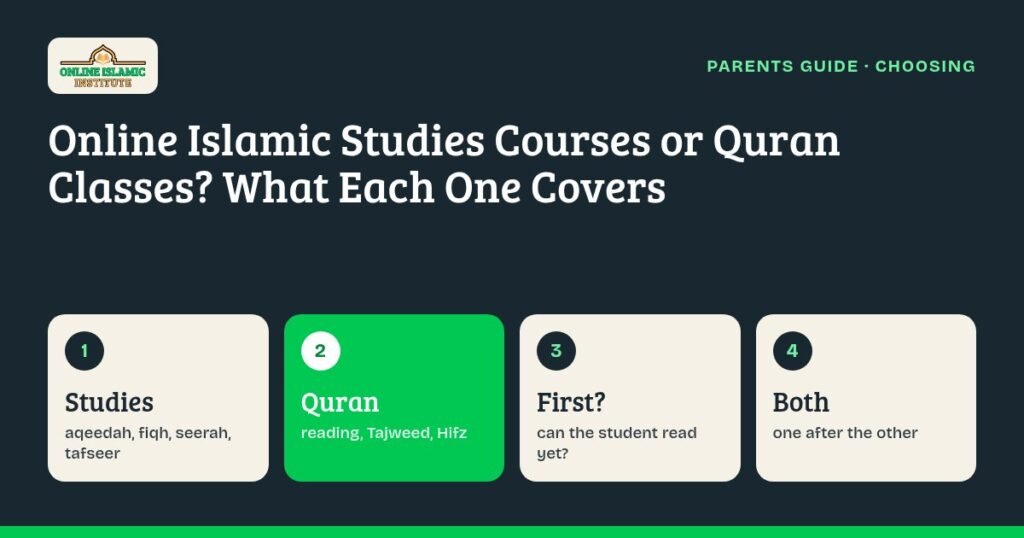
Picture a parent searching for “online Islamic studies” for a nine-year-old. Ask what they really want, and the answer is often simpler than the search: read the Quran properly first, then learn some duas and the basics of salah. That is a very common situation. “Islamic studies” is a wide label, and it helps to know what is inside it before you sign up for anything.
So here is a plain guide to what online Islamic studies courses usually cover, how they differ from Quran classes, and how to decide which one you, or your child, actually need right now. We will be honest about our own place in this too: we teach Quran courses only.
What “Islamic studies” usually includes
Every provider packages it differently, but most Islamic studies courses draw from the same subjects:
| Subject | What it is about |
|---|---|
| Aqeedah | Core beliefs: Allah, the prophets, the unseen |
| Fiqh | How to practise: wudu, salah, fasting, zakat, everyday rulings |
| Seerah | The life of the Prophet ﷺ |
| Hadith | The sayings and practice of the Prophet ﷺ |
| Tafseer | Explanation of the meaning of the Quran |
| Akhlaq and adab | Character, manners and daily duas |
| Arabic language | Grammar and vocabulary to understand the text |
Some courses for children mix a little of each with stories and activities. Some adult programmes go deep into one subject, such as fiqh, with a particular school of thought. In India, many families follow the Hanafi madhhab, so it is worth asking which school a fiqh course teaches.
What Quran classes cover
Quran classes are narrower and more practical. They teach a skill: reading and reciting the Quran correctly, and for some students memorising it. In our case that means four courses:
- Noorani Qaida: the Arabic letters, vowels and joining, from the very first letter.
- Nazra: reading fluently from the mushaf (what Nazra means).
- Tajweed: the rules of correct recitation (the basics).
- Hifz: memorising the Quran with a revision plan.
The key difference
Islamic studies is mostly about knowledge: you learn things you could, in principle, read in a book. Quran reading is a skill: you only get it right by saying it aloud and being corrected, again and again. That is why Quran classes work best live and one-to-one, while some Islamic studies content works fine in a group or even as recorded lessons.
Which one first?
There is no single rule, but these questions help:
- Can the student read the Quran from the page? If not, a reading course usually comes first. Tafseer and Arabic classes assume you can read the text, and salah is recited from it every day.
- How old is the child? Young children learn sounds easily, so the Qaida is a natural first class. Stories of the prophets and simple duas can come from home alongside it.
- What is the real goal? “I want to understand what I recite” points to tafseer or Arabic later. “I want to recite correctly in salah” points to Tajweed now.
- How much time is there? Two demanding courses at once after school and tuition rarely works. One steady class beats two abandoned ones.
A lot of the everyday material, such as the duas for eating and sleeping, the steps of wudu and salah, and stories of the prophets at bedtime, is learned at home long before any formal course. If that is happening already, a structured class for the part that genuinely needs a teacher, reading the Quran aloud, is often the best use of the time and fees.
Many families end up doing both, one after the other: Quran reading first, Islamic studies once the child or adult reads comfortably. Our post on online Islamic courses for beginners walks through that starting point, and for parents the post on online Islamic courses for kids looks at the options by age.
What to look for in any online Islamic course
- A clear syllabus. What exactly will be covered, in what order?
- Who teaches, and how. Live or recorded? Group size? Can you choose a male or female teacher?
- For fiqh, the school of thought. Ask, so there are no surprises at home.
- A trial. Watching a real class tells you more than any brochure.
- Honest claims. Be wary of big promises about how fast you will “complete” Islam in a course.
Local madrasas and masjid classes often teach a mix of Quran and Islamic studies, and for many families that is a good option; here is how they compare with online Quran classes.
Where we fit
Online Islamic Institute is focused on one thing: the Quran. Our online Islamic courses are Quran courses, taught live and one-to-one, 30 minutes a day, five days a week, at any time 24/7 in IST, with male and female teachers. We do not teach fiqh, aqeedah or Arabic grammar as separate subjects. Fees are ₹4,000 a month, ₹21,000 for six months or ₹36,000 a year (see the fee section), with 3 free trial classes first. If you are wondering why so many people put Tajweed early on their list, read about the benefits of learning Tajweed.
Questions
Usually aqeedah (beliefs), fiqh (practice), seerah, hadith, tafseer, akhlaq and sometimes Arabic. Each provider mixes them differently.
If your child cannot yet read the Quran from the page, a Quran reading course usually comes first. Islamic studies can follow once reading is comfortable, or run lightly alongside at home.
No. We teach Quran courses only: Noorani Qaida, Nazra, Tajweed and Hifz.
Yes, much of it works well in groups or recorded lessons. Quran reading is different, because each student needs to be heard and corrected individually.
If reading the Quran is the first step for you or your child, book 3 free trial classes and start there.