
Plenty of people read the Quran every day without studying Tajweed, and they love it. So when someone suggests “you should learn Tajweed”, it can sound like being told your reading is not good enough. That is not really the point.
Tajweed simply means reading each letter the way it was revealed and taught: from its proper place, with its proper qualities, and with the rules that apply when letters meet. Here is why it is worth the effort, for children and adults alike, without any of the guilt.
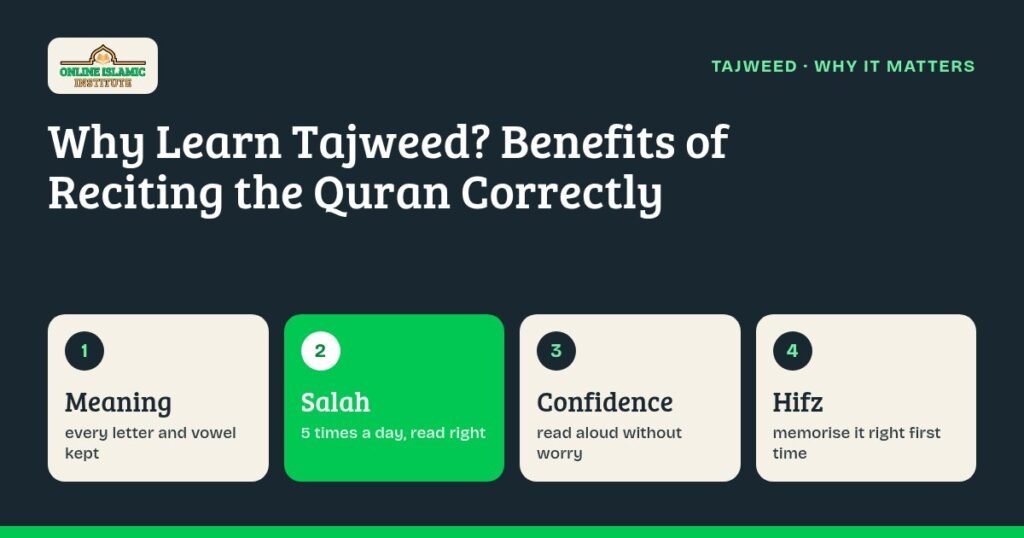
1. The words keep their meaning
Arabic is precise. Change one letter or one vowel and you can end up with a different word. قَلْب (heart) and كَلْب (dog) differ only in the first letter. In Surah Al-Fatiha, أَنْعَمْتَ (“You have favoured”) becomes “I have favoured” if the last vowel changes. Tajweed is, before anything else, the discipline of not making those changes. Our list of common recitation mistakes shows the ones people in India make most.
2. It is how the Quran asks to be read
Allah says in Surah Al-Muzzammil (73:4): وَرَتِّلِ الْقُرْآنَ تَرْتِيلًا, “and recite the Quran with measured recitation”. Scholars have long explained tarteel as reading slowly and clearly, giving the letters their due. Tajweed is the practical way of doing that.
And there is real encouragement for those still learning. In a hadith reported by Bukhari and Muslim, the Prophet ﷺ said that the one who is skilled in the Quran will be with the noble, righteous scribes, and the one who reads it with difficulty, stumbling over it, will have two rewards. So the effort itself counts, from the very first lesson.
3. Your salah benefits
Most of what we recite in salah is Al-Fatiha and short surahs from Juz Amma, read many times a day. Fixing a handful of letters and rules in those surahs improves something you do five times a day for the rest of your life. That is a very good return on a few weeks of focused practice. If you lead your family in prayer, it matters even more.
4. Confidence to read aloud
Lots of adults read silently, or very quietly, because they are not sure they are reading correctly. Once you know the rules, that worry fades. Reading aloud at a family gathering, in a Ramadan khatm, or simply with your children stops being something to avoid.
5. Memorising is easier, and cleaner
If you plan to memorise even a few surahs, learn them correctly the first time. A mistake memorised is very hard to unlearn; you will recite it the same way for years. This is why Hifz students are taught Tajweed early on. See our tips on how to memorise the Quran and the online Hifz classes page.
6. You start to hear the recitation you love
After a few weeks of Tajweed, listening to a good qari changes. You notice the two-count hum of a ghunnah, the six-count stretch of a madd lazim, the little bounce on a qalqalah letter. It feels a bit like learning the notes behind a song you have always known. The madd rules are often the moment this clicks.
7. Children pick it up naturally
Young children copy sounds very well. A child who learns ح and ع properly in the Qaida never has to fix them later. Adults who learned without Tajweed often spend months unlearning “Urdu” pronunciations. Starting right is simply easier.
8. A skill that keeps growing
Tajweed is not one course you finish. Alongside the rules, families ask about pace; Tajweed vs tarteel separates those ideas and the speeds tahqeeq, tadweer and hadr. The basics, such as clear letters, short and long vowels, ghunnah, the noon sakin rules, take a while to settle, and after that there is always a little more polish. Many people find it one of the most satisfying things they learn as adults, because they can hear themselves improve.
What learning Tajweed involves
| Stage | What you work on |
|---|---|
| Letters | Where each letter is made and its qualities (makharij al-huroof) |
| Vowels | Short vowels clean, long vowels held for the right count |
| Core rules | Noon sakin and tanween, meem sakin, ghunnah, qalqalah |
| Madd | The different lengths of stretching |
| Stopping | Where to stop and start, and the waqf signs in your mushaf |
Our Tajweed rules for beginners overview walks through these, and how to learn Tajweed online covers a sensible order for study.
Common worries
- “My voice is not good.” Tajweed is about accuracy, not a beautiful voice.
- “I am too old.” Adults learn Tajweed all the time; see learning Quran as an adult.
- “I do not understand Arabic.” You do not need to. Tajweed is about pronunciation, and you can learn it before or alongside meaning.
- “I would prefer a female teacher.” That is easy to arrange; see our classes for ladies.
Learn Tajweed one-to-one
Our online Tajweed classes are live and one-to-one: 30 minutes, five days a week, at any time 24/7 in IST, with male and female teachers. The teacher listens to every line and corrects as you read. Fees are ₹4,000 a month, ₹21,000 for six months or ₹36,000 a year (see the fee section), and you start with 3 free trial classes. It is part of our online Quran classes in India.
FAQ
Tajweed keeps each letter and vowel correct, so the words keep their meaning. It is also how the Quran asks to be recited, with clear, measured recitation.
No. Anyone who reads the Quran benefits, especially in salah, where the same surahs are recited many times a day.
No. Tajweed is about pronunciation and recitation rules, which you can learn without understanding Arabic.
Children learn the basics of correct pronunciation from the Noorani Qaida itself. Fuller Tajweed rules usually come once they read fluently from the mushaf.
Curious how your recitation sounds to a teacher? Book 3 free trial classes and recite Al-Fatiha in the first one.