
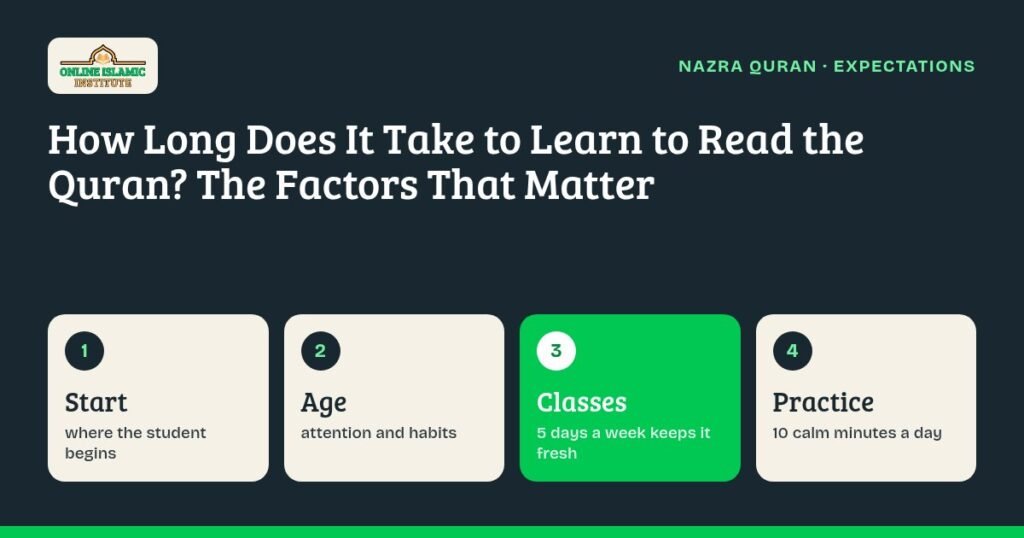
It is the first question almost every parent asks, and most adult beginners too: “How long will it take?” It is a fair question. You are planning time, money and a child’s routine around it.
The honest answer is that nobody can give you a number before hearing the student read, and anyone who promises one without that is guessing. What we can do is explain what learning to read the Quran actually involves, and the handful of things that make it faster or slower. Once you know those, you can make a good estimate for your own situation, and your teacher can refine it after the trial.
What “learning to read the Quran” means
People mean different things by it, so it helps to split it into stages:
- Letters and joining (Noorani Qaida). Recognising the Arabic letters, their sounds, the short vowels, sukoon, shaddah and long vowels, then joining them into words. Our Noorani Qaida lessons guide lists the usual order.
- Reading from the mushaf (Nazra). Moving from Qaida exercises to real pages, slowly at first, then more smoothly. Here is what Nazra involves.
- Reading fluently and correctly (Tajweed). Applying the rules, such as ghunnah and madd, consistently. This keeps improving for years, even for good readers.
Most families mean the first two: “my child can open the mushaf and read it by themselves”. That is a realistic and very worthwhile first goal.
The factors that change the pace
1. Where the student starts
Someone who learned the Qaida as a child and stopped is not starting from zero, even if they feel rusty. Their letters come back quickly. A complete beginner needs every step. Adults are often surprised how much they remember; see Noorani Qaida for adults.
2. Age and attention span
A four-year-old and a fourteen-year-old learn very differently. Very young children manage short lessons and need lots of repetition. Older children and adults can cover more in a sitting but may have more “Urdu habits” to unlearn. Neither is better; the pace is just different. Our guide on the right age to start goes into this.
3. How often classes happen
This one matters a lot. Two classes a week with gaps in between means the first part of each class is spent remembering the last one. Classes five days a week keep the letters fresh, so each lesson builds on the one before. Missed weeks during holidays and exams slow things down more than people expect.
4. Practice between classes
Ten calm minutes a day of reading back the lesson makes a large difference, especially for children. Without it, the teacher spends class time re-teaching. Our post on supporting Quran learning at home has a simple routine.
5. One-to-one or a group
In a group of eight, each child reads aloud for a few minutes. In a one-to-one class they read for most of the session, and every mistake is caught. More reading time, more corrections, faster progress.
6. Accuracy versus speed
A student who rushes ahead with shaky letters often has to come back and fix them, which takes longer overall. A student who gets each letter right before moving on can look slower early, and then speeds up. Our list of common recitation mistakes shows what tends to go wrong when foundations are rushed.
7. One script, one book
Most Indian families read the Indo-Pak script. Switching between that and a Madani (Uthmani) mushaf partway through can confuse beginners for a while. Pick one with the teacher and stay with it.
A quick self-estimate
| If this sounds like you… | Expect… |
|---|---|
| Complete beginner, classes 5 days a week, short daily practice | Steady progress through the Qaida, then a gradual move into Nazra |
| Learned as a child, stopped years ago | A quick Qaida refresher, often moving into Nazra sooner than expected |
| Reads slowly with mistakes | Mostly Nazra practice with corrections, then Tajweed |
| Reads fluently, unsure of the rules | Straight into Tajweed |
| Classes often missed, no practice | Slow progress at any age |
Notice there are no months in that table. That is deliberate. Two children with the same age and timetable can move at very different speeds, and that is fine.
Better questions than “how long?”
Instead of a finish date, watch for signs that things are working: A full first reading ends in a Quran khatam; that guide covers the path and the day, still without promised durations.
- Fewer pauses per line than last month.
- Letters that used to be mixed up now come out right without prompting.
- Short vowels clean and long vowels held properly.
- Your child (or you) opening the book without a fight.
Ask the teacher for a short update every few weeks: where the student is now, what is next, and what to practise at home.
Adults and busy schedules
Adults usually move through the early stages quickly because they understand instructions and can practise on their own. What slows them down is time. A slot you can protect most days, even at 6 am or 11 pm, is worth more than an ambitious plan you keep missing. See learning Quran as an adult and Quran classes for working professionals.
How our classes are set up
Our online Quran classes in India are live and one-to-one: 30 minutes a day, five days a week, 20 classes a month, at any time 24/7 in IST, with male and female teachers. Beginners start with Noorani Qaida online, move to Nazra Quran online, and then Tajweed. Fees are ₹4,000 a month, ₹21,000 for six months or ₹36,000 a year (see the fee section). The teacher checks the student’s level in the 3 free trial classes and can then give you a realistic idea of the next steps.
Questions
It depends on where the student starts, their age, how often they have classes, how much they practise and whether classes are one-to-one. A teacher can give a realistic idea after hearing the student read.
Adults often move through the early stages faster because they can follow instructions and practise alone, but they have less time. Children need more repetition but often build very natural pronunciation.
Yes. A short daily read-through of the lesson keeps letters fresh, so class time goes on new material instead of re-teaching.
Usually, yes. Moving to the mushaf with weak letters makes every page a struggle. Your teacher will tell you when the student is ready.
Often, if your joining and vowels are solid. The teacher checks this in the trial and may suggest a short refresher instead of the whole book.
Want a realistic answer for your own child or yourself? Book 3 free trial classes and ask the teacher after the third one.