
It usually starts well. The first few weeks, your child is at the screen five minutes early, Qaida open, showing off a new letter to anyone who walks past. Then, somewhere around week six, “Ammi, five more minutes” turns into “Do I have to?”
That dip is normal. It happens with piano, swimming, school maths, everything. It is not a sign that your child does not love the Quran or that online classes are failing. It is a sign that the novelty has worn off and the real work has started. Here is what tends to help, from parents who have been through it and teachers who see it every week.
First, find out why
“Not motivated” covers a lot of different problems, and each has a different fix. Before changing anything, watch one class quietly and talk to your child afterwards. Most cases fall into one of these:
| What you notice | Likely reason | Try this |
|---|---|---|
| Yawning, slumped, eyes drifting | Wrong time of day | Move the class away from straight-after-school or late night |
| Gets upset when corrected | The work feels too hard, or corrections feel harsh | Ask the teacher to slow down and revise; check the tone |
| Rushes, bored, “I know this” | The work feels too easy | Ask whether they are ready for the next step |
| Fine in class, refuses practice | Practice has become a fight at home | Shorter practice, tied to a fixed routine |
| Says “I don’t like Sir/Ma’am” | The fit with the teacher | Talk to us about a change of teacher |
Make it theirs
Children work harder for things that feel like their own. Small things make a difference:
- Let them choose their own Qaida cover, bookmark or rehal.
- Give them a “Quran corner”, even if it is one shelf and a cushion.
- Let them pick the class slot between two options you are happy with.
- Ask them to teach you the letter they learned today. Being the teacher is very motivating at seven.
Show progress they can see
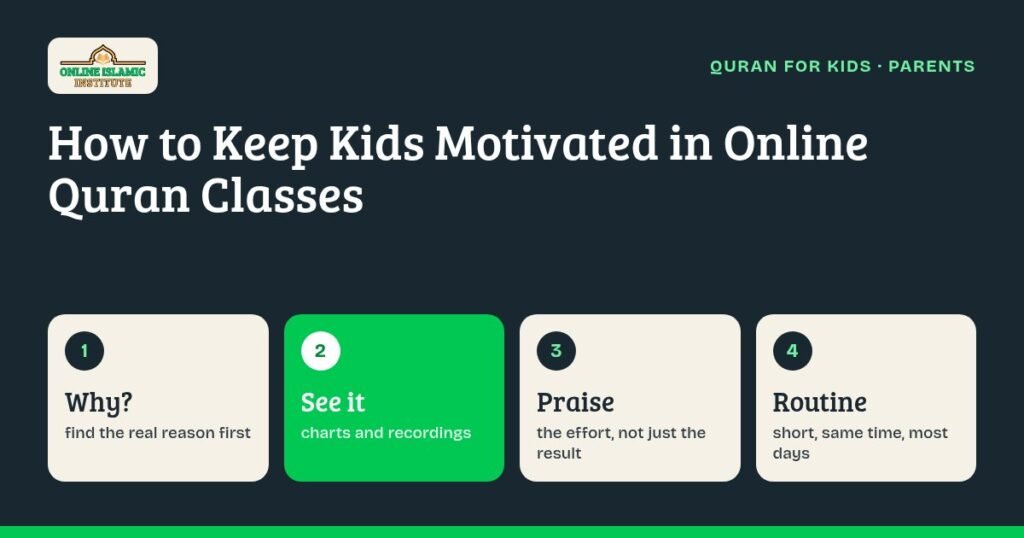
A child cannot feel progress the way adults can. “You are reading better” means little. A chart on the wall means a lot. Put up the Qaida lesson numbers, or the surahs of Juz Amma, and let your child colour one in each time it is done. Our list of short surahs for kids to memorise gives a good order for the chart. For older children doing Nazra, a simple page counter works.
Once in a while, play a recording from their first week next to one from today. The difference is usually obvious, and children are amazed by it.
Praise the effort, not just the result
“Well done, you finished the page” is fine. “I heard you go back and fix that ح by yourself” is better, because it praises something the child controls. Children who are only praised for getting it right start avoiding anything they might get wrong. Children praised for trying keep trying.
Be careful with rewards. A small treat at a milestone, like finishing the Qaida, is lovely. Paying for every lesson tends to turn the Quran into a job, and the effort stops when the payments do.
Keep comparisons out of it
Family WhatsApp groups and Eid gatherings are full of “my nephew has finished three paras already”. Your child hears all of it. Every child learns at a different pace, and a rushed child who starts to dread the mushaf has lost more than a slow one who loves it. Our guide on the right age to start learning Quran talks about this too.
Let them see you with the Quran
This one is uncomfortable but true: children copy what they see far more than what they are told. If they see you reading, even a few lines after Fajr, Quran time looks like something grown-ups choose to do, not a punishment for kids. If your own reading is rusty, there is no shame in learning alongside them; plenty of parents do.
Small routines beat big speeches
Motivation goes up and down. Routine carries you through the down days. Tie practice to something that already happens every day, keep it short, and keep it at the same time. Our post on supporting your child’s Quran learning at home has a simple 10 to 15 minute routine.
- Same time, same place, most days.
- Short enough that they stop wanting a little more.
- No screens or games waiting “after one more page” as bait.
- A day off when they are ill or exams are on, without guilt.
Work with the teacher
A good teacher wants to know when a child is losing interest. Tell them what you have noticed. They can change the pace, add a little revision so the child feels confident, use a short story behind a surah, or set a small goal for the week. In a one-to-one class the teacher can adjust to your child in a way a big batch cannot, and that is one of the main reasons families choose it (here is a comparison with the local madrasa).
If the problem is the fit with the teacher, say so. It is not rude. A child who looks forward to seeing the teacher learns much more than one who dreads it, and our guide on choosing an online Quran teacher lists what to look for.
For older children and teens
Teenagers need different things. They want reasons, not rules. Talk about why the Quran matters to you. Give them more say in the goal: some teens get very motivated by Tajweed, because it is a skill they can hear themselves improve; others like a memorisation goal, such as Juz Amma (see our tips on how to memorise the Quran, and the Hifz guide for parents if they want to go further). Respect their timetable, especially in board exam years.
When to take a break
If there are tears every single day for weeks, something is wrong, and pushing harder rarely fixes it. A short pause, a change of time or teacher, or simply going back to easier material for a while can reset things. For very young children, waiting a few months is sometimes the kindest option.
How our classes help
Our online Quran classes for kids are live, one-to-one and 30 minutes long, five days a week, at any time 24/7 in IST, with male and female teachers. Most young children start with Noorani Qaida. Parents can sit in, and you can ask to change the time or the teacher. Fees start at ₹4,000 a month (less per month on longer plans, see the fee section), and every new student starts with 3 free trial classes before you pay anything. It is all part of our online Quran classes in India.
Parents ask
First find out why: watch a class and talk to your child. The usual reasons are the wrong time of day, work that feels too hard or too easy, or the teacher fit. Each has a simple fix.
Small rewards at milestones, like finishing the Qaida, are fine. Avoid paying for every lesson, which can turn it into a job. Specific praise for effort works better day to day.
For most young children, 10 to 15 minutes of calm practice is plenty. Keep it short and at the same time each day.
You can ask. Tell us what is not working and we will try to arrange a different teacher, male or female, at a time that suits you.
If you think a fresh start might help, book 3 free trial classes and see how your child gets on.