
Someone in the family WhatsApp group forwards a number. “Very good Quran teacher, teaches online, my neighbour’s kids learn from him.” You save it, and then you sit there wondering what you’re supposed to ask.
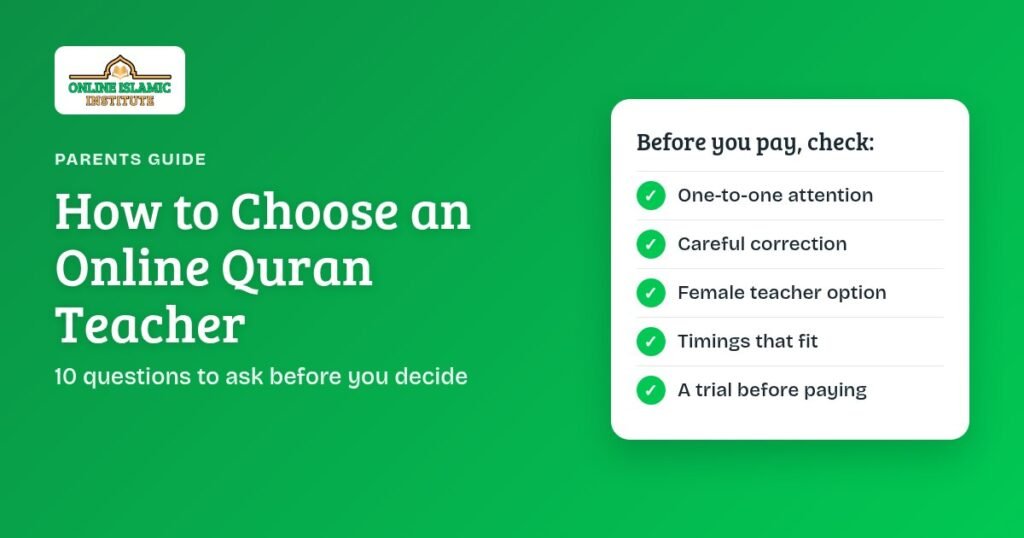
Choosing a Quran teacher is a bigger decision than it looks. This person will spend hours with your child every month, shape how they pronounce every word of the Quran, and, honestly, shape how they feel about learning it. Here are the questions worth asking before you commit, whether you go with us or with someone else.
10 questions to ask before you choose
1. Will my child get one-to-one attention?
Group classes are cheaper, but in a group of eight children, your child might recite for a few minutes in an hour. For reading and pronunciation, one-to-one makes a big difference because every mistake gets heard. Ask directly: how many students are in each class?
2. Can I sit in on the first few classes?
A good teacher won’t mind at all. Watching a couple of sessions tells you more than any recommendation: how they speak to your child, how they correct mistakes, and whether your child looks relaxed or tense.
3. How do you correct mistakes?
You want someone who stops the student, models the right sound, and makes them repeat until it’s correct, without making them feel small. Some teachers let small errors slide to “keep the flow”. With the Quran, those small errors become habits.
4. Where would you start my child?
A teacher who has actually listened to your child should be able to tell you: start with Noorani Qaida, move to Nazra, or work on Tajweed. If the answer is the same for every child, that’s a sign they aren’t really assessing. (If you’re not sure what these stages mean, our Noorani Qaida guide for parents explains the first step.)
5. Do you teach Tajweed, or just reading?
Plenty of teachers can help a child read. Fewer will teach them to recite with proper Tajweed. Ask how they handle letters that Urdu and Hindi speakers commonly mix up, like ض and “z”, or ق and “k”. Their answer tells you a lot. Our Tajweed rules for beginners post lists the usual suspects.
6. Is a female teacher available?
For daughters, younger children and many sisters learning themselves, this matters. Don’t just ask “do you have female teachers?” Ask whether one is available at the time you actually need. We’ve written more about learning with a female Quran teacher online.
7. Which class timings can you offer?
Indian school timings, tuition, madrasa, office hours and the commute leave odd windows of free time. A teacher who can only do 4 to 6 pm might work for the neighbour and not for you. Check that the slot works on weekdays and during exam season too.
8. What do the fees include, and when do I pay?
Get the full picture: monthly fee, any longer-term plans, how many classes per week and how long each class is. Also ask whether you can try before paying. You shouldn’t have to pay three months in advance for someone your child has never met. (We go through the maths in online Quran classes fees in India.)
9. How will I know my child is improving?
Ask how progress is shared. Some teachers send a quick note after class, others give a short update every few weeks. The format matters less than the habit. You should never have to guess where your child is.
10. Does my child actually like the class?
This one you ask your child, not the teacher. After a week, ask them what they learned and how the teacher talks to them. Kids are honest about this, and a child who looks forward to class will learn faster than one who dreads it.
A few red flags
- The teacher is always on their phone or talks to someone else during class.
- Lessons feel like a race to “finish pages” with very little correction.
- There’s pressure to pay months in advance before a single class.
- Your child becomes nervous or makes excuses to skip class.
- You can’t get a straight answer about timings, fees or who will teach.
One red flag on a bad day isn’t the end of the world. A pattern is.
Online or at home: does it change what to look for?
Mostly no. The same questions apply. Online does add one practical check: the teacher’s audio. If their microphone is muffled or the connection keeps dropping, your child can’t hear the fine differences between letters. That shows up in the first trial class, so pay attention to it.
The upside of online is choice. You’re no longer limited to whoever lives within a few kilometres of your home, and you can find a time and a teacher that genuinely suit your child.
How our answers stack up
Since you’re reading this on our site, here are our own answers to the questions above. At our online Quran institute, every class is live and one-to-one, for Noorani Qaida, Nazra, Tajweed and Hifz. Classes run 24/7 in IST, and both male and female teachers are available at any time. Parents are welcome to sit in.
Fees are ₹4,000 a month, ₹21,000 for six months or ₹36,000 for a year, the same for every course; the fee section on our homepage has the details. And on question 8: every new student gets 3 free trial classes, and you pay only after the trial, if you’re happy.
Quick answers
Two or three classes are usually enough to judge how a teacher explains, corrects and connects with your child. That is why we offer 3 free trial classes before any payment.
For learning to read and recite correctly, one-to-one is usually more effective because the teacher hears and corrects every mistake. Group classes can work for revision or older students who already read well.
It is entirely your family’s choice. Many parents prefer a female teacher for girls, especially as they grow older. Ask whether a female teacher is available at the times you need.
Got that WhatsApp number saved? Ask them these questions. And if you’d like to compare, book 3 free trial classes with Online Islamic Institute and see how we answer them in practice.