
In a lot of Indian neighbourhoods, the evening still has a familiar sound. After Asr, children with caps and dupattas walk to the masjid or the maktab down the lane, Qaida under one arm, and the hum of young voices reading floats out of the windows. Many of us grew up exactly like that.
So when parents ask us whether online Quran classes are “as good as” a local madrasa, we understand the question. It is not really about technology. It is about whether your child will miss something you valued. This post tries to answer it fairly, because the honest answer is that both have real strengths, and the right choice depends on your child and your week.
What a local madrasa or maktab does well
Let us start here, because these strengths are real and worth protecting.
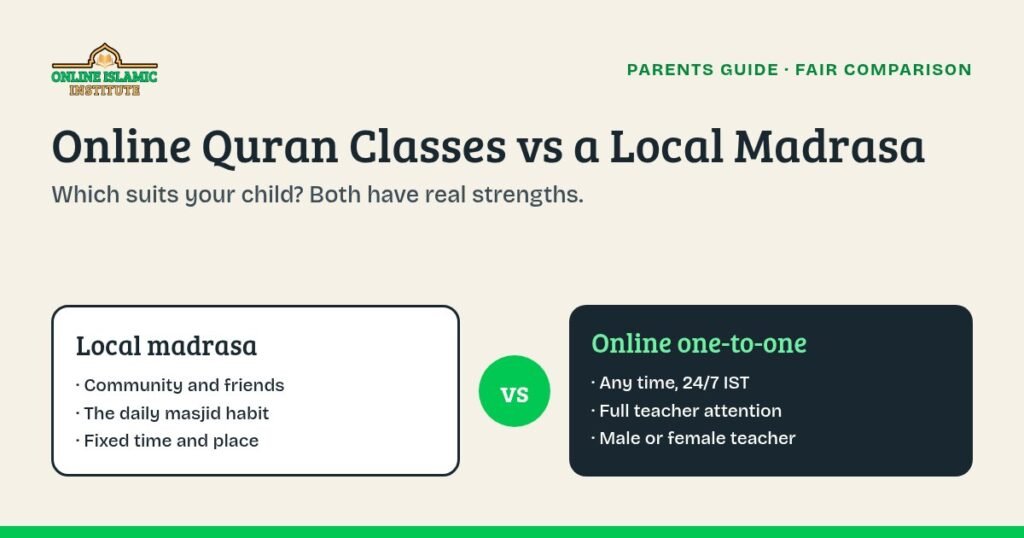
- Community. Children learn alongside friends from the mohalla. They feel part of something bigger than their own home.
- The masjid habit. Walking to the masjid every day builds a bond with it. Many children pray their first jama’at salah because they were already there for class.
- Elders around them. The imam, the older students, the uncles at the gate. Children absorb adab simply by being in that space.
- Structure. A fixed time, a fixed place, a teacher who knows the family. For some children that rhythm works beautifully.
- Affordability. Many local maktabs charge a modest fee or run on community support, which matters for a lot of families.
If you have a good madrasa nearby, with a teacher your child respects and timings that fit, that is a blessing. Nobody should talk you out of it.
Where online classes can help
Online classes exist because many families simply cannot make the local option work, or need something it does not offer. The common reasons we hear:
- Timings. School until 2:30, tuition from 5 to 7, and the maktab slot is right in the middle. Online classes run 24/7 in IST, so the class goes where your day has space.
- Travel. Not every family lives near a masjid with classes. In big cities the drive can be longer than the class, and monsoon roads make it harder still.
- Attention. Batch sizes vary, and in a larger group each child reads aloud for only part of the session. A one-to-one class gives the teacher all 30 minutes with your child. (More on that in our comparison of one-to-one Quran classes and group classes.)
- Choice of teacher. Male and female teachers are available any time, which many families want for daughters as they grow. See female Quran teacher online.
- Parents can see the class. You can sit beside your child or listen from the next room and know exactly what was taught.
- Adults and older beginners. A 13-year-old starting Qaida, or a parent learning alongside their child, may feel more comfortable in a private class.
Side by side
| Local madrasa / maktab | Online one-to-one class | |
|---|---|---|
| Where | The masjid or a nearby centre | At home, on a laptop, tablet or phone |
| Timing | Fixed slot, often after Asr or Maghrib | Any time, 24/7 in IST, agreed with you |
| Group | Usually a group of children | One child, one teacher |
| Community feel | Strong: friends, imam, masjid | Built at home and at the masjid separately |
| Teacher choice | Whoever teaches the batch | Male or female teacher, by your preference |
| Parent visibility | Depends on the madrasa | You can watch or listen any time |
| Cost | Often modest or community-supported | ₹4,000 a month, less on longer plans |
Five questions to help you decide
- Is there a madrasa nearby whose teacher you trust, at a time your child can actually attend?
- Does your child do better in a group, or do they go quiet and let others read?
- How many evenings does school and tuition really leave free?
- Do you want a female teacher for your daughter, and is one available locally?
- Is your child a complete beginner who needs every letter checked, or a confident reader?
If you are leaning towards online, our list of questions to ask an online Quran teacher helps you compare tutors properly. If you are still unsure whether your child is ready to start at all, read the right age to start learning Quran.
You do not have to choose only one
Plenty of families mix the two. A child might attend the Friday or weekend programme at the local masjid for community and adab, and take a weekday online class for focused reading practice. Others use the madrasa for Qaida and switch to online classes later for Tajweed or Hifz, when timings get tighter in higher classes. There is no rule that says a child must belong to one system.
If you go online, keep the community part alive
The thing online classes cannot replace is the masjid itself. So build it in on purpose. Take your child for Jumu’ah. Go together for Maghrib when you can. Let them join Ramadan programmes and Eid gatherings. Introduce them to the imam. The Quran lesson can happen at home while the community bond grows at the masjid, and the two support each other.
It also helps to know what children usually learn first. Our piece on why kids should start with the Quran lays out the path, starting with the Noorani Qaida online course and moving to Nazra. Families considering memorization can read about Hifz for kids at home and these tips on how to memorize the Quran.
What online classes cost with us
Our online Quran classes in India are one-to-one, 30 minutes a day, 5 days a week, 20 classes a month. The fee is ₹4,000 a month, ₹21,000 for six months (₹3,500 a month) or ₹36,000 a year (₹3,000 a month), the same for every course. See the fee plans or our guide to online Quran class fees in India. Every new student gets 3 free trial classes and pays only after the trial. The online Quran classes for kids page has the details for children.
Madrasa or online: common questions
Neither is better for every child. A good local madrasa offers community and the masjid habit; online one-to-one classes offer flexible timings and full attention. Many families use both.
Only if the masjid drops out of family life. Take your child for Jumu’ah, Maghrib and Ramadan programmes so the community bond grows alongside the online lessons.
Yes. Some children go to a weekend masjid programme and take a weekday online class, or switch to online later for Tajweed or Hifz.
Book 3 free trial classes. You pay only after the trial, so you can see how your child responds before choosing.
If you are torn, let your child show you. Book 3 free trial classes, sit nearby for the first one, and compare how they read afterwards with how they feel about the local class. Whichever way you go, the goal is the same: a child who reads the Quran well and loves coming back to it.