
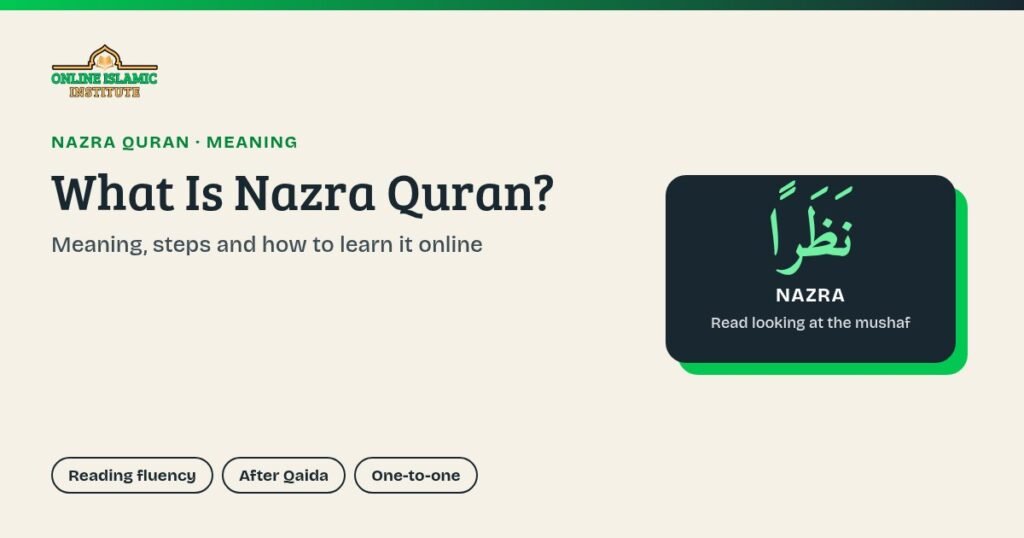
Nazra Quran meaning, in one line: reading the Quran by looking at the page, rather than from memory. In Urdu it is ناظرہ, from nazar (sight), so “Nazra Quran” simply means dekh kar Quran parhna. Nazirah, Nazira and Nazra-e-Quran are the same word spelled differently.
Nazra means reading the Quran by sight, straight from the mushaf, rather than reciting it from memory. You will also see it written Nazirah or Nazira; all three come from the Arabic for looking. If you grew up around a madrasa or a family Quran circle in India, you have probably heard parents say it casually: “Pehle Nazra karwao, phir Hifz.” But if you are new to the terms, or your child is just finishing Qaida, it helps to know what Nazra Quran involves day to day, and how it is different from memorising or from Tajweed.
This post spells it out in plain language: the meaning, the usual steps, and how families learn Nazra online without turning the week upside down. If you already know you want a teacher, our Nazra Quran online classes in India are live and one-to-one.
Want to read Nazra with a teacher? Book 3 free trial classes in our Nazra Quran online classes: one-to-one, 30 minutes, at a time that suits you in IST. Not reading the letters yet? Start with Noorani Qaida online. You pay only if you are satisfied.
Nazra Quran: the simple meaning
Because Nazra is reading while looking at the mushaf, the aim is fluent, accurate reading from the page: recognising words quickly, joining ayahs smoothly, and moving through pages without constant hesitation.
It is not the same as Hifz. In Hifz, the student memorises and recites without looking. It is also not the same as Tajweed study on its own, though a good Nazra teacher corrects basic pronunciation as you go. Think of Nazra as the bridge between knowing the letters and reading the Book with ease.
Nazra Quran meaning in Urdu, and the other spellings
In Urdu, ناظرہ (Nazra) comes from نظر (nazar), sight or looking. That is why Indian and Pakistani families say a child is “Nazra parh raha hai” once they have finished the Qaida and are reading the Quran itself from the mushaf. The opposite is Hifz, which families often call reading zabani, by heart.
| You may see it written as | What it means |
|---|---|
| Nazra, Nazira, Nazirah | Reading the Quran from the page |
| Nazra-e-Quran, Nazra Quran Sharif | The same thing, with an Urdu honorific or “of the Quran” |
| Quran Nazra | The same thing, word order swapped |
| Nazra vs Hifz | Dekh kar (looking) vs zabani (from memory) |
So if a madrasa form asks whether your child has done “Nazra-e-Quran”, it is asking whether they can read the whole Quran from the mushaf, not whether they have memorised it.
Where Nazra sits in the learning path
Most teachers in the subcontinent follow a familiar order:
- Noorani Qaida for letters, vowels, sukoon, shaddah and joined forms. See our Noorani Qaida online guide if you are still at that stage, or the walkthrough of Noorani Qaida lessons for what each page teaches.
- Nazra for reading full surahs and juz from the mushaf with growing fluency.
- Tajweed for deeper rules of correct recitation. When you are ready, how to learn Tajweed online and our beginner Tajweed rules post help map the next step.
- Hifz if the student wants to memorise, ideally after reading is steady (parents considering that path can read our guide to online Hifz classes for kids).
Skipping Qaida and jumping into Nazra with weak letters usually means slow, frustrating pages. Skipping Nazra and jumping into Hifz often means memorising mistakes. The order exists for a reason. The first full Nazra pass ends in a child’s Quran khatam; our guide covers getting there and marking the day simply.
What a Nazra student actually practises
In a typical Nazra lesson, the teacher listens as the student reads a set portion aloud. Corrections cover:
- Letter accuracy (especially pairs Indian speakers mix, like س/ص or ح/ه).
- Short and long vowels so words are not flattened.
- Stopping and starting in sensible places (our guide to the waqf signs in the Quran explains each mark).
- Pace: not so slow that meaning breaks, not so fast that letters blur.
- Gradually longer portions as fluency grows.
Early Nazra often starts with short surahs or the last juz, then moves into longer passages. Along the way students meet the places of prostration marked in the margin, explained in our guide to sajdah tilawat. Some teachers begin from the end of the mushaf; others follow a syllabus their institute uses. Either way, the measure of progress is cleaner, more confident reading, not how many pages were “covered” in a rush.
Nazra vs “just reading at home”
Reading alone at home is valuable. Live Nazra is different because someone stops you when ق slips toward ك, or when you swallow a sukoon. Children especially need that feedback; they cannot hear their own mistakes yet. Adults who grew up reading quickly with soft errors benefit just as much. If that is you, here is how adults can learn Quran online without starting from scratch.
Signs your child (or you) is ready for Nazra
You do not need a formal test. A few practical signs are enough:
- Qaida lessons feel mostly easy; joined words no longer cause a freeze.
- Short surahs from memory are clear, but opening a random page still feels hard.
- The student can sit for a full 30-minute class without constant restlessness.
- You can protect five class days a week around school or work, even if the hour is early or late.
If letters still collapse into each other, stay on Qaida a little longer. Pushing into Nazra too soon makes every page feel like a struggle, and children start to dread the mushaf.
Learning Nazra Quran online
Online Nazra works well for Indian families because the class comes to the dining table. At our online Islamic institute, Nazra Quran online classes are one-to-one, 30 minutes a class, five days a week. Classes run 24/7 in IST, so you can choose early morning before school, a quiet mid-morning slot, or evening after tuition.
Parents can sit in for the first weeks. Many do, then step back once the child knows the routine: mushaf open, headset on, teacher waiting on screen. Male and female teachers are available any time; families who want a woman teacher for a daughter can say so when they enquire (more in our female Quran teacher post).
What you need at home
- A phone, tablet or laptop with a stable connection.
- A headset with a mic so soft letters are audible.
- A clear mushaf (colour-coded Tajweed mushafs are optional at Nazra stage; clarity matters more). If you are choosing between an Indo-Pak or Uthmani (Madani) mushaf, this comparison helps.
- A calm corner for half an hour, five days a week.
A realistic week during school term
Picture a child in Class 5 in Lucknow or Bengaluru: school till mid-afternoon, one tuition class, homework after Maghrib. Nazra still fits if you pick the calmer hour. Some families use 6:30 a.m. before the rush. Others use 8:00 p.m. once homework is done. What fails is a slot that collides with the noisiest part of the day, then blaming the child for not focusing.
How long does Nazra take? (honest answer)
Parents often want a month count. The honest answer is: it depends on how often the student attends, how strong their Qaida was, and how much they revise between classes. A child who reads five days a week with short home practice will move differently from one who misses half the month for exams and travel.
What you can watch instead of a calendar promise: fewer freezes per page, cleaner short vowels, and a willingness to open the mushaf without a fight. Those signs matter more than a target juz number stuck on the fridge. For the factors that set the pace, see how long it takes to learn to read the Quran.
Fees
Nazra uses the same plans as our other courses: ₹4,000 a month, ₹21,000 for six months (₹3,500/month), or ₹36,000 a year (₹3,000/month). Full detail is in the homepage fee section and our fees in India article. You get 3 free trial classes first and pay only after the trial.
If you are still choosing a tutor, keep these teacher questions handy before you commit.
Quick answers about Nazra
Nazra means reading the Quran while looking at the mushaf, with the goal of fluent, accurate reading from the page.
In Urdu, Nazra (ناظرہ) comes from nazar, sight. Nazra Quran means reading the Quran by looking at the mushaf (dekh kar parhna), as opposed to Hifz, which is reciting from memory.
Nazirah, or Nazira, is another spelling of Nazra: reading the Quran from the page. Nazra-e-Quran means the same thing.
No. Hifz is memorisation (often without looking). Nazra is reading from the mushaf. Many students do Nazra before Hifz.
Adults can and do. Anyone who wants to read more fluently from the mushaf benefits from Nazra with a live teacher.
Yes, in most cases. Strong letters and vowels make Nazra far less frustrating.
Live one-to-one video classes where the teacher listens to your reading, corrects mistakes, and sets the next portion. At Online Islamic Institute that is 30 minutes, five days a week, at a time you choose in IST.
Many students finish Nazra and then move on to memorisation. When you reach that point, our online Hifz classes continue with the same one-to-one format, and you can see how our online Quran classes in India work for both children and adults.
If Nazra is the next step for you or your child, you do not need a perfect plan on day one. Book 3 free trial classes, open the mushaf, and let a teacher hear where you are. The path gets clearer after that first honest page.