
Somewhere in a flat in Mumbai or a house in Rampur, a child will one day close the mushaf on the last page of Amma para and look up. That quiet moment is a Quran khatam: the first time they have read the whole Book looking at the text. Families mark it in different ways. The common thread is simple gratitude, not a show.
This guide is about getting there through Nazra, and marking the day without pressure. It does not promise how many months it will take; that depends on age, practice and the teacher, as our page on how long Quran reading takes explains.
What a child’s first khatam means
Khatam (also said khatm) means completing a full reading. For a child, the first one is almost always a Nazra khatam: reading every page while looking, from Al-Fatiha through to An-Nas. It is not the same as a Hifz khatam, where the Quran is memorised. Both are valued; they are different milestones.
If the word Nazra is still fuzzy in your house, start with what is Nazra Quran. In short: fluent reading from the mushaf, with a teacher hearing and correcting.
The path that leads there
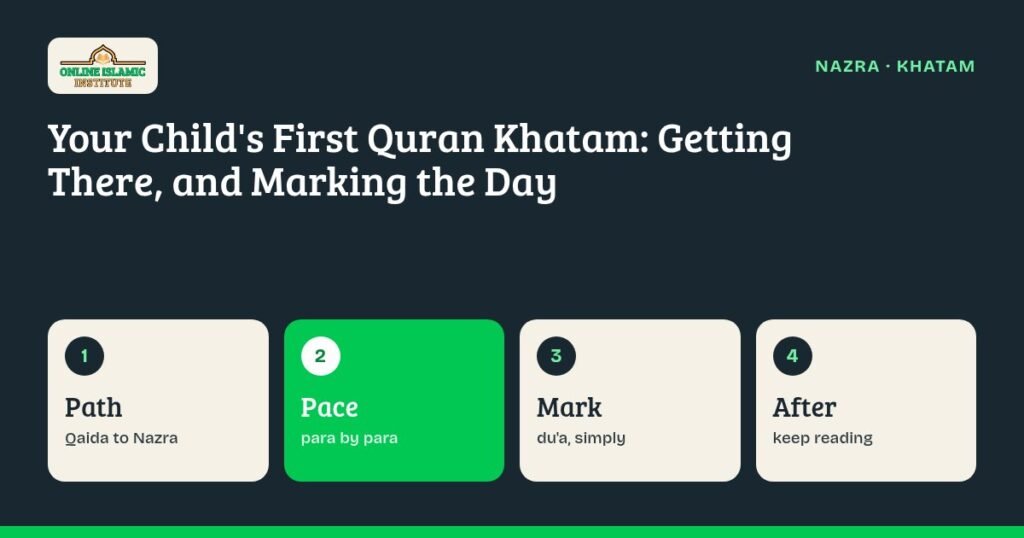
- Noorani Qaida. Letters, vowels, joining. Skipping this makes every later page a struggle.
- Early Nazra. Short surahs and the last para, where children already feel at home.
- Steady paras. Moving para by para (Sayaqool, then the next), with revision of older pages so fluency does not fade. Our list of Quran para names helps you talk about progress the Indian way.
- The closing stretch. The last paras often feel faster because the surahs are shorter, but tiredness is real. Keep the same daily slot.
One-to-one classes help because the child reads for most of the 30 minutes. Five days a week (20 a month) keeps the chain from breaking. Missed weeks after cousins’ weddings or board exams are normal; what matters is returning without shame.
How parents can help without hovering
You do not need to correct every letter. You do need a calm corner, the same mushaf the teacher uses, and a habit of asking once a fortnight: which para are we on, and what should we revise at home? More on that supporting role is in supporting Quran learning at home.
When motivation dips mid-Quran — and it often does around the longer paras — change the reward, not the goal. A sticker chart for pages, a walk after class, or simply sitting with a cup of chai while they read can help. See keeping kids motivated for ideas that stay light.
Marking the day
Customs vary across India. Some families distribute simple sweets, invite grandparents for du’a, or have the child read the last page aloud at home. Others keep it private: a quiet du’a and a phone call to an uncle. Stay general and choose what fits your home. Avoid turning the day into a competition with cousins’ timelines.
A few gentle ideas families use:
- Let the child choose a modest sweet to share after Maghrib.
- Ask the teacher to join a short online du’a on the class link.
- Write the date inside the back cover of the mushaf.
- Start the next intention the following week: deeper Tajweed, or a second reading at a calmer pace — without announcing a race.
After the first khatam
The mushaf should not go back on the shelf. Many teachers begin a second Nazra pass with more attention to Tajweed, or set a light daily page so the skill stays warm. Some children later move toward Hifz; that is a separate decision, not an automatic next step.
If the first khatam felt rushed, the second reading is a chance to slow down. If it felt steady, keep the same timetable so the habit does not break.
Learning Nazra toward that day
Our Nazra Quran online classes and online Quran classes for kids are live and one-to-one: 30 minutes, five days a week, at any time 24/7 in IST, with male and female teachers. The teacher tracks para progress and sets revision so older pages do not slip.
Fees for online Quran classes in India are ₹4,000 a month, ₹21,000 for six months or ₹36,000 a year; see the fee section.
Signs you are getting close
Near the end, children often mix excitement with fatigue. Pages in Amma para are short, so the stack of remaining leaves looks small, yet focus can wander. Keep the same class time. Ask the teacher to set a tiny revision from an earlier para each day so the finish does not erase older fluency.
Watch for steadier breathing at the end of a line, fewer invented vowels, and a child who can tell you which para comes next. Those are better signals than counting calendar months.
If the khatam stalls
Illness, a new baby in the house, or a tough school term can pause Nazra for weeks. When you return, do not restart from Al-Fatiha unless the teacher says the reading has slipped badly. Usually a short revision bridge is enough, then continue from the last solid para.
Avoid comparing your child to a neighbour who “finished in one year”. Houses differ. The useful question is whether this week’s pages are cleaner than last month’s.
Quran khatam: questions parents ask
It usually means the child has read the entire Quran looking at the text (Nazra), from beginning to end, with a teacher’s guidance along the way.
No. Nazra is reading while looking. Hifz is memorisation. A child can complete a Nazra khatam without having memorised the Quran.
Keep it simple and true to your family: du’a, a small sweet, grandparents on a call. There is no single required custom.
Pace depends on age, practice and prior Qaida. Compare your child only to their own earlier pages, not to someone else’s calendar.
Often a second, slower reading with more Tajweed, or a light daily page to keep fluency. Hifz is optional and separate.
Want a teacher who will walk para by para with your child? Book 3 free trial classes; you pay only after the trial if you continue.