
It usually happens in the middle of a class. A ten-year-old in Bhopal is reading Surah Al-Alaq with her teacher, reaches the last ayah, كَلَّا لَا تُطِعْهُ وَاسْجُدْ وَاقْتَرِبْ, and sees a line over the words and “sajdah” written in the margin. She stops and looks up: “Now what?”
What comes next is sajdah tilawat, the prostration of recitation. It is short and simple, but parents often are not sure of the details themselves, so here is a plain guide: where the sajdahs are, how Indian mushafs mark them, and how to do one, following the Hanafi way that most families in India follow.
A note before we start: the schools of fiqh differ on some points below, including how many places there are and whether the sajdah is required. We give the Hanafi position and point out the main differences. For a question about your own situation, ask a scholar you trust.
What sajdah tilawat is
In certain ayahs the Quran describes believers or the whole of creation prostrating to Allah, or tells the reader to prostrate. When you recite one of these ayahs, or hear it being recited, you make a single prostration. The Prophet ﷺ did this, and the Companions followed him.
In the Hanafi school the sajdah is wajib (necessary) both for the person reciting the ayah and for anyone who hears it. In the Shafi’i and Hanbali schools it is a strongly recommended sunnah rather than a requirement.
How to spot a sajdah ayah in your mushaf
- Indo-Pak (Indian) copies usually print the word السجدة or “sajdah” in the margin, and often draw a line over the word where the sajdah falls.
- Madani (Uthmani) copies place the symbol ۩ at the end of the sajdah ayah, often with a line above the key word.
- Fifteen markings, fourteen sajdahs. Many copies mark fifteen places. Hanafis perform fourteen of them and leave out the second place in Surah Al-Hajj (22:77). Some Indian copies print a small note there saying it is a sajdah according to Imam Shafi’i.
If the margins of your mushaf are still confusing, our guide to waqf signs in the Quran explains the stopping marks, and the 30 paras and their names explains the ruku and manzil markings.
The 14 places of sajdah (Hanafi)
Ayah numbers follow the common numbering; a few Indian prints number some ayahs one off, so go by the marking in your own copy.
| # | Surah | Ayah | Para |
|---|---|---|---|
| 1 | Al-A’raf | 7:206 | Qal Al-Mala’u (9) |
| 2 | Ar-Ra’d | 13:15 | Wa Ma Ubarri’u (13) |
| 3 | An-Nahl | 16:50 | Rubama (14) |
| 4 | Bani Isra’il (Al-Isra) | 17:109 | Subhanallazi (15) |
| 5 | Maryam | 19:58 | Qal Alam (16) |
| 6 | Al-Hajj | 22:18 | Iqtaraba (17) |
| 7 | Al-Furqan | 25:60 | Wa Qalallazina (19) |
| 8 | An-Naml | 27:26 | Wa Qalallazina (19) |
| 9 | As-Sajdah | 32:15 | Utlu Ma Oohiya (21) |
| 10 | Sad | 38:24 | Wa Maliya (23) |
| 11 | Ha Meem As-Sajdah (Fussilat) | 41:38 | Faman Azlam (24) |
| 12 | An-Najm | 53:62 | Qala Fama Khatbukum (27) |
| 13 | Al-Inshiqaq | 84:21 | Amma (30) |
| 14 | Al-Alaq | 96:19 | Amma (30) |
The Shafi’i and Hanbali schools also count fourteen, but their list includes the second place in Al-Hajj (22:77) and treats Surah Sad (38:24) as a prostration of thankfulness rather than of recitation. The Maliki school counts fewer. These are long-standing scholarly differences, and none of them is a reason for argument at home or in the masjid.
How to do sajdah tilawat (Hanafi method)
The conditions are the same as for salah: you should have wudu, your clothes and place should be clean, your satr covered, and you should face the qiblah.
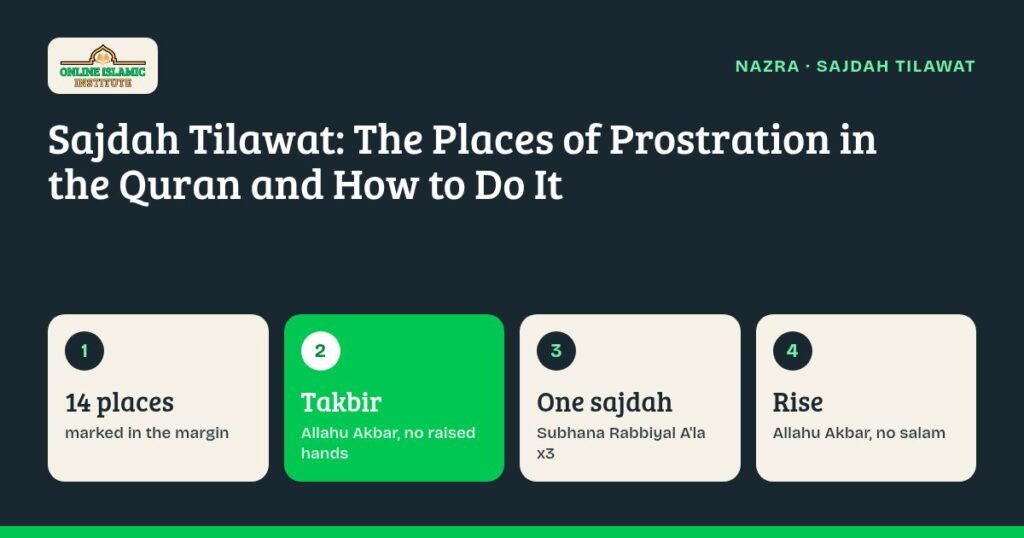
- Make the intention in your heart to perform the sajdah of recitation.
- Say اللَّهُ أَكْبَرُ and go down into sajdah. Do not raise your hands as you do at the start of salah. Many scholars recommend going down from a standing position if you can, but sitting and going straight down is fine.
- In sajdah say سُبْحَانَ رَبِّيَ الْأَعْلَى (Subhana Rabbiyal A’la) three times.
- Say اللَّهُ أَكْبَرُ and come up. That is it: there is no tashahhud and no salam.
There is also a dua reported from the Prophet ﷺ for this sajdah, which some people like to add: سَجَدَ وَجْهِيَ لِلَّذِي خَلَقَهُ وَشَقَّ سَمْعَهُ وَبَصَرَهُ بِحَوْلِهِ وَقُوَّتِهِ, “My face has prostrated to the One who created it and brought forth its hearing and sight by His might and power.”
If you cannot do it straight away
Perhaps you heard the ayah while travelling on the Mumbai local, or you are reading from memory without wudu. In the Hanafi school the sajdah stays due, and you can perform it later; it is better not to delay too long. If you recite or hear the same sajdah ayah several times in one sitting, one sajdah is enough.
Inside salah
If an imam recites a sajdah ayah in salah, he goes into sajdah and the congregation follows, then everyone stands and the recitation continues. Hanafi scholars also explain when the ruku of the salah can count for it. This is worth asking your local imam about, as the details matter.
Sajdah tilawat in an online class
Children reading Nazra will meet all fourteen places eventually, and one comes surprisingly early: the end of Surah Al-Alaq, in Amma para. In our classes the teacher pauses at a sajdah ayah. If the student has wudu and space, they can make the sajdah there and then and carry on reading. If not, the teacher reminds them to do it after class, and a parent can follow up.
Scholars differ over whether hearing a sajdah ayah through a speaker, a live call or a recording makes the sajdah necessary for the listener. Families who want certainty on this should ask a scholar they follow. Making wudu before class, which our first-class setup guide suggests anyway, removes most of the awkwardness.
A simple way to teach children: when they see “sajdah” in the margin, they finish the ayah, say Allahu Akbar, prostrate, say Subhana Rabbiyal A’la three times, and come back up with Allahu Akbar. After two or three times it becomes natural. More ideas for the parent’s role are in how to support your child’s Quran learning at home.
Reading the whole mushaf with a teacher
Sajdah ayahs, waqf signs, ruku marks: these are things a student picks up naturally while reading the mushaf from cover to cover in Nazra. Our Nazra Quran online classes are one-to-one, 30 minutes a day, 5 days a week, with a teacher who explains the markings as they come up. For younger children, see the online Quran classes for kids.
Online Islamic Institute is an online Islamic institute that teaches only the Quran: Noorani Qaida, Nazra, Tajweed and Hifz. Classes run 24/7 in IST with male and female teachers at any time. Fees are ₹4,000 a month, ₹21,000 for six months or ₹36,000 a year; the fee section has the details.
Common questions about sajdah tilawat
In the Hanafi school there are 14 places of sajdah tilawat. Many mushafs mark 15; Hanafis do not perform the second one in Surah Al-Hajj, while Shafi’is perform it and do not count Surah Sad.
In the Hanafi school it is wajib (necessary) for the reciter and for whoever hears the ayah. In the Shafi’i and Hanbali schools it is a recommended sunnah.
Say Allahu Akbar going down, Subhana Rabbiyal A’la three times in sajdah, and Allahu Akbar coming up. You may also add the reported dua “Sajada wajhiya lilladhi khalaqahu…”.
In the Hanafi school, yes. If you cannot do it at the time, for example without wudu, it remains due and you can perform it later. Try not to delay it for long.
Yes. The same conditions as salah apply: wudu, clean clothes and place, covering and facing the qiblah.
The first is at the end of Surah Al-A’raf (7:206), in para 9.
Want your child to read the mushaf confidently, sajdah signs and all? Book 3 free trial classes; you pay only after the trial, if you decide to continue.