
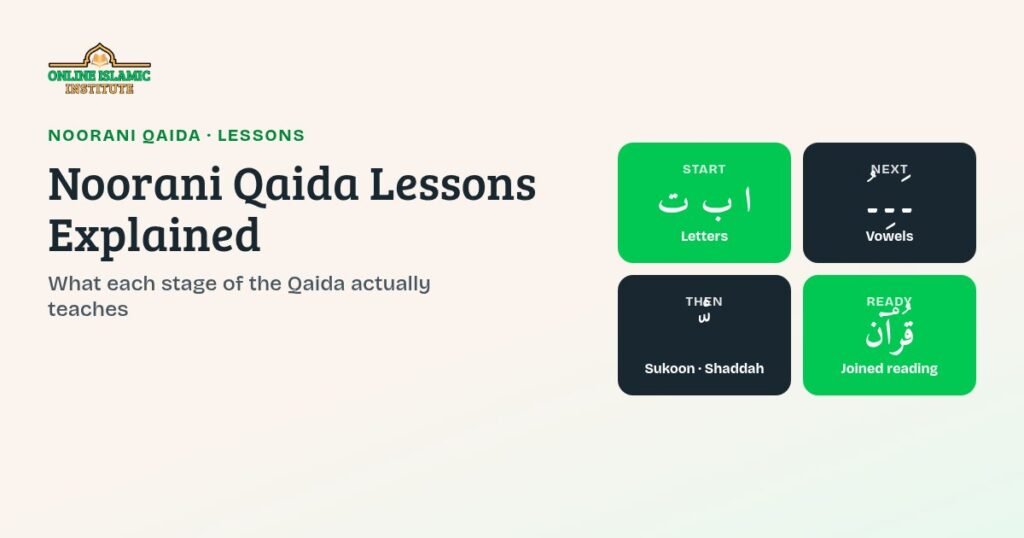
Open a Noorani Qaida and it looks simple: big letters, a few lines per page, colourful marks. Then your child gets stuck on one page for a week, and you wonder whether the book is badly designed or something is wrong. Usually neither. Each block of lessons teaches a skill that the next block needs, and rushing past a shaky page only makes the later ones harder.
This guide walks through what Noorani Qaida lessons typically teach, in the order most Indian editions use, so you know what “stuck on lesson 8” actually means and how to support your child without turning the dining table into a battlefield.
Why the Qaida is ordered the way it is
Noorani Qaida is a primer. It takes a student from single Arabic letters to reading joined Quranic words with vowels, sukoon and shaddah. Different printings number lessons slightly differently, but the ideas travel in the same direction: see the letter, say the letter, join the letter, then read with the marks that change the sound.
If you want the bigger picture of starting online, our how to learn Noorani Qaida online post covers class format and parent tips. Families still deciding when to begin can also read about the right age to start learning Quran. Here we zoom into the lessons themselves.
Individual letters (the first lessons)
Early pages introduce the Arabic alphabet, often a few letters at a time. The teacher listens for:
- A clear sound from the right place in the mouth or throat (makhraj), not a Hindi/Urdu near-miss.
- The difference between lookalike shapes once dots are added (ب ت ث, or ج ح خ).
- Confidence saying the letter alone before it appears in a word.
This is where Indian learners often mix س/ص/ث or ز/ذ/ظ. A live teacher will drill the pair your child confuses. A workbook alone cannot hear the difference.
Letter forms: start, middle and end
Arabic letters change shape depending on where they sit in a word. Mid-Qaida lessons train the eye to recognise the same letter in its joined forms. Children who only memorised the isolated shape freeze when ب becomes a small hook in the middle of a word. Slow practice here saves tears later.
Fatha, kasra and damma (short vowels)
Once letters are familiar, short vowels arrive. Suddenly بَ بِ بُ are three different sounds. Good lessons keep the pace gentle: one vowel mark across many letters, then mix them. Parents can help by asking for three slow examples after class, not a whole page raced for speed.
Standing fatha, long vowels and stretch
Next come longer sounds (alif, wow, yeh as madd letters, and related marks depending on the edition). The idea is simple: some sounds are held longer than a short vowel. Children who clip these short will later rush Quranic words. Teachers often clap or count lightly so the ear learns length without a lecture on every Tajweed name yet. Deeper rule names can wait for Tajweed for beginners.
Sukoon and the stop on a letter
Sukoon means the letter is read without a short vowel. Many children either add a random vowel or skip the letter. Lessons at this stage are short on purpose. Master a handful of sukoon words before stacking more rules.
Shaddah (tashdeed)
Shaddah doubles the sound. It feels odd at first, especially in the middle of a word. Teachers usually exaggerate the doubling so the student feels it, then soften toward a natural reading. Skipping this page to “move ahead” is a classic reason Nazra later sounds muddy.
Tanween, small marks and joining practice
Later lessons bring tanween (an/in/un endings) and denser joining drills: short Quranic words and phrases that look like the real mushaf. This is the bridge toward Nazra Quran. When these pages feel comfortable, the student is usually ready to read short surahs from the mushaf with a teacher listening.
What “finishing the Qaida” should mean
Finishing is not racing the last page with shaky letters. It means the student can read a mixed line of Qaida-style words with few freezes, and can accept correction without shutting down. Some children need longer on vowels; others fly until shaddah and then slow down. Both patterns are normal.
How online Qaida lessons run day to day
At Online Islamic Institute, Noorani Qaida is taught one-to-one in 30-minute classes, five days a week. The teacher hears every letter, repeats the stuck ones, and sets a small homework line for the next day. Classes are available 24/7 in IST, so early morning before school or evening after homework both work. Male and female teachers are available any time. You can see how the course is structured on our Noorani Qaida online course page.
Fees match our other courses: ₹4,000 a month, ₹21,000 for six months, or ₹36,000 a year. See fees and our India fees guide. You start with 3 free trial classes and pay only after the trial.
Choosing who teaches matters as much as the book. Keep these questions for an online Quran teacher nearby, and ask for a female teacher if that is your preference.
Parent tips while lessons move forward
- Sit in for a week if your child is under seven, then give them space once the routine sticks.
- Praise clear letters, not only “finishing” a page.
- If school exams arrive, tell the teacher; revision of old lessons beats stacking new ones under stress.
- Avoid comparing sibling page numbers. Qaida is not a race between cousins on the family WhatsApp group.
Questions about Noorani Qaida lessons
Numbering varies by publisher, but the skills usually follow the same path: letters, joined forms, short vowels, longer sounds, sukoon, shaddah, then joined Quranic practice.
Not by itself. Some pages introduce a new skill that needs repetition. A live teacher will decide whether to drill, simplify, or review earlier letters.
A teacher can move faster on familiar pages, but skipping shape-joining or sukoon often causes trouble later. A short placement listen in the free trial is the safest start.
Usually Nazra: fluent reading from the mushaf. After that, many students continue into Tajweed, and some into Hifz when reading is steady.
If you are ready to see how your child responds to live correction, book 3 free trial classes. Bring the Qaida you already have at home, or ask the teacher which edition they prefer. The first few lessons will tell you more than any table of contents.