
Try this before you read on. Say إِنَّ (inna) slowly, and halfway through the “nn”, pinch your nose shut. If the sound stops dead, you were doing ghunnah. If it carries on unchanged, the sound was coming from your mouth, and that is the habit this article is about.
Ghunnah is one of the first Tajweed rules a child meets after the Noorani Qaida, and one of the easiest to get almost right. Most readers in India make some nasal sound on نّ and مّ. The usual problems are that it is too short, too long, or slipped onto letters where it does not belong.
What ghunnah is
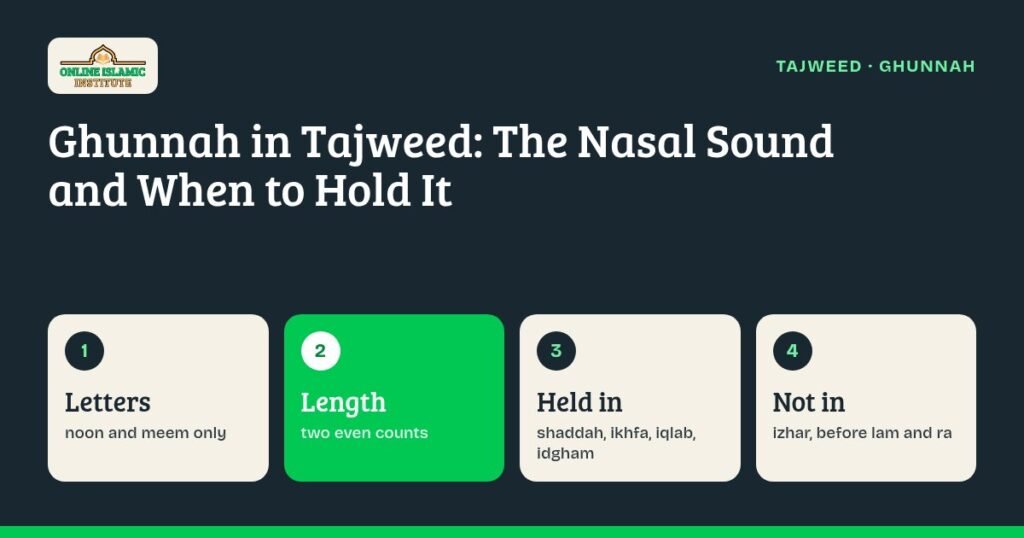
Ghunnah is a nasal sound, a soft hum that comes out through the nose. In Tajweed it belongs to two letters only: ن (noon) and م (meem). Every noon and meem carries a little of it. The rule that matters for your reading is about when that hum is held for a measured length, and when it is not.
Classical Tajweed books give the source of the sound its own name, the khayshum, the inside of the nose. That is why ghunnah is listed separately in the guide to makharij al-huroof: it does not come from the throat, tongue or lips but from the nasal passage.
The basic rule: noon and meem with shaddah
Whenever you see a noon or a meem with a shaddah (نّ or مّ), hold the ghunnah for two counts. This is called ghunnah mushaddadah, and it applies every time, in the middle of a word or at the end.
You can find it in almost every short surah:
- إِنَّا أَعْطَيْنَاكَ الْكَوْثَرَ (Al-Kawthar): the noon in inna.
- ثُمَّ كَلَّا سَوْفَ تَعْلَمُونَ (At-Takathur): the meem in thumma.
- مِنَ الْجِنَّةِ وَالنَّاسِ (An-Nas): the noon in al-jinnati and an-naas.
- عَمَّ يَتَسَاءَلُونَ (An-Naba): the meem in ‘amma.
How long is “two counts”?
A count (harakah) is roughly the time it takes to fold one finger at a calm reading pace. Teachers in India often have children tap two fingers on the desk while they hum. The exact length matters less than keeping it the same every time. If your ghunnah on إِنَّ is twice as long as the one on ثُمَّ a line later, the reading sounds uneven even to people who know no Tajweed.
Two counts is also the length of a natural madd, so a student who already reads the long vowels evenly has a ready ruler. The madd rules article explains that count in more detail.
The other places you hold ghunnah
Shaddah is the clear case. The rules for noon sakin, tanween and meem sakin add a few more spots where the two-count hum appears, even though no shaddah is printed (or the shaddah is on the next letter).
| Rule | What happens | Example |
|---|---|---|
| Idgham with ghunnah | Noon sakin or tanween merges into ي ن م و | فَمَن يَعْمَلْ (Az-Zalzalah) |
| Iqlab | Noon sakin or tanween before ب turns into a meem sound | لَيُنبَذَنَّ (Al-Humazah) |
| Ikhfa | Noon sakin or tanween before one of 15 letters is “hidden” | مِّن جُوعٍ (Quraysh) |
| Ikhfa shafawi | Meem sakin before ب | تَرْمِيهِم بِحِجَارَةٍ (Al-Fil) |
| Idgham shafawi | Meem sakin merges into a following meem | أَطْعَمَهُم مِّن (Quraysh) |
Each of these has its own article: noon sakin and tanween rules covers the first three, and meem sakin rules covers the last two. For ghunnah, the takeaway is simple: in all of them the hum is held for about two counts.
When there is no held ghunnah
Just as important is knowing where not to hum. Over-nasal reading is common among keen beginners who have just learned the rule.
- Izhar. Noon sakin or tanween before a throat letter (ء ه ع ح غ خ) is read clearly, with no held hum: مِّنْ خَوْفٍ.
- Idgham without ghunnah. Before ل and ر the noon disappears completely, nasal sound included: وَلَمْ يَكُن لَّهُ (Al-Ikhlas).
- Izhar shafawi. Meem sakin before any letter other than ب and م is read plainly: لَكُمْ دِينُكُمْ (Al-Kafirun).
- Inside one word. In a few words such as الدُّنْيَا the noon sakin is followed by ي in the same word, so there is no idgham; the noon is read clearly.
One ayah that shows all three
The last ayah of Surah Quraysh is a handy practice line, because it puts three different treatments of noon and meem side by side:
الَّذِي أَطْعَمَهُم مِّن جُوعٍ وَآمَنَهُم مِّنْ خَوْفٍ
- أَطْعَمَهُم مِّن: meem sakin meets meem, so they merge into a meem with shaddah and you hold the ghunnah.
- مِّن جُوعٍ: the noon sakin before jeem is hidden (ikhfa), with a two-count hum.
- مِّنْ خَوْفٍ: the noon before kha is read clearly (izhar), with no held hum.
If your child can read this one ayah with the right three sounds, they have understood ghunnah better than many people who can recite the definitions.
Mistakes we hear most from Indian readers
Treating it like the Urdu or Hindi nasal vowel
Urdu has noon ghunna, the nasal “n” in words like ہیں (hain) or میں (main), and Hindi writes the same sound with a chandrabindu. It is a nasal vowel with no real n in it. Quranic ghunnah is different: the noon or meem is fully there, the tongue or lips are in position, and the hum is held on that letter. Readers who carry the Urdu habit over tend to swallow the noon in إِنَّ and say something closer to “iñ”.
Rushing it
Fast readers, often adults who learned as children and never revisited Tajweed, clip the shaddah to a single beat. النَّاس becomes “an-nas” with one short n.
Holding it too long
The opposite habit comes from imitating long, emotional recitations. Three, four or five counts on every نّ sounds dramatic but breaks the rule.
Making the hum heavy all the time
In ikhfa, the ghunnah follows the letter that comes next. Before a heavy letter it is read heavier, as in مِن قَبْلِ; before a light one it stays light. If heavy and light letters are still new to your child, read heavy and light letters in Tajweed first.
A one-week practice plan at home
Ten minutes a day is enough. Many families fit it in after Maghrib, before homework.
| Day | What to practise |
|---|---|
| 1-2 | Al-Kawthar and At-Takathur: only the نّ and مّ. Tap two fingers each time. |
| 3 | An-Nas: every النَّاس, same length each time. Record it on the phone and listen back. |
| 4 | Al-Fil and Al-Humazah: ikhfa shafawi and iqlab. |
| 5 | Quraysh: the three-sound ayah above. |
| 6 | Al-Ikhlas and Al-Kafirun: the places with no held hum. |
| 7 | Read all six surahs once, slowly, with a parent listening only for ghunnah. |
Most of these are among the first surahs children memorise; our list of short surahs for kids has them in a sensible order.
Getting it checked
The pinch test helps, but it cannot tell you whether your count is even or whether you are humming in the wrong places. That needs an ear. In our online Tajweed classes a teacher listens to every line in a one-to-one, 30-minute class, 5 days a week, and corrects ghunnah as it comes up rather than as a separate lecture. If you want the bigger picture first, start with Tajweed rules for beginners.
Classes run 24/7 in IST, with male and female teachers available at any time, so a slot after school in Lucknow or late evening in Kozhikode both work. Fees for online Quran classes in India with us are ₹4,000 a month, ₹21,000 for six months or ₹36,000 a year; see the fee section for details.
Ghunnah: quick questions
Ghunnah is the nasal sound that comes from the nose. It belongs to the letters noon and meem, and is held for about two counts when they carry a shaddah and in rules such as ikhfa, iqlab and idgham with ghunnah.
About two counts (harakat), roughly the time to fold two fingers at a calm pace. Keep it the same length every time you read it.
Only noon and meem. The held ghunnah appears on noon or meem with shaddah, and on noon sakin, tanween or meem sakin in certain rules.
Pinch your nose while holding the sound. If the sound stops, it is coming through the nose as it should. A teacher can then check that your length is even and that you are not humming where the rule does not apply.
No. Urdu noon ghunna is a nasal vowel with no full n. In Quranic ghunnah the noon or meem is pronounced fully and the nasal hum is held on it.
Want someone to listen to your إِنَّ and tell you honestly how it sounds? Book 3 free trial classes and pay only if you decide to continue.