
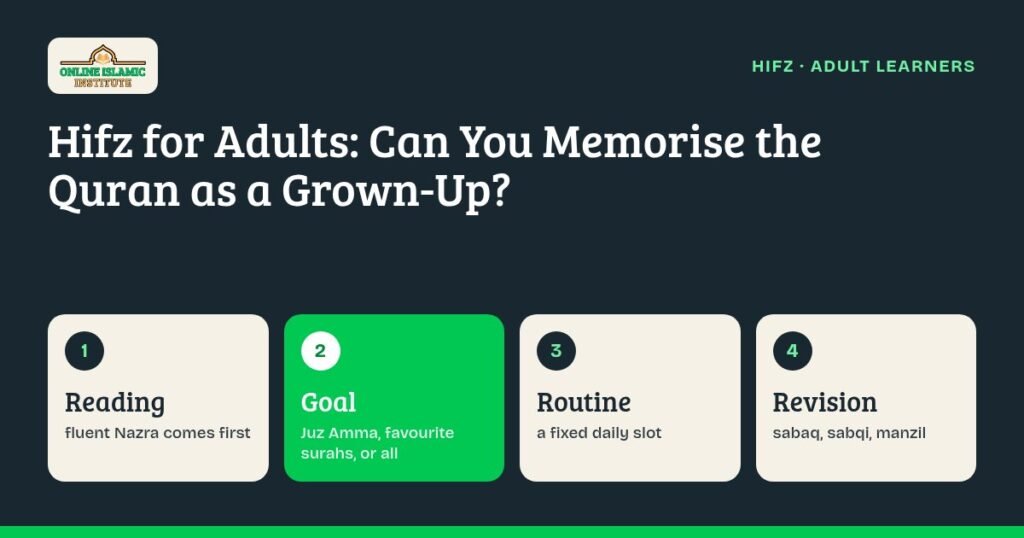
“I am 38. Isn’t it too late?” It is usually the first thing an adult asks about Hifz. It might be a software engineer in Bengaluru who reads well and wants more, or a mother in Hyderabad whose children have started memorising and who would like to keep up with them.
The short answer is that it is not too late. People memorise the whole Quran, or large parts of it, in their thirties, forties and well beyond. The longer answer is that adult Hifz works differently from a child’s, and knowing those differences up front saves a lot of frustration.
What is different for adults
Children often have more free hours and a quick ear for sounds. Adults have other things going for them.
| Adults may find it harder to… | Adults usually have… |
|---|---|
| find long, unbroken hours | a clear reason for doing it, which keeps them going |
| memorise by sound alone | the habit of understanding, so meaning helps memory |
| stay consistent through busy weeks | the discipline to plan and protect a fixed slot |
| feel comfortable being corrected | the maturity to ask questions and track their own progress |
Allah says in Surah Al-Qamar, وَلَقَدْ يَسَّرْنَا الْقُرْآنَ لِلذِّكْرِ فَهَلْ مِن مُّدَّكِرٍ, “And We have certainly made the Quran easy to remember, so is there anyone who will remember?” That promise is not limited to the young. Many adults test themselves with one surah first; Surah Al-Mulk is a popular choice, and our simple plan to memorise Surah Al-Mulk is written for busy schedules.
Before you start: check your reading
Hifz rests on reading. If you still hesitate on words or are unsure of the vowels, you will memorise those hesitations too. A teacher can usually tell within a class or two whether you are ready. If not, a stretch of Nazra (reading from the mushaf) first, and some Tajweed alongside, makes the memorising far smoother. Our page on learning Quran as an adult covers that earlier stage.
Also choose your copy of the Quran now and keep it. Memory leans on where an ayah sits on the page, so many students in India use a 15-line Hafizi copy throughout. If you are unsure which style to pick, see Indo-Pak or Uthmani (Madani) mushaf.
Pick a goal that fits your life
Not every adult needs to aim for all 30 paras on day one. Some begin with a smaller target and decide later:
- Juz Amma, the last para, which many adults half know already and can complete.
- Surahs read often, such as Al-Mulk, Ya-Sin, Al-Kahf or Al-Waqi’ah.
- Full Hifz, if you can give it steady daily time for the long term.
Any of these is worthwhile. Finishing a smaller goal also tells you, honestly, whether full Hifz fits your life right now.
A daily routine that survives a job
The routine matters more than the size of each day’s portion. Here is one pattern many working adults find realistic; adjust it to your shifts:
- Before work (20 to 30 minutes). Your class with the teacher, or your new lesson. The mind is fresh after Fajr.
- During the day. Listen to the portion you are learning on the commute or at lunch. Recite the new lines in your sunnah prayers.
- Evening (10 to 15 minutes). Revise yesterday’s lesson and a slice of older pages.
- Weekend. A longer revision sitting, and a check of anything that felt weak during the week.
Classes that run around the clock help here. Our classes run 24/7 in IST, so a 6 am slot before the office or an 11 pm slot after the children sleep are both possible. The guide on Quran classes for working professionals has more on fitting lessons around a job.
The three parts of every day
Hifz students in India use the words sabaq (the new lesson), sabqi (recent lessons) and manzil (older revision). Adults who only do sabaq tend to lose what they learned a month ago. Our Hifz revision plan explains how to balance the three, and the general tips on how to memorise the Quran apply just as well to adults.
Common worries, honestly answered
“My memory is not what it used to be.”
Memory for the Quran is built mostly through repetition and revision, not raw talent. Smaller daily portions with steady revision work well for most adults. Understanding the meaning of what you memorise, even roughly in your own language, also helps it stay.
“I don’t know Arabic.”
Many huffaz in India did not know Arabic when they started either. You need accurate reading and good pronunciation. Arabic study is a separate, optional path.
“How long will it take?”
We will not give you a number, because nobody honestly can. It depends on how much you memorise each day, how much time revision takes, how many days you miss and how far you already read fluently. What we can say is that steady daily work, even in small amounts, adds up. For the factors that set the pace in reading, see how long it takes to learn to read the Quran; the same logic applies to Hifz.
“I keep starting and stopping.”
That is the most common pattern of all. A fixed class time with a teacher waiting is the simplest cure. So is a smaller goal: it is easier to protect 30 minutes a day than a vague plan to “do Hifz”.
Learning with a teacher
A teacher hears your new lesson and revision every day, catches mistakes before they settle, and keeps the pace realistic. In our online Hifz classes that happens one-to-one, in 30-minute classes, 5 days a week (20 a month). Male and female teachers are available at any time; women who prefer a female teacher can also read about our Quran classes for ladies. If your reading needs polishing first, the online Tajweed classes are a good place to start.
Fees are the same for every course: ₹4,000 a month, ₹21,000 for six months or ₹36,000 a year. Details are in the fee section, and you can read more about our online Islamic institute.
Questions adults ask about Hifz
Yes. Many people memorise the whole Quran as adults. It needs fluent reading, a steady daily routine and regular revision, ideally with a teacher listening.
Start small, such as a few lines, and increase only when your revision stays strong. A portion you can keep up every day is better than a large one you cannot.
You need accurate reading and correct pronunciation. Many students keep improving their Tajweed alongside Hifz, with the teacher correcting as they go.
Yes, if you keep a fixed daily slot. Our classes run 24/7 in IST, so early morning and late night times are both possible.
If you have been wondering whether you can still do it, the easiest way to find out is to try. Book 3 free trial classes, and pay only if you decide to continue.