
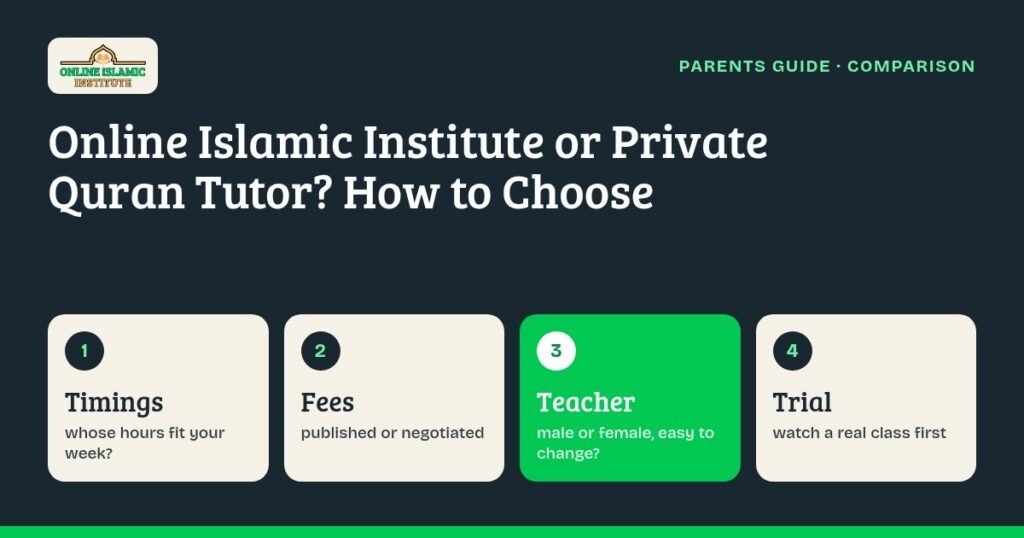
For online Quran classes, Indian families usually end up choosing between two kinds of arrangement. One is a private tutor, often found through a relative, a WhatsApp forward or the local masjid, who teaches from home on a video call. The other is an online Islamic institute: an organisation that arranges teachers, timings and fees for many students.
Both can work very well. Both can go wrong. The right choice depends less on the label than on a handful of practical things, and this guide goes through them honestly, including where a private tutor might suit you better than an institute like ours.
What an online Islamic institute is (and is not)
“Institute” sounds grand, but online it usually just means there is an organisation behind the classes rather than a single person. That can bring structure: set fees, a booking process, more than one teacher, and someone to talk to if something is not working. It does not automatically mean better teaching. A class is still one teacher and one student on a screen, and that half-hour is what matters most.
It is also worth checking what an institute actually teaches. Some offer a wide range of Islamic subjects; others, like us, focus only on the Quran (here is how Islamic studies courses differ from Quran classes).
Side by side
| Private tutor | Online institute | |
|---|---|---|
| Finding them | Word of mouth; quality varies a lot | Website, booking form, published fees |
| Timings | Depends on one person’s free hours | Often wider; some run round the clock |
| If the teacher is unavailable | Class is usually missed | Another teacher may be arranged |
| Changing teacher | Means starting the search again | Usually a request |
| Fees | Often negotiable, sometimes unclear | Fixed and published |
| Personal connection | Can be very strong, especially a family friend | Depends on the teacher you get |
None of these is a rule. A brilliant family-friend tutor with reliable evening slots may be the best thing that happens to your child. An institute with a nice website and a disorganised teacher is not.
When a private tutor may be the better choice
- You already know and trust a specific teacher, and their timings fit.
- You want a mix of Quran and other Islamic subjects from one person.
- Your schedule is very regular and you do not expect to need changes.
When an institute may suit you better
- Your timings are unusual: late at night, very early, shift work, or a different time zone from family.
- You want a choice of male or female teacher. Many women prefer a female teacher; see learning with a female Quran teacher online.
- You want fees and terms in writing before you start.
- You would rather not have an awkward conversation with a family friend if things are not working.
Questions to ask either one
Whichever route you take, the same questions sort the good from the not-so-good. Our longer list is in how to choose an online Quran teacher; the short version:
- Is it live and one-to-one, or a group?
- How long is each class, and how many classes a month? (Divide the fee by that number, as in our fees guide.)
- How are mistakes corrected? Watch for this in a trial class.
- Can a parent sit in?
- What happens when a class is missed, by either side?
- Is there a trial before paying?
Be careful with anyone who promises your child will “finish the Quran” by a fixed date, or who will not let you watch a class.
Give it a few weeks either way
Whichever you choose, judge it on the first few weeks rather than the first class. Is your child reading aloud for most of the session? Are the same mistakes being corrected until they stop? Does the timing still hold during exams and family functions? If the answers are yes, you have found a good arrangement, whatever it is called. If not, change it early rather than hoping it improves.
Red flags with both
- Pressure to pay for several months before a single class.
- Vague answers about class length or frequency.
- A teacher who talks most of the class while the student listens.
- No way to raise a concern without it becoming personal.
How we work
Online Islamic Institute is an online Islamic institute focused only on the Quran: Noorani Qaida, Nazra, Tajweed and Hifz. Classes are live and one-to-one, 30 minutes a day, five days a week, and run 24/7 in IST, with male and female teachers available at any time. Fees are published: ₹4,000 a month, ₹21,000 for six months or ₹36,000 a year (see the fee section). Every new student starts with 3 free trial classes, and you pay only after the trial if you want to continue. Parents can sit in. There is more on our classes for kids and classes for ladies, or start from our online Quran classes in India page.
If you have a good local madrasa or tutor, that is a blessing too; our madrasa vs online classes comparison is honest about that.
If you lean towards an institute, see how ours works: Online Islamic Institute offers one-to-one Quran classes in India, 24/7 IST, with male and female teachers.
Questions
Not automatically. An institute usually offers wider timings, published fees and an easier way to change teacher; a trusted private tutor can be just as good. Judge the actual teacher in a trial class.
Ask about class length and number per month, whether classes are one-to-one, how mistakes are corrected, whether a parent can sit in, and whether there is a free trial before paying.
No. We teach Quran courses only: Noorani Qaida, Nazra, Tajweed and Hifz, live and one-to-one.
Yes. Male and female teachers are available at any time, 24/7 in IST.
Yes. The new teacher checks the student’s level during the trial and continues from where they are.
The easiest way to decide is to see a class. Book 3 free trial classes and compare for yourself.