
You do not need to read Arabic beautifully to help your child learn the Quran. That surprises a lot of parents. Some of us learned in a mohalla maktab decades ago and have grown rusty; some never learned properly at all and feel a bit embarrassed about it. Neither is a reason to stay out of the picture.
A teacher handles the pronunciation and the rules. What happens at home between classes is where you come in, and it often decides whether a child moves steadily or stalls. Here is what that looks like in practice, in an ordinary Indian home with school, tuition, cousins and a TV that is always on somewhere.
First, be clear about your role
If a teacher is teaching your child, your job is not to teach a second, slightly different version. Children get confused when Ammi says a letter one way and the teacher says it another. Think of yourself as the coach who runs the practice, not the one who writes the rules. Your part is:
- The routine: making sure class and practice actually happen.
- The listener: hearing the homework, even if you only follow along.
- The mood: keeping Quran time warm, never a punishment.
- The link to the teacher: telling them what you notice at home.
If you do read well, you can help more with the practice itself. Just ask the teacher first how they want letters and rules corrected, so the two of you say the same thing. Free apps and recitations help at home too; here is what free online Islamic courses do well, and where they fall short.
Give it a fixed place in the day
Children cope with a busy day surprisingly well as long as it is predictable. Quran practice that floats around (“we’ll do it later”) usually ends up squeezed out by homework and cricket. Tie it to something that already happens every day:
- straight after Asr or Maghrib salah, when the family is already in prayer mode;
- after the evening snack, before tuition homework;
- just before bed, for a quick revision of the day’s lesson.
Ten to fifteen minutes is plenty for most young children. Older children doing Nazra can manage a little more. Keep it short enough that they finish wanting more, not counting the seconds. If the enthusiasm has already faded, here are some ideas on how to keep kids motivated.
Make a small Quran corner
It need not be fancy. A clean shelf, a wooden rehal (the folding stand most of us grew up with), the child’s Qaida or mushaf, a pencil, and a cloth to cover the book. When the child sits there, the brain knows what is coming. It also keeps the Qaida from getting lost under school notebooks, which happens in every house. For the manners that go with that corner, see our guide to the etiquette of reading the Quran.
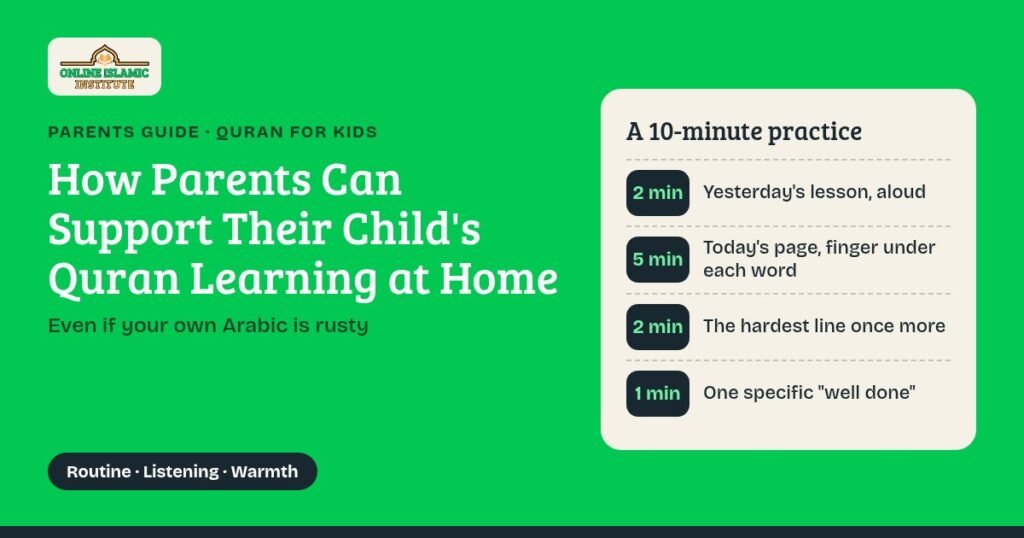
A 10-minute practice that works
Here is a simple pattern that suits most children in Noorani Qaida or early Nazra:
- Two minutes: read yesterday’s lesson once, aloud.
- Five minutes: read today’s homework page slowly, pointing with a finger or pencil under each letter or word.
- Two minutes: read the hardest line once more.
- One minute: tell them one specific thing they did well.
That last step matters more than it looks. “Your ح was really clear today” lands much better than “good”. It tells the child exactly what to keep doing. If you want to know what each stage of the Qaida is meant to cover, our guide to Noorani Qaida lessons lists them in order.
Use your phone, but for listening
Record your child reading for thirty seconds once a week and save it. A month later, play the old one and the new one side by side. Children love hearing that they have improved, and you will notice things you miss while sitting next to them. Listening to a clear reciter at home also helps: short surahs playing in the car on the school run do more than people expect.
If you cannot read Arabic yourself
This is more common than people admit, and it is fine. You can still do almost everything above. Sit beside your child, follow the line with your finger, and ask them to “teach” you the letter they learned today. Children love being the teacher, and explaining a letter out loud fixes it in their own memory.
Many parents take this as the push to start their own lessons. Many mothers want to learn alongside their children, and we have online Quran classes for ladies with female teachers at any hour, and our article on Noorani Qaida for adults shows what starting from the letters looks like as a grown-up. One practical tip: use the same script as your child’s teacher. If the class uses the Indo-Pak script common in India, practise from an Indo-Pak Qaida and mushaf at home too.
Correcting without spoiling it
- Pick one correction per sitting. A child who is stopped on every word stops wanting to read.
- Let the teacher handle Tajweed corrections during class. Prompting from behind the screen confuses everyone.
- Never use Quran time as a punishment (“no cartoons, go and read Qaida”). It teaches exactly the wrong lesson.
- Keep the cousins out of it. Comparing juz counts on family WhatsApp groups helps nobody.
Stay in touch with the teacher
Every couple of weeks, ask the teacher three short questions: What is going well? What should we practise at home? Is there anything you want me to stop doing? That one practice point is often a Tajweed sound; our guide to Tajweed for kids shows the usual order children learn the rules. Online classes make this easy, because you are usually in the next room. If your child is very young, sitting nearby during the first few classes helps them settle; as they grow in confidence, you can step back.
If you are still deciding how your child should learn, our comparison of online Quran classes and a local madrasa may help, and our guides on the right age to start and on online Islamic courses for kids cover the earlier questions.
When home support meets a good teacher
Our online Quran classes for kids are one-to-one and live, 30 minutes a day, five days a week (20 classes a month). Children start with Noorani Qaida online and move on to Nazra once they read with confidence. Online Islamic Institute runs classes 24/7 in IST, so you can pick a slot that fits school and tuition, and male and female teachers are available at any time. Fees are ₹4,000 a month, ₹21,000 for six months (₹3,500 a month) or ₹36,000 a year (₹3,000 a month), shown in our fee section.
Parents ask us
Let a teacher handle reading and pronunciation, and support from home: keep a fixed daily practice time, sit beside your child, follow along with your finger, and ask them to explain what they learned.
For most young children, ten to fifteen minutes of focused practice is enough, ideally at the same time every day.
Gently, and one at a time. Ask the teacher how they want corrections made so you both say the same thing, and leave corrections during class to the teacher.
It helps in the first few classes while a young child settles. As they grow confident, you can step back and check in at the end.
Want to see how your child gets on with a teacher? Book 3 free trial classes; you pay only after the trial, and only if you want to continue.