
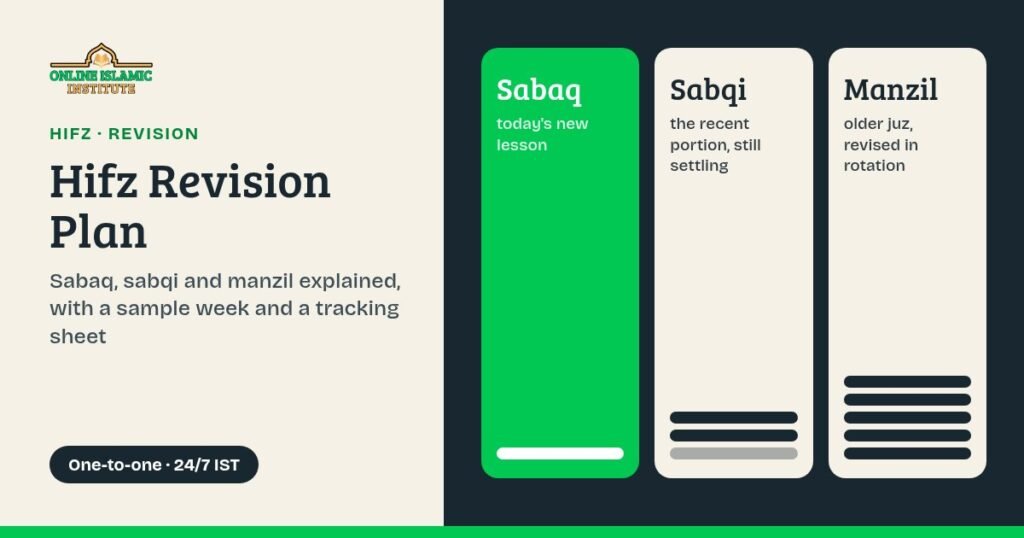
Open the daily notebook of a Hifz student in many Indian madrasas and you will find the same three words heading each day: sabaq, sabqi, manzil. Some teachers write them in Urdu, some in English, some just as initials. Under each one goes a page number, and often a small tick or a note about mistakes.
Those three columns are the whole revision system. Parents who did not do Hifz themselves often hear the words for the first time when their child starts, and nod along without being quite sure what each one covers. This post explains them, shows how the balance changes as a student memorises more, and gives you a plan you can adapt with your teacher.
Sabaq: the new lesson
Sabaq is today’s new portion, the lines or ayahs memorised fresh. For a beginner on Juz Amma this might be a few short ayahs. Later it may be several lines or a page of a 15-line mushaf. The size is set by the teacher, and it should be small enough to recite cleanly the next day, not just tonight.
The usual pattern is to prepare the sabaq at home, recite it to the teacher in class, and only move on when it is clean. If you want help with the memorising itself, our post on how to memorise the Quran covers the method line by line.
Sabqi: the recent portion
Sabqi is the portion memorised just before today’s lesson. Teachers define it a little differently. In some places it means the last several days of sabaq; in others it is the whole juz the student is currently working on, up to yesterday. Either way, it is the material that is still settling.
Sabqi is where most new mistakes show up, because the portion is young. A good rule many teachers use: if the sabqi is weak, tomorrow’s sabaq waits. It feels slow to a keen child, but it stops a crack from spreading.
Manzil: the older portions
Manzil is everything memorised before the sabqi, the juz that are “done”. They are revised on a rotation, a fixed amount each day, so that every part comes round again before it fades. Students call a portion pakka when it is solid and kachcha when it is still shaky, and manzil is how kachcha juz become pakka and stay that way.
Manzil never ends. Even after completing the Quran, a hafiz keeps a daily manzil for life. (The same word also names the seven reading portions printed in Indian mushafs; our guide to Quran para names explains those markings.) That is worth saying to a child at the start, gently, so revision is understood as part of Hifz, not a punishment for forgetting.
How the balance changes as you memorise more
The three parts do not stay the same size. At the start, almost all the effort goes into sabaq. A few juz in, revision begins to take over the day. The table below is an example to discuss with your teacher, not a fixed rule; every student and every teacher works a little differently.
| Stage | Sabaq | Sabqi | Manzil |
|---|---|---|---|
| Juz Amma, just starting | A few short ayahs | Everything learned in the past week or so | Short surahs already solid, recited in salah |
| Up to about 5 juz | A few lines to half a page | The current juz up to yesterday | Around a quarter to half a juz a day, rotating |
| About 5 to 15 juz | As the teacher sets | The current juz | Roughly half a juz to a juz a day |
| More than 15 juz | As the teacher sets | The current juz | A juz or more a day, so the cycle stays short |
Notice what grows: manzil. A student who keeps the same small manzil while the memorised portion doubles will find the cycle getting longer and longer, and the oldest juz going weeks without being touched. That is usually when parents hear “I’ve forgotten Surah Yasin” at the dinner table.
A sample week with online classes
With live classes of 30 minutes, five days a week, there is not time to hear everything in class. So the work splits between class and home. Here is one pattern families use:
- Before class: prepare the sabaq and read through the sabqi once.
- In class: the teacher hears the sabaq, then some or all of the sabqi, and a piece of the manzil when time allows. Then sets tomorrow’s sabaq.
- Later the same day: the day’s manzil portion, recited aloud at home, ideally to a parent or sibling following in the mushaf.
- Weekends: no new sabaq. A longer manzil and a full read of the sabqi, so Monday starts clean.
After Fajr is the classic time for sabaq because the house is quiet. But plenty of children memorise better at 4 p.m. after school, and adults fitting this around a job usually pick late evening (here are slot ideas for working professionals). Our classes run 24/7 in IST, so the class can go wherever your best hour is.
Keep a simple tracking sheet
A plain notebook works better than any app. One line per day:
| Date | Sabaq | Sabqi | Manzil | Mistakes / notes |
|---|---|---|---|---|
| Mon | Juz 3, p. 4, lines 1-7 | Juz 3, pp. 1-3 | Juz 1, first half | 2 small slips in sabqi |
| Tue | Repeat lines 1-7 | Juz 3, pp. 1-4 | Juz 1, second half | Clean |
Look at the second row: the sabaq was repeated, because the sabqi had slips the day before. A sheet like this lets a parent see the pattern at a glance, and it gives the teacher something concrete to look at when deciding whether to speed up or slow down.
Signs the revision is slipping
- The student keeps stopping at the start of pages, where the eye has to “find” the first word.
- Similar ayahs from different surahs (mutashabihat) start getting mixed.
- Sabqi is taking longer every day.
- A juz that was pakka last month needs a peek at the mushaf.
None of this is a disaster. The fix is almost always the same: shrink the sabaq or pause it for a few days, keep the manzil going daily even if smaller, and recite memorised portions in sunnah and nafl prayers. Tell the teacher early. It is far easier to repair one weak juz than five.
Exams, weddings and Ramadan
Indian family life has busy seasons. During board exams, a cousin’s wedding or a family trip, a sensible plan is to stop sabaq and protect the manzil. In Ramadan, many students and huffaz find that reciting in Taraweeh, or simply listening carefully to it, is the best manzil of the year.
Revision with an online Hifz teacher
Our online Hifz classes follow this same sabaq, sabqi and manzil pattern, one-to-one, for 30 minutes a day, five days a week (20 classes a month). Students who are not yet reading fluently usually start with Nazra Quran online first, since memorising on shaky reading is hard to undo (our page on what Nazra means explains why). Parents of younger children will find more in our guide to Hifz for kids at home, and women who prefer a female teacher can look at our online Quran classes for ladies.
As an online Quran institute serving families across India, we have male and female teachers available at any time. Fees are ₹4,000 a month, ₹21,000 for six months or ₹36,000 for a year (details in the fee section), and every new student gets 3 free trial classes, paying only after the trial.
Hifz revision: FAQ
Sabaq is the new lesson, sabqi is the recently memorised portion (often the current juz), and manzil is the older memorised portions, revised on a rotation.
It grows with the amount memorised. A beginner may only revise a few short surahs, while a student with many juz often revises half a juz to a juz or more daily. Your teacher sets the amount.
Usually, yes. Many teachers pause or shrink the sabaq until the sabqi and manzil are clean again.
The time you can protect every day. After Fajr is traditional, but a calm afternoon or evening slot works well for many students.
No. A hafiz keeps a daily manzil for life so the whole Quran stays fresh.
Yes. In one-to-one online classes the teacher hears the sabaq and revision live, and sets what to revise at home before the next class.
If your child’s notebook has more crossed-out pages than ticks, start with a conversation. Book 3 free trial classes and ask the teacher to hear their sabqi.