
In a lot of Indian homes the Quran lives on the highest shelf, wrapped in a cloth cover, with a wooden rehal folded beside it. Nobody sat the children down and explained why. They simply watched a grandmother wash her hands, unwrap it slowly, kiss the cover and settle down to read, and they learned that this book is handled differently from every other.
That is adab: the manners and respect we bring to the Quran. Some of it comes straight from the Quran and Sunnah, some is good family custom, and it helps to know which is which. Here is a simple guide for parents and for adults who are learning themselves.
Before you open the mushaf
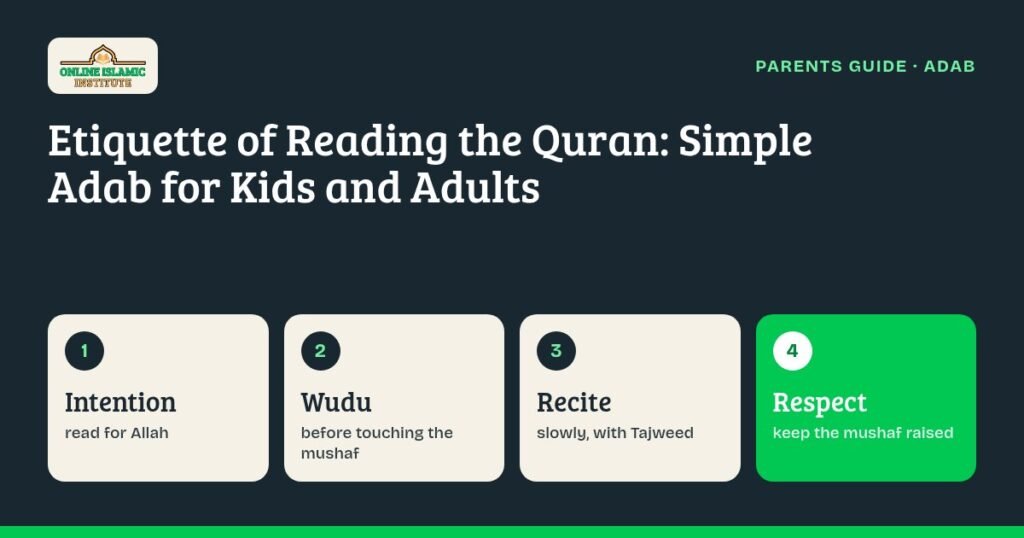
1. Make the intention
Read for Allah, to understand and to be guided, not to finish a target or impress anyone. For children this can be one sentence said before class: “I am reading the Quran to please Allah.” It sounds small. Over months it changes how they sit down to read.
2. Wudu
Scholars of the four main schools hold that you need wudu to touch the mushaf itself. Reciting from memory without wudu is allowed. Many scholars say that reading from a phone or tablet screen does not count as touching the mushaf, though plenty of families prefer wudu anyway; your teacher or local scholar can guide you on the details, including what applies during menstruation or after major impurity, where the schools differ.
For children, making wudu before class is also a useful signal that this is a different kind of time from homework or cartoons.
3. A clean place, and a calm one
A clean spot, decent clothes, the television off and phones face down. Facing the qiblah is good but not required. In a two-room flat in Mumbai or a busy joint family home in Lucknow this can mean claiming one corner of a room for twenty minutes, and that is enough.
While you read
4. Seek refuge, then begin with Bismillah
Allah says, فَإِذَا قَرَأْتَ الْقُرْآنَ فَاسْتَعِذْ بِاللَّهِ مِنَ الشَّيْطَانِ الرَّجِيمِ, “So when you recite the Quran, seek refuge in Allah from Satan, the expelled” (An-Nahl 16:98). So we start with أَعُوذُ بِاللَّهِ مِنَ الشَّيْطَانِ الرَّجِيمِ and, at the start of every surah except At-Tawbah, بِسْمِ اللَّهِ الرَّحْمَٰنِ الرَّحِيمِ.
5. Read slowly and correctly
“And recite the Quran with measured recitation” (وَرَتِّلِ الْقُرْآنَ تَرْتِيلًا, Al-Muzzammil 73:4). Reading correctly is itself part of respect, which is why Tajweed is not an optional extra. If you are new to it, start with Tajweed rules for beginners. Speed comes later; a clear page beats a rushed para.
6. Listen when it is recited
“So when the Quran is recited, listen to it and be silent, that you may receive mercy” (Al-A’raf 7:204). At home this is a lovely rule for siblings: when one child is reading in class, the others lower their voices. Playing recitation as background noise while everyone chats is something many scholars discourage for the same reason.
7. Pause, and respond
When you reach a sajdah ayah, prostrate (our guide to sajdah tilawat explains how). When an ayah mentions Allah’s mercy, it is good to ask for it; when it warns of punishment, to seek protection. Even a child can learn to stop and say “Ya Allah, make me one of them” after an ayah about the people of Jannah.
Handling the mushaf
- Keep it high. Put it on a shelf, a table or a rehal, never on the floor and never under other books.
- Nothing on top. Phones, glasses and teacups go beside it, not on it.
- Close it when you stop. Many families also keep it in a cloth cover (ghilaf), a good custom, though not an obligation.
- Worn-out copies. Do not throw old or torn pages in the dustbin. Many masjids in India collect them for respectful disposal; ask yours.
- Bags and travel. Carry it in its own pouch or the top of the bag, not squashed under shoes or lunch boxes.
Adab in an online Quran class
Online classes bring the Quran into the bedroom or the dining table, so it helps to agree on a few house rules. Most are common sense, and the first online class setup guide covers the technical side.
| Do | Avoid |
|---|---|
| Be on time, with wudu done and the mushaf or Qaida ready | Joining from bed, or with a snack in hand |
| Greet the teacher with salam and listen when corrected | Arguing with every correction, or answering in a rush |
| Sit up, dress decently, keep the camera steady | Lying down, walking around, or reading while gaming |
| Keep other tabs and the TV off | Chatting with siblings while the teacher is speaking |
Respect for the teacher is part of the adab too. Children notice how parents speak about their Quran teacher, and they copy it.
Teaching adab to children without nagging
Adab sticks best when it is shown rather than lectured. A few ideas from parents:
- Do it yourself first. If they see you make wudu and sit properly with the Quran, they will copy you.
- Give them their own small things: a Qaida with a cover, a little rehal, a pouch they chose.
- Explain one adab at a time, with its reason, instead of a list of rules on day one.
- Praise effort out loud (“You remembered your wudu without being told”).
- Keep it gentle. A child who is scolded every time they slump will start to dread Quran time.
Our articles on keeping kids motivated in Quran classes, supporting your child’s Quran learning at home and the right age to start go further into the parent’s side.
Learning with a patient teacher
Good teachers teach adab quietly, alongside the letters and the rules. Our online Quran classes for kids and classes for ladies are one-to-one, 30 minutes a day, 5 days a week, with male and female teachers available at any time and classes running 24/7 in IST. We teach Noorani Qaida, Nazra, Tajweed and Hifz only. Online Islamic Institute fees are ₹4,000 a month, ₹21,000 for six months or ₹36,000 a year (see fees).
Questions parents ask about Quran adab
To touch the mushaf, scholars of the four main schools say wudu is needed. Reciting from memory without wudu is allowed. For reading on a phone, and for women during menstruation, the rulings differ, so ask a scholar you follow.
It is better not to. Use a rehal, a table or a cushion so the mushaf is raised, and never put it on the floor or under other books.
Say “A’udhu billahi minash shaitanir rajim” before you begin, and “Bismillahir Rahmanir Rahim” at the start of each surah except Surah At-Tawbah.
If you would like a teacher who will help your child read well and with the right manners, book 3 free trial classes. You pay only after the trial, if you decide to continue.