
Type “online Islamic courses for kids” into Google late at night, once the children are finally asleep, and you get a long scroll of choices. Islamic studies, Arabic, seerah, manners, duas, Quran, sometimes all of them squeezed into one colourful timetable. A lot of parents close the laptop more confused than when they opened it.
This post is for the mother or father who wants their child to grow up close to Islam and simply wants to know where to begin. Our answer, as people who teach children every single day, is short: begin with the Quran. Everything else matters too. But reading the Quran properly is the one skill that opens the door to the rest, and it is the one most families need outside help with.
What parents usually mean by “Islamic courses”
When we speak to parents in Hyderabad, Lucknow, Mumbai or Malappuram, the words “Islamic course” can mean quite different things:
- reading the Quran correctly, letter by letter;
- learning short surahs by heart for salah;
- duas for eating, sleeping and travelling, plus the steps of wudu and salah;
- stories of the prophets and the Sahaba;
- good manners, honesty, respect for elders;
- Arabic as a language.
Look at that list again and notice how much of it is learned at home. A child learns salah by standing next to a parent at Maghrib. Duas stick when the whole family says them before dinner. Stories of the prophets work best at bedtime, from a grandparent who has told them a hundred times.
What most homes cannot do alone, unless someone in the family reads with Tajweed and has the patience of a saint, is teach the Quran from the first letter with the right pronunciation. That is where a teacher earns their place. Whether that teacher sits in the local maktab or on a screen is a separate question, and we compare online Quran classes and a local madrasa fairly in another post.
Why the Quran makes sense as the first course
Pronunciation habits form early
Children copy sounds. If a child learns ح as a soft “h”, or reads ق and ك the same way, the habit settles in quietly. Fixing it at fourteen takes far more effort than learning it right at six. A teacher who listens to every letter catches these slips while they are small.
It makes everything else easier
The surahs your child recites in salah are in Arabic. So are most of the duas you want them to know. A child who can read can open the mushaf or a dua book and read for themselves, instead of depending on someone to repeat each word for them.
It gives the day a small, steady rhythm
Thirty minutes, five days a week. That is enough to build a habit without crowding out school, play and sleep. Over months, that half-hour becomes simply part of who your child is: “This is when I read Quran.”
The path we follow with children
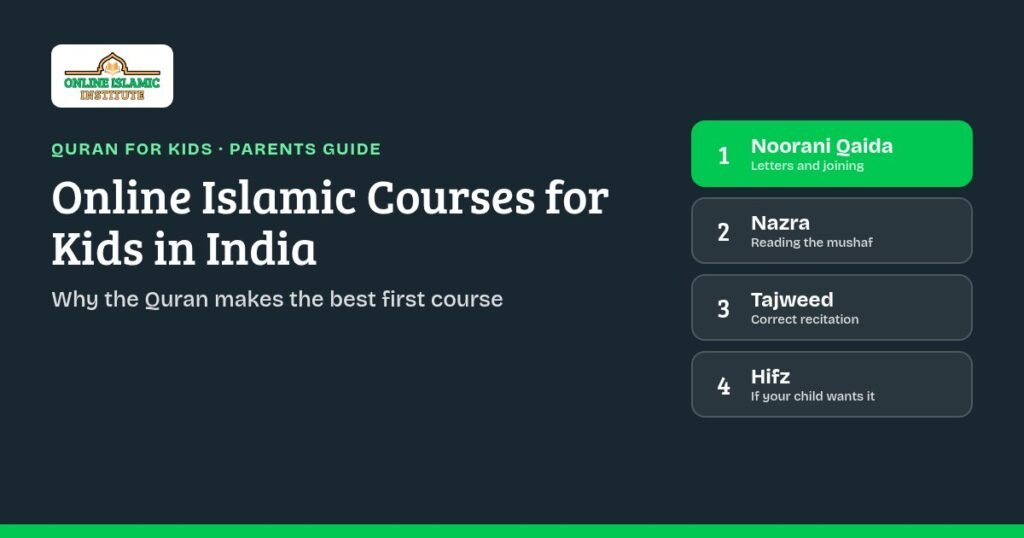
There is a natural order to learning the Quran, and most children move through it in stages. Here is how it looks in our classes:
| Stage | What your child does | Who it usually suits |
|---|---|---|
| Noorani Qaida | Arabic letters, vowel marks, joining letters into words | Complete beginners, often around 5 to 7 years old |
| Nazra | Reading from the mushaf, slowly at first, then more fluently | Children who have finished the Qaida |
| Tajweed | The rules of recitation: makharij, noon sakin, madd and more | Readers who want their recitation to be correct and beautiful |
| Hifz | Memorising the Quran with daily revision | Only children who are willing, and who already read steadily |
You will notice there is no “three months for this, one year for that”. Children move at their own speed. Some fly through the Qaida, others need longer with joining letters, and both are normal. If you are unsure whether your child is ready at all, our piece on the right age to start learning Quran may calm a few worries. For the first stage in detail, see how to learn Noorani Qaida online, and for the second, what Nazra Quran really means.
Hifz deserves a special word. Please do not push it because a cousin is doing it. Our parent’s guide to Hifz for kids at home explains how to tell if your child genuinely wants it.
What about duas, salah and Islamic stories?
We would rather be honest with you here. At Online Islamic Institute, our online Islamic courses are Quran courses: Noorani Qaida, Nazra, Tajweed and Hifz. We do not run separate Islamic studies or Arabic language classes.
That still leaves you plenty of room at home. A few simple ideas that work in busy Indian households:
- Stick one dua on the fridge each week. Say it together before meals until everyone knows it.
- Keep one book of prophets’ stories by the bed and read a page a night. Five minutes is enough.
- Let your child pray next to you, even if they just copy the movements for now.
- Once your child can read, ask the Quran teacher to practise the short surahs they recite in salah, such as Al-Fatiha and Al-Ikhlas, so the words they say five times a day are read correctly.
Five things to check before you pick a course
- One-to-one or group? In a group of eight, your child reads for a few minutes. One-to-one, the teacher hears every line.
- How mistakes are corrected. Gentle, clear correction keeps a child coming back. Sharp scolding does the opposite.
- Timings. The slot has to fit your real week, not an ideal one.
- Teacher choice. Many families want a female teacher for daughters, or for younger children. See how a female Quran teacher online works.
- A trial before paying. Watch a few classes before you commit any money. Our list of questions to ask an online Quran teacher helps here.
Fitting Quran class into an Indian school week
A typical weekday for a Class 2 child in Bengaluru might look like this: school bus at 7:15, home by 2:30, lunch and rest, tuition from 5 to 6:30, homework, dinner. Where does Quran go? Usually one of three places. Around 4 p.m., after the post-lunch slump. Around 7:30 p.m., after tuition and before dinner. Or early morning, if your child wakes up bright and chatty.
Our classes run 24/7 in IST, and male and female teachers are available at any time, so the slot can follow your family instead of the other way round. Parents on night shifts, or with a long Mumbai commute, can pick a late evening slot that actually works for them. Classes are 30 minutes, five days a week, 20 classes a month, and you set the timing during the free trial.
Fees, in plain numbers
The fee is the same for every course and every teacher: ₹4,000 a month, ₹21,000 for six months (₹3,500 a month) or ₹36,000 a year (₹3,000 a month). You can see the plans in our fee section, and our guide to online Quran class fees in India shows how to compare offers fairly.
Every new student gets 3 free trial classes. You pay only after the trial, once you have seen how your child gets on with the teacher. Our online Quran classes for kids page sets out how the lessons run.
Questions parents ask us
No. Our courses are Quran courses only: Noorani Qaida, Nazra, Tajweed and Hifz. Many families teach duas, salah and stories at home alongside the Quran class.
With Noorani Qaida. It starts from the very first letter, so no prior knowledge is needed. The teacher checks the level during the free trial.
Yes. Parents are welcome to sit in, and many do for the first few weeks until the child is comfortable with the teacher.
If you have been scrolling through course lists for weeks, it may help to start small. Book 3 free trial classes, sit beside your child for the first one, and see how it feels. You will know a lot more after three classes than after three more nights of searching.