
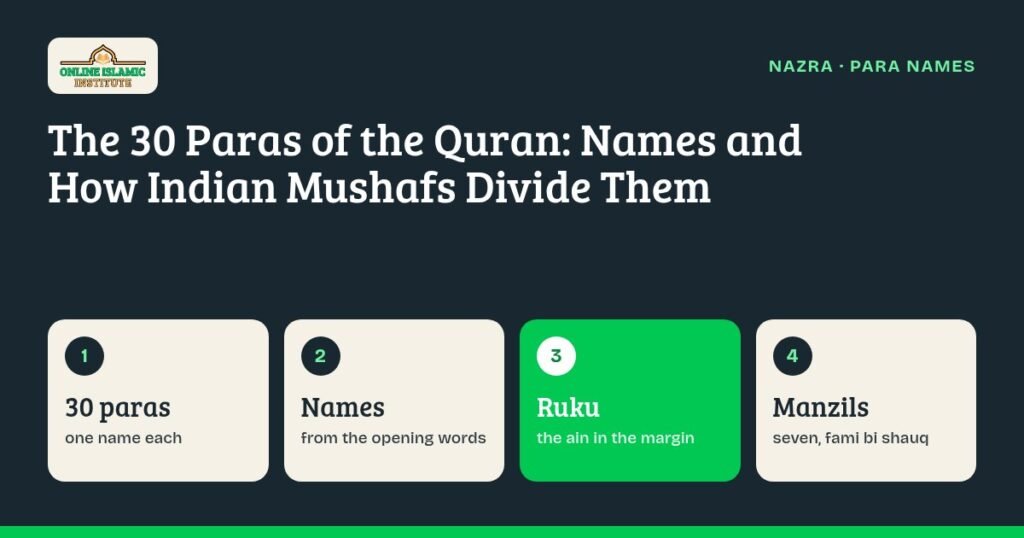
“Kaunsa para chal raha hai?” Which para are you on? Ask any child in a Quran class in Mumbai, Patna or Malappuram and you will get an answer like “Sayaqool” or “Amma para”, not “juz two” or “juz thirty”. In Indian homes the 30 parts of the Quran go by names, and most of us picked those names up long before anyone explained where they came from.
This guide lists all 30 para names as they are said in India, explains why each part is called what it is, and shows how an Indian (Indo-Pak) mushaf marks paras, rukus and manzils on the page, so the margins of your family Quran stop looking like a puzzle.
Para, sipara, juz: one thing, three words
Juz (جزء) is the Arabic word for “part”. Para is the Persian and Urdu word for “piece”, and sipara joins Persian si (thirty) with para: one of thirty pieces. All three refer to the same thirty roughly equal parts the Quran is divided into for reading and memorising. The division is a practical aid; it does not follow the surahs, so a para can start in the middle of one.
Why each para has a name
The name is simply the opening word or words of that para. Para 2 begins with سَيَقُولُ السُّفَهَاءُ, so it is Sayaqool. Para 29 opens with Surah Al-Mulk, تَبَارَكَ الَّذِي بِيَدِهِ الْمُلْكُ, so it is Tabarakallazi, which families often shorten to “Tabarak para”. The first para is the exception that proves the rule: it starts with Al-Fatiha, but it is named after the opening of Al-Baqarah that follows, الم.
All 30 para names
Spellings in English vary a lot from one printer to the next (Sayaqool, Sayaqul, Sayakool), so do not worry if your copy writes them differently. The Arabic is what you will find printed at the top of the pages.
| Para | Name (Arabic) | As said in India | Starts in Surah |
|---|---|---|---|
| 1 | الم | Alif Lam Meem | Al-Fatiha |
| 2 | سَيَقُولُ | Sayaqool | Al-Baqarah |
| 3 | تِلْكَ الرُّسُلُ | Tilkar Rusul | Al-Baqarah |
| 4 | لَنْ تَنَالُوا | Lan Tanaloo | Aal-e-Imran |
| 5 | وَالْمُحْصَنَاتُ | Wal Muhsanat | An-Nisa |
| 6 | لَا يُحِبُّ اللَّهُ | La Yuhibbullah | An-Nisa |
| 7 | وَإِذَا سَمِعُوا | Wa Iza Sami’oo | Al-Ma’idah |
| 8 | وَلَوْ أَنَّنَا | Wa Lau Annana | Al-An’am |
| 9 | قَالَ الْمَلَأُ | Qalal Mala’u | Al-A’raf |
| 10 | وَاعْلَمُوا | Wa’lamoo | Al-Anfal |
| 11 | يَعْتَذِرُونَ | Ya’tazeroon | At-Tawbah |
| 12 | وَمَا مِنْ دَابَّةٍ | Wa Ma Min Dabbah | Hud |
| 13 | وَمَا أُبَرِّئُ | Wa Ma Ubarri’u | Yusuf |
| 14 | رُبَمَا | Rubama | Al-Hijr |
| 15 | سُبْحَانَ الَّذِي | Subhanallazi | Bani Isra’il (Al-Isra) |
| 16 | قَالَ أَلَمْ | Qal Alam | Al-Kahf |
| 17 | اقْتَرَبَ | Iqtaraba | Al-Anbiya |
| 18 | قَدْ أَفْلَحَ | Qad Aflaha | Al-Mu’minun |
| 19 | وَقَالَ الَّذِينَ | Wa Qalallazina | Al-Furqan |
| 20 | أَمَّنْ خَلَقَ | Amman Khalaq | An-Naml |
| 21 | اتْلُ مَا أُوحِيَ | Utlu Ma Oohiya | Al-Ankabut |
| 22 | وَمَنْ يَقْنُتْ | Wa Man Yaqnut | Al-Ahzab |
| 23 | وَمَا لِيَ | Wa Maliya | Ya-Sin |
| 24 | فَمَنْ أَظْلَمُ | Faman Azlam | Az-Zumar |
| 25 | إِلَيْهِ يُرَدُّ | Ilaihi Yuraddu | Ha Meem As-Sajdah (Fussilat) |
| 26 | حم | Ha Meem | Al-Ahqaf |
| 27 | قَالَ فَمَا خَطْبُكُمْ | Qala Fama Khatbukum | Adh-Dhariyat |
| 28 | قَدْ سَمِعَ اللَّهُ | Qad Sami’allah | Al-Mujadilah |
| 29 | تَبَارَكَ الَّذِي | Tabarakallazi | Al-Mulk |
| 30 | عَمَّ | Amma (Amma Yatasa’aloon) | An-Naba |
Children usually know two names best: Amma para, the 30th, because that is where most of the short surahs kids memorise first are found, and Alif Lam Meem, the first. How to recite that opening, and the other letter groups, is in our guide to huroof muqatta’at.
How an Indian mushaf marks the divisions
Open a 15-line Indo-Pak copy, the kind sold outside almost every masjid in India, and you will see three sets of markings around the text.
The para itself
Each para usually begins on a new page with its name in a decorated box or in the top margin, and the para name and number are often repeated at the top of every page. In the common 15-line copies a para runs to roughly 20 pages, which is why so many Hifz students think of their progress in pages and paras. Inside each para, marginal notes show the quarter, half and three-quarter points, written as الربع, النصف and الثلاثة.
The ruku sign
The letter ع in the margin, usually with numbers above and below it, marks the end of a ruku, a short passage on one theme. The numbers tell you which ruku of the surah and of the para you have just finished. The name is usually explained by the old practice of bowing (ruku) in tarawih after reciting about this much.
The seven manzils
A third division splits the Quran into seven manzils, so that someone reading one manzil a day completes it in a week. Teachers remember where they begin with the phrase فَمِي بِشَوْق (fami bi shauq): Al-Fatiha, Al-Ma’idah, Yunus, Bani Isra’il, Ash-Shu’ara, As-Saffat and Qaf. In a Hifz class the word manzil is also used for older revision, which our Hifz revision plan explains; same word, different use.
What changes in a Madani (Uthmani) copy
The 30 juz are the same in both styles, but a Madani mushaf usually prints them without the Urdu-style para names and divides each juz into two hizb, each split into quarters marked with ۞. Rukus and manzils are usually absent. In a handful of places the para break may sit a few ayahs earlier or later in different prints, so if your child switches between a school copy and an app, expect small differences. Our comparison of the Indo-Pak and Uthmani (Madani) mushaf covers the rest, including the script itself.
Using the para names day to day
- Ramadan. Reading one para a day finishes the Quran in a month, and many families track it this way. When people say the hafiz at tarawih “finished Qad Aflaha tonight”, they mean para 18.
- Hifz progress. Students and teachers talk in paras: “he has done Amma and Tabarak and is on Qad Sami’allah.” It is a simple way for parents to follow along.
- Finding your place. Knowing that Surah Ya-Sin sits in Wa Maliya or that Al-Kahf starts in Subhanallazi and continues into Qal Alam helps a child open the mushaf to the right spot without a contents page.
If you want to learn the names, a nice habit is to say the para name aloud each time you start a new one. Within a few months it sticks.
From names to reading
Knowing the para names is the easy part; reading every page of them fluently is the real goal. That is what Nazra Quran is, and in our Nazra Quran online classes a teacher listens one-to-one, in 30-minute classes, 5 days a week (20 classes a month), and moves through the mushaf at the student’s pace, para by para. Adults who are starting late can read learning Quran as an adult, and students ready to memorise can look at the online Hifz classes.
As an online Quran institute, we teach only Noorani Qaida, Nazra, Tajweed and Hifz. Classes run 24/7 in IST with male and female teachers available at any time. Fees are ₹4,000 a month, ₹21,000 for six months or ₹36,000 a year (see the fees).
Questions about the paras
There are 30 paras (juz) in the Quran. Each is named after its opening words, for example Alif Lam Meem for the first, Sayaqool for the second and Amma for the thirtieth.
A surah is a chapter revealed with its own beginning and end; there are 114. A para is one of 30 roughly equal reading portions, so one para can contain several surahs or start in the middle of one.
In Indian mushafs Surah Ya-Sin begins near the end of para 22 (Wa Man Yaqnut), and most of it is in para 23 (Wa Maliya).
The letter ain in the margin of an Indo-Pak mushaf marks the end of a ruku, a short passage. The numbers beside it show the ruku count within the surah and within the para.
If your child can name the paras but still stumbles through the pages, a teacher can help. Book 3 free trial classes; you pay only if you decide to continue.