
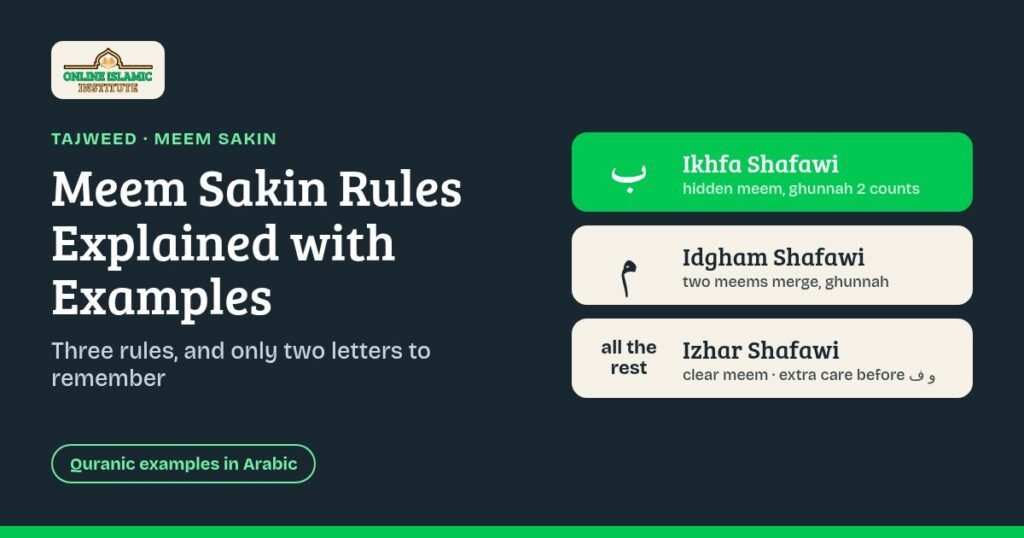
Good news if the noon sakin rules made your head spin: meem sakin is much lighter. There are three rules, and you only have to remember two letters. Everything else falls into the third rule on its own.
Close your lips and hum “mmm”. That is where meem lives, on the two lips, which is why all three rules carry the word shafawi, meaning “of the lips”. Keep that picture in mind and the rules make sense.
What is meem sakin?
Meem sakin is a م with no vowel: مْ. You meet it constantly, inside words such as الْحَمْدُ and at the end of very common words such as هُمْ, لَكُمْ and عَلَيْهِمْ. What happens to it depends, once again, on the letter that comes next.
| Next letter | Rule | How it sounds |
|---|---|---|
| ب | Ikhfa Shafawi (hiding on the lips) | Meem is hidden, with ghunnah for two counts |
| م | Idgham Shafawi (merging), also called Idgham Mithlayn | Two meems join into one meem with shaddah, with ghunnah for two counts |
| Any other letter | Izhar Shafawi (clear) | Meem is said clearly, with no extra ghunnah |
Rule 1: Ikhfa Shafawi, meem sakin before ب
When meem sakin is followed by ب, the meem is not pronounced in full. The lips come together lightly, without pressing, and the ghunnah is held through the nose for about two counts before the ب. (Some teachers leave the very slightest gap between the lips; follow the way your teacher recites.)
Examples you will recognise:
- تَرْمِيهِمْ بِحِجَارَةٍ (tarmīhim biḥijāratin), Surah Al-Fil
- إِنَّ رَبَّهُمْ بِهِمْ يَوْمَئِذٍ لَخَبِيرٌ (inna rabbahum bihim yawma’idhil lakhabīr), the last verse of Surah Al-‘Adiyat (in رَبَّهُمْ بِهِمْ)
- وَمَنْ يَعْتَصِمْ بِاللَّهِ (wa may-ya’taṣim billāh), Surah Aal-Imran
Students who have just learned Iqlab often ask whether this is the same thing. The sound is very close: in both cases you hear a hidden meem with ghunnah before ب. The difference is where it starts. In Iqlab, a noon or tanween changes into a meem. In Ikhfa Shafawi, the meem was a meem all along. Our guide to noon sakin and tanween rules covers Iqlab in full.
Rule 2: Idgham Shafawi, meem sakin before م
When meem sakin meets another meem, the two merge into one doubled meem, read with ghunnah for two counts. Because the two letters are the same, scholars of Tajweed also call it Idgham Mithlayn Saghir, the “small merging of two identical letters”.
Surah Quraysh gives you two examples in a single verse:
الَّذِي أَطْعَمَهُمْ مِنْ جُوعٍ وَآمَنَهُمْ مِنْ خَوْفٍ
alladhī aṭ’amahum min jū’iw wa āmanahum min khawf
Listen to أَطْعَمَهُمْ مِنْ and وَآمَنَهُمْ مِنْ: the meem at the end of “-hum” joins the meem of “min”, and you hold one humming meem. More examples:
- إِنَّهَا عَلَيْهِمْ مُؤْصَدَةٌ (innahā ‘alayhim mu’ṣadah), Surah Al-Humazah
- كَمْ مِنْ فِئَةٍ (kam min fi’atin), Surah Al-Baqarah
- لَهُمْ مَا يَشَاءُونَ (lahum mā yashā’ūn)
Rule 3: Izhar Shafawi, meem sakin before every other letter
With every letter apart from ب and م, usually counted as 26 letters, the meem is pronounced clearly: the lips close, the meem is said, and you move on without holding a ghunnah.
You already recite this every day. Surah Al-Fatiha has several:
- الْحَمْدُ (al-ḥamdu): meem sakin before د
- أَنْعَمْتَ (an’amta): meem sakin before ت
- عَلَيْهِمْ غَيْرِ (‘alayhim ghayri): meem sakin before غ
- عَلَيْهِمْ وَلَا الضَّالِّينَ (‘alayhim wa laḍ-ḍāllīn): meem sakin before و
Surah Al-Fil opens with another: أَلَمْ تَرَ (alam tara).
Take extra care before و and ف
This is the part of the rule people get wrong most. The letter و is made with the lips, just like meem, and ف uses the lower lip, close by. Because they are neighbours, the mouth is tempted to hide the meem or slide it into the next letter, which turns “‘alayhim wa” into something like “‘alayhi-wa”. Tajweed teachers stress that Izhar is strongest here: close the lips fully on the meem, then open into the و or ف.
Practise with عَلَيْهِمْ وَلَا from Al-Fatiha and هُمْ فِيهَا خَالِدُونَ (hum fīhā khālidūn), which appears many times in the Quran. If you want to see exactly where the lips do their work, the lip section of our makharij al-huroof guide helps.
Two related points that confuse beginners
Meem with shaddah
A meem with shaddah, as in ثُمَّ or عَمَّ يَتَسَاءَلُونَ at the start of Surah An-Naba, is always read with ghunnah for two counts. It is not one of the three meem sakin rules, but it is the same humming sound you hold in Idgham Shafawi, so many teachers practise them together.
When meem sakin gets a vowel
If a word ending in meem sakin is followed by a word that starts with a silent joining alif, such as ال, the meem takes a vowel so the two words can be joined. On the plural meem of words like عَلَيْكُمْ and لَهُمْ that vowel is a damma. That is why we read كُتِبَ عَلَيْكُمُ الصِّيَامُ as “kutiba ‘alaykumuṣ-ṣiyām”, the verse many of us hear every year before Ramadan. Once it has a vowel, it is no longer sakin, so none of the three rules apply.
Test yourself
Name the rule for the meem in each phrase. Answers are below.
- وَهُمْ بِالْآخِرَةِ
- عَلَيْهِمْ مُؤْصَدَةٌ
- أَلَمْ نَشْرَحْ
- هُمْ فِيهَا
Answers: 1. Ikhfa Shafawi (before ب). 2. Idgham Shafawi (before م). 3. Izhar Shafawi (before ن). 4. Izhar Shafawi, with extra care before ف.
Learning meem sakin with a teacher
These rules are easy to state and surprisingly easy to slip on when you recite at normal speed, especially the Izhar before و. A teacher listening live catches it at once. In our online Tajweed classes, students work through makharij, noon sakin, meem sakin and the rest in live one-to-one lessons of 30 minutes, five days a week. Beginners who are still building fluency start with Noorani Qaida or Nazra, and Hifz students apply the same rules while memorising in our online Hifz classes. For the full map of Tajweed, see Tajweed rules for beginners.
As an online Quran institute for students across India, we run classes 24/7 in IST, which helps if you are fitting lessons around a job (here are some slot ideas for working professionals). Male and female teachers are available any time. The fee is ₹4,000 a month, ₹21,000 for six months (₹3,500 a month) or ₹36,000 a year (₹3,000 a month), listed in our fee section. Every new student gets 3 free trial classes and pays only after the trial.
Meem sakin rules: FAQ
Ikhfa Shafawi before ب, Idgham Shafawi (Idgham Mithlayn) before م, and Izhar Shafawi before every other letter.
They sound alike, a hidden meem with ghunnah before ب. In Iqlab a noon sakin or tanween changes into meem; in Ikhfa Shafawi the letter was a meem sakin to begin with.
Both letters are made at or near the lips, like meem, so the meem is easily hidden or merged by mistake. Izhar must be clearest there.
About two counts (harakat) in both.
Try it now: recite Surah Al-Fatiha slowly and stop at عَلَيْهِمْ وَلَا. Did your lips close on the meem? If you are not sure, book 3 free trial classes and let a teacher listen.