
Ask three relatives the right age to start learning Quran and you will get three confident answers: “At four.” “After they can read English.” “When they can sit still for an hour.” Each family is speaking from its own story, not from a single rule written on a stone.
There is no one birthday that suddenly makes Quran class “correct.” What matters is readiness: attention, interest, and a home routine that can protect a short daily lesson. This guide helps Indian parents match the stage of learning to the child in front of them, without guilt if the neighbour’s child started earlier.
Readiness beats a number on the cake
A child who can follow a simple instruction, enjoy short rhymes or surahs, and sit for 15–20 minutes with light support is often ready to begin letter play. A child who is exhausted after school and melts down at the sight of a book may need a gentler season, even if they are older.
Age bands below are only rough guides. Your teacher’s ear in a trial class matters more than any blog chart, including this one.
Around 4–5: curiosity and letter play
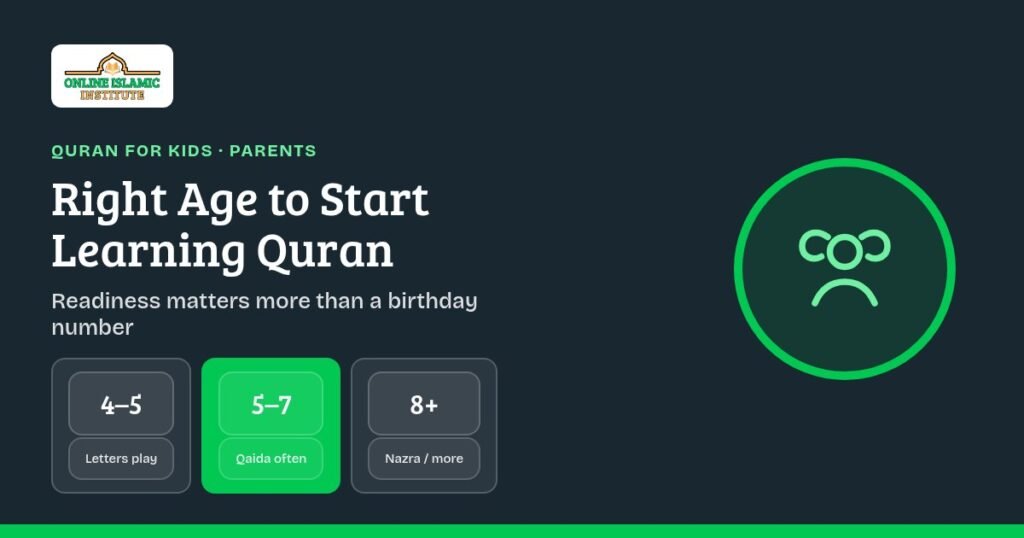
Many families begin with short, warm sessions: Arabic letter names as a game, listening to short surahs, sitting beside a parent during a live class without pressure to perform. Formal Noorani Qaida can start here for some children; for others it is still early.
Keep sessions short. Celebrate trying. If tears arrive every day, pause and try again in a few months. Quran learning should not become the thing your child dreads before bedtime.
Around 5–7: a common window for Noorani Qaida
This is when many Indian children start structured Qaida with a teacher. School has begun, attention is longer, and letter shapes start to stick. Our posts on learning Noorani Qaida online and what each Qaida lesson teaches show what those months look like.
Thirty-minute one-to-one classes work well at this age if the slot is calm. Early morning or early evening often beats late night. Parents usually sit nearby for the first weeks.
Around 7–10: Nazra and stronger reading
Once Qaida feels solid, children move into Nazra: reading from the mushaf with growing fluency. Some will also begin light Tajweed habits with their teacher. A few show interest in memorising short surahs more seriously; that can grow toward Hifz later if the child is willing and school load allows. See our note on Hifz for kids at home before you push memorisation hard.
At this age, comparing cousins becomes common on family calls. Try not to turn someone else’s juz count into your child’s homework. Steady reading with a patient teacher beats a rushed plan that ends in refusal.
Tweens and teens: it is not “too late”
Parents sometimes worry that starting at 11 or 14 means the chance has gone. It has not. Older children often move faster through Qaida because they already understand “school.” Teens can also start Tajweed properly if they already read; how to learn Tajweed online maps that path, and Tajweed rules for beginners gives a plain overview.
What changes is the conversation. Involve them in choosing the time slot and, if they wish, a female or male teacher. Ownership beats nagging.
Adults who never started
If you are reading this for yourself: there is no upper age limit. Adults begin at Qaida every week. One-to-one online classes keep the pace private and respectful. You do not need to explain your story to a group.
School, tuition and the real Indian calendar
CBSE exam weeks, board prelims, Ramadan evenings, wedding seasons: the year is lumpy. A good plan bends. During heavy school months, ask the teacher to emphasise revision. During lighter weeks, new lessons can move again. Classes at our online Quran classes in India run 24/7 in IST, which makes that bending possible.
Also be honest about tuition load. A child with two coaching classes after school may only have one calm half-hour left. Protect that half-hour rather than adding Quran as a fourth battle.
How to test readiness without pressure
- Book a short trial and watch: does your child settle after a few minutes, or stay braced for conflict?
- Ask the teacher what they noticed about attention and letter readiness.
- Try the same slot for a week before judging the whole idea.
- If you are comparing tutors, use these questions so you are not choosing on price alone.
Fees when you do start
Whenever you begin, the fee structure is the same for every course: ₹4,000 a month, ₹21,000 for six months (₹3,500/month), or ₹36,000 a year (₹3,000/month), for 20 one-to-one classes of 30 minutes. Details sit in our fees guide and the fee section. Every new student gets 3 free trial classes and pays only after the trial.
Questions parents ask about starting age
There is no single right age. Many children begin letter play around 4–5 and structured Noorani Qaida around 5–7, but readiness, attention and routine matter more than the birthday.
For some children, short playful sessions work. For others, waiting until they can sit calmly for a short class is kinder. A trial will show you quickly.
No. Older beginners often progress quickly with one-to-one attention. Start where they are: Qaida if needed, Nazra if they already read.
Helpful, not required. Arabic letter learning can run alongside school literacy. Do not delay forever waiting for a perfect academic moment.
Yes. Male and female teachers are available 24/7. Mention your preference when you book the trial.
If you have been waiting for a perfect age, you can stop waiting. Look at your child this week, pick a calm half-hour, and book 3 free trial classes with Online Islamic Institute. The trial will answer more than another year of wondering.