
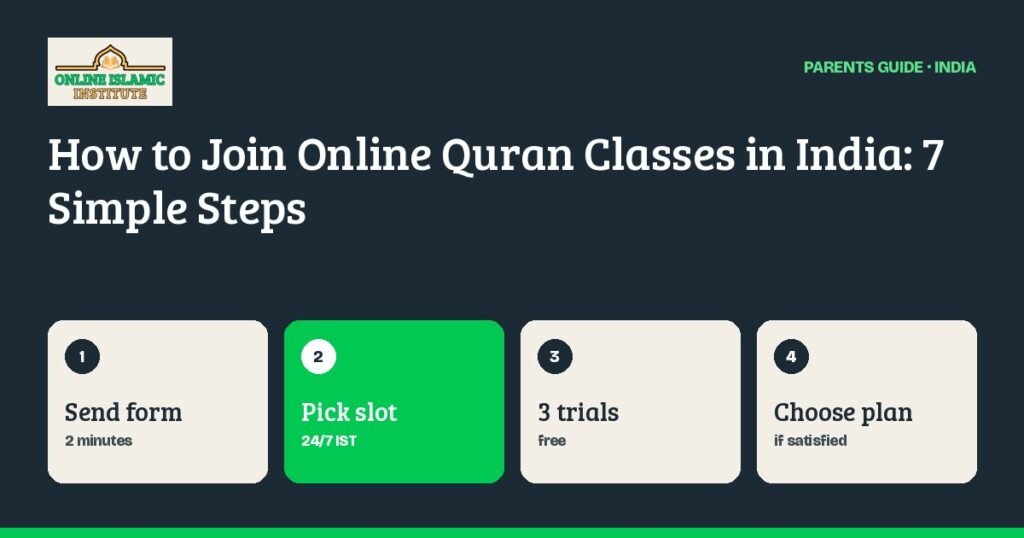
Plenty of parents tell us the same thing: “I meant to start my son’s Quran classes months ago, but I did not know where to begin.” So here is the whole process of joining online Quran classes in India, from the first message to the first paid month. It takes less time than a parent-teacher meeting.
Step 1: Decide who is learning and what the goal is
Write one line: “My daughter, 8, knows some letters, wants to read the Quran.” Or “Me, 34, read as a child, want to fix my Tajweed.” That one line tells the teacher where to start.
Step 2: Send the contact form
On our homepage, fill in the contact form with your name, email, country and, if you like, a mobile number and a short message. Mention the learner’s age and any timing preference in IST.
Step 3: Pick a trial slot
We get back to you to fix a time. Classes run 24/7, so suggest whatever really suits your day; our guide to Quran class timings in India can help. Say if you want a male or female teacher.
Step 4: Set up the device
A phone works; a laptop or tablet is easier for small children because the text is bigger. Use earphones in a noisy house and sit somewhere with steady Wi-Fi or mobile data. Our setup checklist for online Quran classes covers the details.
Step 5: Take the 3 free trial classes
The first trial class is mostly a gentle level check. The teacher listens, then suggests a course:
- Noorani Qaida if the learner is starting from the letters,
- Nazra for fluent reading,
- Tajweed for correct recitation,
- Hifz for memorisation.
Use the other two classes to see how your child responds. More on what to watch for is in what happens in the 3 trial classes.
Step 6: Choose a plan, only if you are happy
If you are satisfied, pick a plan. The fee is the same for every course: ₹4,000 a month, ₹21,000 for six months, or ₹36,000 for a year, all for 30-minute one-to-one classes, five days a week. If you are not satisfied, you do not pay.
Common worries before joining
“My child will not sit still for a screen.” Thirty minutes is shorter than most cartoons, and one-to-one means the teacher keeps the child busy reading. The first trial class will show you quickly whether it works.
“I do not read Arabic myself, so I cannot help.” You do not need to. Your job is the routine: same time, quiet corner, device charged. The teacher handles the reading.
“What if we do not like the teacher?” That is what the trial is for. You pay only if you are satisfied after the 3 trial classes.
“Our internet is patchy.” Try the trial on your usual connection at your usual time. If it holds for three classes, it will usually hold.
What parents do in the first week
Keep the qaida or mushaf in one place so nobody hunts for it five minutes before class. Put the class time on the family calendar or a sticky note on the fridge. Ask your child, in a light way, what they learned today. And resist the urge to correct them yourself during class. Let the teacher do the teaching.
Step 7: Keep the routine for the first month
The first four weeks set the habit. Keep the same slot, sit near younger children for the first few classes, and ask the teacher for a quick update every week or two.
Before you start: quick answers
Send the contact form on our homepage, pick a trial slot in IST, take 3 free trial classes, then choose a plan only if you are satisfied.
No. A phone works, though a laptop or tablet is easier for young children.
All courses cost ₹4,000 a month, ₹21,000 for six months, or ₹36,000 for a year.
Yes. Male and female teachers are available at any time.
The teacher checks the level in the first trial class. Most children start with Noorani Qaida.
That is all there is to it. Send the form and we will set up your trial.