
A seven-year-old in Indore does not need a wall chart of forty Tajweed terms. She needs one clean ر, then a steady نّ, then a teacher who stops her kindly when the hum runs too long. That is how Tajweed for kids actually works: one small rule, heard and fixed, then another.
This guide is for parents who want the path in plain order. The full map of rules lives in Tajweed rules for beginners. Here we talk about how children meet those rules, what you can help with at home, and what to leave to the teacher.
What Tajweed means for a child
Tajweed means giving every letter its right. For a child that starts as “say this letter from the right place” and “hold this sound for two taps”, not as Arabic jargon. Names like ikhfa and qalqalah can wait until the ear already hears the difference.
Kids who rush through Nazra without this step often sound fluent to relatives and still carry habits that are hard to undo later. Slow and early is kinder than fast and vague.
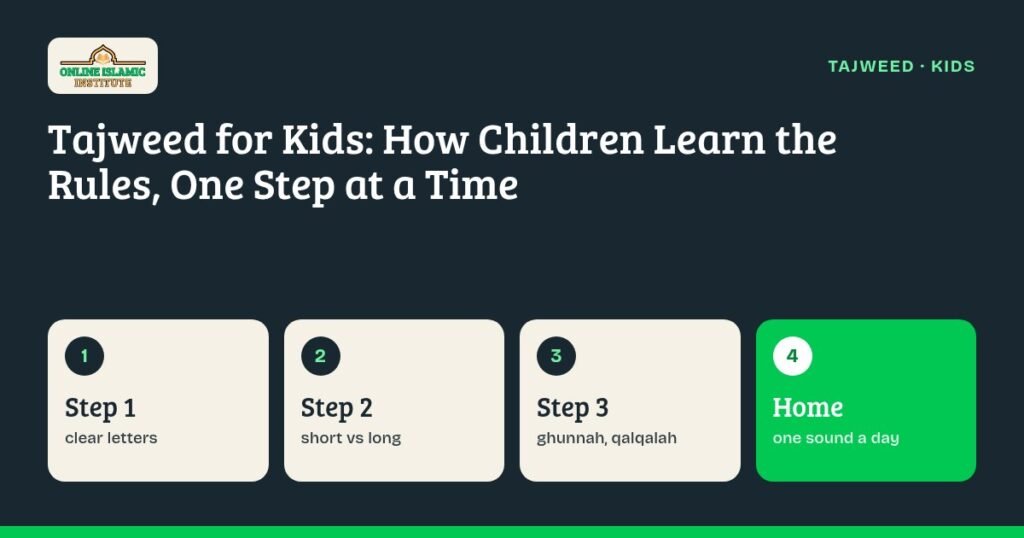
The step-by-step path most teachers use
1. Letters that sound right
Before rules, the letter itself. ع is not أ. ق is not ك. A child who mixes these will “apply” every later rule on the wrong sound. Short drills, one pair of look-alike letters at a time, beat long lectures.
2. Short and long vowels
Zabar stays short; a madd letter stretches. Children who chant Qaida too musically often lengthen everything. A teacher claps or taps so the short ones stay short.
3. Noon and meem with a hum
Ghunnah on نّ and مّ is usually the first “rule” kids enjoy, because they can feel it. Two taps on the desk, pinch-the-nose check, done. Our page on ghunnah in Tajweed is written for that stage.
4. Echo letters (qalqalah)
The bounce on ق ط ب ج د when they carry a sukoon makes children smile once they hear it. Keep it light, not a thud. See qalqalah letters when you are ready for examples.
5. Noon sakin, tanween, meem sakin
These come after the child can already read a page without panic. Teachers introduce one rule group at a time — izhar first, then idgham, and so on — using the short surahs the child already knows.
6. Stopping and starting cleanly
Waqf signs and how to restart a line matter once the child reads longer passages. Until then, “finish the word, then breathe” is enough.
How parents help without becoming the teacher
Your job is the routine and the cheerleading. The teacher’s job is the ear. A short note on that split is in how parents can support Quran learning at home.
- Keep the same mushaf style the class uses.
- Ask the teacher each fortnight: what one sound should we listen for at home?
- Practise that one sound for five minutes, not the whole rule book.
- Record a short clip once a week so the child hears their own progress.
- Protect sleep and school homework; a tired child guesses letters.
Motivation dips are normal around exams and weddings. Ideas that stay light are in how to keep kids motivated.
A sample week at home (ages roughly 6–10)
| Day | Ten-minute focus |
|---|---|
| Mon | Two look-alike letters the teacher named |
| Tue | Short vs long vowels in Al-Fatiha |
| Wed | Ghunnah on every نّ / مّ in a short surah |
| Thu | Qalqalah in Al-Ikhlas |
| Fri | Read yesterday’s lines once, slowly, for a parent |
| Sat | Rest or listen only |
| Sun | Optional: replay the week’s phone recording |
Ages vary. Some five-year-olds love the hum; some nine-year-olds still need letter work. Our note on the right age to start is about readiness, not a fixed birthday.
Mistakes parents can skip
- Playing a famous qari on loop and asking a child to “copy the style” before letters are clear.
- Correcting every word during homework until the child freezes.
- Switching teachers every month; Tajweed needs a familiar ear.
- Promising a finish date for “complete Tajweed”. Rules deepen over years.
Learning Tajweed with a live teacher
In our online Tajweed classes and online Quran classes for kids, lessons are one-to-one and 30 minutes, five days a week (20 a month). The teacher hears each line and fixes one thing at a time. Classes run 24/7 in IST; male and female teachers are available any time, so a slot after school in Jaipur or before breakfast in Bengaluru both work.
Fees at our online Quran institute are ₹4,000 a month, ₹21,000 for six months or ₹36,000 a year; see the fee section.
School, tuition and a 30-minute class
In cities like Hyderabad and Lucknow the evening is already packed: school homework, maths tuition, then dinner. A Quran class only works if it is short and fixed. Thirty minutes, five days a week, is a rhythm many families can keep. Moving the slot every other day usually means missed classes.
Pick a time when the child is fed and not half-asleep. After Maghrib works for some houses; early morning before school works for others. Sit nearby for the first weeks so the laptop does not become a cartoon portal. Then step back once the routine sticks.
What “progress” looks like for a child
Do not wait for a certificate moment. Watch for smaller signs: fewer freezes on ق and ك, a ghunnah that lasts two taps instead of one, a willingness to open the mushaf without a fight. Those signs mean the ear is waking up.
If a month passes with no change on the one sound the teacher named, ask for a clearer home drill rather than adding new rules. Piling terms on a shaky letter slows everyone down.
Tajweed for kids: parent questions
Once letter sounds are mostly clear and they can read short lines without constant freezing. For many children that follows Noorani Qaida and early Nazra, but teachers decide case by case.
You can support practice and listen for the one sound the teacher named. Full correction needs a trained ear, especially on look-alike letters.
Children need shorter drills, more repetition through surahs they know, and less jargon. The rules are the same; the teaching pace is gentler.
Many teachers weave light Tajweed into Nazra early, then deepen rules later. Ask your teacher which model they use rather than waiting for a perfect “finish”.
Curious how your child sounds to a teacher on one short surah? Book 3 free trial classes and pay only if you decide to continue.