
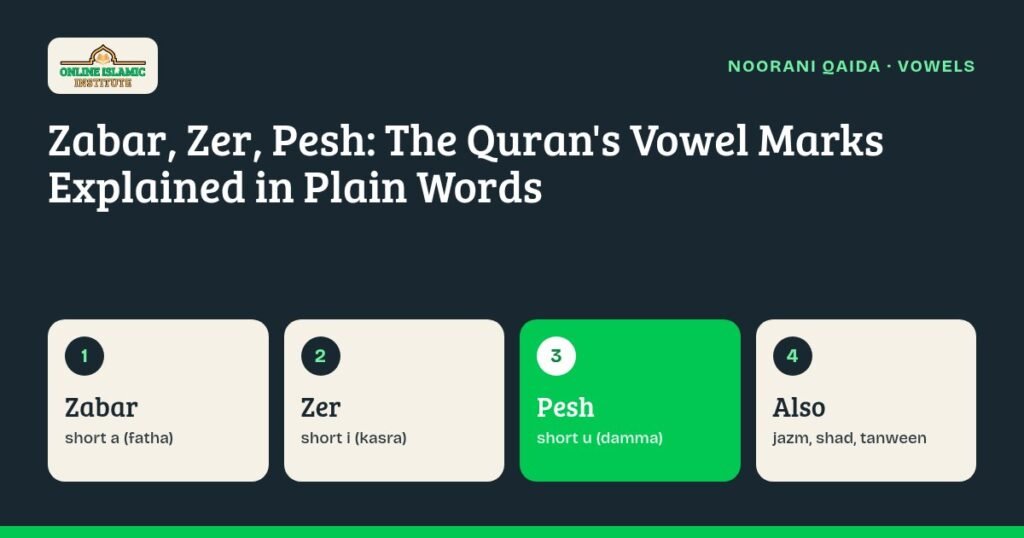
Quick answer: zabar, zer and pesh are the Urdu names of the three short vowel marks. In English (using their Arabic names) they are fatha (zabar, a short “a”), kasra (zer, a short “i”) and damma (pesh, a short “u”). So بَ is “ba”, بِ is “bi” and بُ is “bu”.
Open any Indo-Pak mushaf from a bookshop in Hyderabad or Lucknow and the first thing that catches your eye is the small marks sitting above and below the letters. A short stroke up, a short stroke down, a little curl. Your grandmother called them zabar, zer and pesh. Your child’s Qaida teacher still does. Those three names, and a few cousins, are the whole short-vowel system of the Quran in Indian homes.
This guide names each mark the way Indian families say it, shows what sound it gives, and points out where the same marks look different in a Madani print. It is for parents sitting with a child on Noorani Qaida, and for adults who skipped the names the first time round.
Learning the marks with a teacher is faster. In our Noorani Qaida online classes a teacher hears every zabar, zer and pesh one-to-one, 30 minutes a day. Already reading? Move on to Nazra Quran online. Start with 3 free trial classes and pay only if you are satisfied.
Why vowel marks matter
Arabic letters on their own do not tell you the short vowel. The letter ب could be “ba”, “bi” or “bu”. The small mark next to it decides. Without those marks a beginner cannot read a word correctly, which is why every Noorani Qaida starts with them early, right after the letter shapes. Our walkthrough of Noorani Qaida lessons shows where vowels sit in the usual lesson order.
The same marks appear throughout the mushaf. Once they feel automatic, Nazra (reading from the Quran) becomes possible. Until then, every page feels like guesswork.
The three short vowels: zabar, zer, pesh
| Indian name | Arabic name | Where it sits | Sound |
|---|---|---|---|
| Zabar | Fatha | Above the letter | Short “a”, as in “ba” |
| Zer | Kasra | Below the letter | Short “i”, as in “bi” |
| Pesh | Damma | Above the letter (small waw-like curl) | Short “u”, as in “bu” |
Say them out loud with three letters your child already knows:
- بَ تَ ثَ — ba, ta, tha (all zabar)
- بِ تِ ثِ — bi, ti, thi (all zer)
- بُ تُ ثُ — bu, tu, thu (all pesh)
Teachers in India often drill these in a chant: “ba, bi, bu; ta, ti, tu.” It is not fancy, and it works. Keep the short vowels short. Stretching zabar into a long “aa” is one of the earliest habits a Tajweed teacher has to undo later.
Do zabar, do zer, do pesh (tanween)
When you see two of the same mark, that is tanween: an “n” sound added at the end of the word.
| Indian name | Marks | Sound at the end |
|---|---|---|
| Do zabar | Two fathas | “-an”, as in كِتَابًا |
| Do zer | Two kasras | “-in”, as in كِتَابٍ |
| Do pesh | Two dammas | “-un”, as in كِتَابٌ |
In Indo-Pak prints, do zabar is often written as one zabar with a tiny alif-like stroke, and do pesh as one pesh with a second curl. The sound is the same as in a Madani copy. Children who already speak Urdu recognise tanween quickly because Urdu uses the same idea in its own script.
Jazm (sukoon) and shad (shaddah)
Jazm
Jazm, also called sukoon, means the letter has no short vowel. In Indo-Pak Qaidas it is usually a small circle or a tiny “j” shape on the letter. The letter is read and then you move straight to the next one: أَنْعَمْتَ — the noon and the meem carry jazm.
The common mistakes are adding a random zabar, or skipping the letter entirely. Short, slow practice on a handful of jazm words beats racing through a whole page.
Shad
Shad (shaddah) means the letter is doubled: you hold it slightly and then release into its vowel. In print it looks like a small “w” on its side above the letter. إِنَّ has a noon with shad; رَبِّ has a ba with shad. Without the hold, the word changes.
Khari zabar, khari zer, and ulta pesh
These three confuse parents more than the short vowels, because the names are local and the shapes look like long-vowel helpers.
- Khari zabar (standing fatha): a small upright stroke. It stands in for a long “aa” sound, the way alif would. You see it often in Indo-Pak prints where a full alif is not written.
- Khari zer (standing kasra): a small upright stroke below, standing in for a long “ee” (ya) sound.
- Ulta pesh (inverted damma / little waw mark): stands in for a long “oo” (waw) sound in some Indo-Pak conventions.
A Madani (Uthmani) mushaf usually writes the full madd letters instead of these standing marks, which is one reason the same ayah can look different in two copies. Our comparison of the Indo-Pak and Uthmani script explains the rest of those differences without asking you to change mushafs overnight.
Zabar, zer, pesh in English (and in Arabic)
| Urdu name | Arabic / English name | Sound | Example |
|---|---|---|---|
| Zabar | Fatha | short a | بَ ba |
| Zer | Kasra | short i | بِ bi |
| Pesh | Damma | short u | بُ bu |
| Do zabar | Tanween fath | an | بًا ban |
| Do zer | Tanween kasr | in | بٍ bin |
| Do pesh | Tanween damm | un | بٌ bun |
| Jazm | Sukoon | no vowel | اَبْ ab |
| Shad | Shaddah | letter doubled | اَبَّ abba |
If your child’s school or an English app says “fatha” and the Qaida teacher says “zabar”, they are talking about the same mark.
How many zabar are in the Quran?
You will find exact counts of zabar, zer and pesh printed in some pocket books and shared on WhatsApp. The numbers differ from one source to another, partly because people count differently: does do zabar count as one or two, is a khari zabar a zabar, does the count follow the Indo-Pak or the Madani print? We have not been able to confirm one reliable figure, so we will not quote one here.
For reading, the count does not matter. What matters is that every mark on the page is read correctly, and that is something a teacher can check line by line.
A five-day home drill
Ten minutes after Maghrib is enough. Use the Qaida page your teacher set, not a random sheet.
| Day | Focus |
|---|---|
| 1 | Only zabar on three letters your child already knows |
| 2 | Add zer on the same letters |
| 3 | Add pesh; mix ba/bi/bu in a short chant |
| 4 | Do zabar / do zer / do pesh on endings |
| 5 | Jazm and shad on five words from the current lesson |
If a four-year-old is still learning letter shapes, pair this with playful letter work from Arabic letters for kids. Adults starting late can follow the same drill; our note on Noorani Qaida for adults covers the pace and the embarrassment that usually fades by week two.
Indo-Pak marks vs what you see on an app
Phone apps often show Madani-style text. Your child’s school Qaida is almost certainly Indo-Pak. The sounds are the same; the marks are not drawn the same way. If the teacher uses one and homework uses the other, say so in the first week. Switching every other day slows everyone down. Pick one mushaf style for home practice and stick to it until reading is steady.
Learning the marks with a teacher
Hearing the difference between a clipped zabar and a stretched one is hard on your own. In our Noorani Qaida online course a teacher listens live, one-to-one, in 30-minute classes, five days a week (20 a month), and stops on the mark that slipped. Classes run 24/7 in IST, with male and female teachers available any time, so a slot after school in Pune or early morning in Kochi both work.
Fees for online Quran classes in India with us are ₹4,000 a month, ₹21,000 for six months or ₹36,000 a year; see the fee section. You can also read how to learn Noorani Qaida online for the wider path from letters to fluent pages.
Zabar, zer, pesh: quick questions
They are the Indian (Urdu) names for the three short vowels: zabar (fatha, “a”), zer (kasra, “i”) and pesh (damma, “u”). The mark sits above or below the letter and tells you which short sound to read.
In English they are usually called by their Arabic names: fatha (zabar, short a), kasra (zer, short i) and damma (pesh, short u).
Different books give different counts, depending on how tanween, khari zabar and the print are counted, so there is no single figure we can confirm. For reading, it is more useful to read each mark correctly.
Do zabar is tanween with two fathas. It adds an “n” sound, so the ending is read “-an”. Do zer is “-in” and do pesh is “-un”.
Jazm (sukoon) means the letter has no short vowel. You read the letter and move on. Children often add a random vowel or skip the letter; short practice fixes both.
Khari zabar is a standing fatha used in Indo-Pak prints for a long “aa” sound. Khari zer and ulta pesh play a similar role for long “ee” and “oo”. Madani prints usually write the full long-vowel letters instead.
Either works if you stay consistent. Most Indian homes and local Qaidas use Indo-Pak marks. Match whatever the teacher uses in class.
Once the vowel marks feel easy, the next step is joining words and reading short ayahs with a teacher who can hear every zabar. Our online Quran classes for kids take children from Qaida to Nazra one-to-one, and families across the country join our online Quran classes in India at a time that suits them.
Want a teacher to hear whether your child’s zabar is short enough? Book 3 free trial classes and pay only if you decide to continue.